Over the last five years, Pakistan and Uzbekistan have steadily reshaped their bilateral relationship, moving beyond conventional diplomatic exchanges toward a more deliberate and economically driven partnership. This transformation has been neither abrupt nor cosmetic.
Instead, it has unfolded through a sequence of policy decisions, institutional arrangements, and high-level engagements aimed at overcoming long-standing constraints related to geography, connectivity, and market access. What is now emerging is a partnership increasingly defined by economic logic, commercial incentives, and shared regional ambitions.
For much of the past three decades, economic relations between Pakistan and Uzbekistan remained limited in scale and scope. Bilateral trade volumes were consistently low, rarely exceeding a few tens of millions of dollars annually.
These modest figures were not the result of weak political ties, but rather structural obstacles: Uzbekistan’s landlocked geography, the absence of reliable transit corridors, limited customs cooperation, and a lack of formal trade facilitation mechanisms. As a result, commercial engagement remained sporadic and largely opportunistic.
By the late 2010s, however, both governments began to reassess this underperformance. The recognition was clear that political goodwill alone was insufficient to generate economic outcomes.
What was required was an institutional framework capable of reducing trade costs, improving predictability, and incentivizing private-sector participation.
In response to this realization, both governments began implementing measures to create a more structured and predictable trading environment. T
hese efforts, including the development of formal trade facilitation mechanisms, improved customs cooperation, and initiatives to streamline transit corridors helped reduce trade costs and incentivize private-sector engagement.
Consequently, Pakistan–Uzbekistan economic relations have experienced a significant quantitative expansion, transforming what was once marginal trade into a steadily growing commercial relationship. Trade volumes that hovered below $40 million in the mid-2010s have now exceeded $400 million annually by 2024, reflecting a more than tenfold increase.
This expansion has been accompanied by consistent year-on-year growth, often in the range of 15–20 percent, with certain periods registering much sharper increases. As per these statistics, this places Pakistan–Uzbekistan trade among the fastest-growing bilateral relationships for both countries.
A critical shift began with the signing of the Transit Trade Agreement in 2021, which formally enabled Uzbekistan to use Pakistani ports for external trade.
This agreement addressed one of the most fundamental barriers to economic cooperation by providing a legal basis for transit access to the Arabian Sea. While implementation remained gradual, the agreement signaled a clear intent to reposition Pakistan as a maritime gateway for Uzbek trade.
Momentum continued with the entry into force of the Preferential Trade Agreement in 2023. By introducing tariff concessions on selected goods, the PTA marked the first substantive attempt to liberalize bilateral trade.
Although the initial product coverage was limited, it established an essential precedent and created a platform for incremental expansion.
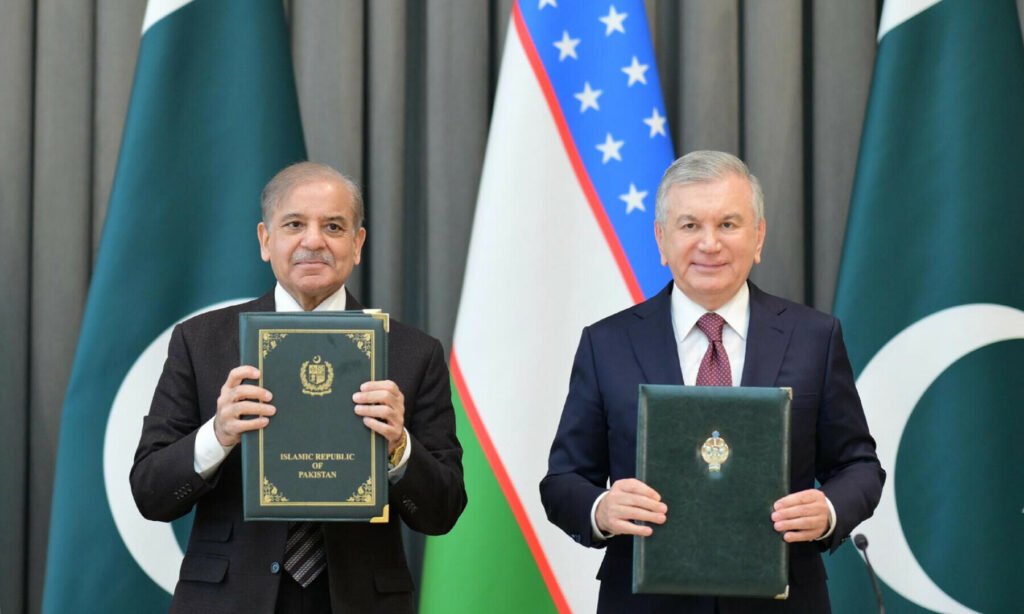
The visit of Pakistan’s Prime Minister to Tashkent in early 2025 represented a pivotal moment in redefining the economic relationship. During this visit, both sides agreed on a clear and time-bound objective: to raise bilateral trade to USD 2 billion within five years.
Importantly, this target was accompanied by commitments to strengthen coordination mechanisms and move toward project-based cooperation rather than ad hoc initiatives. Discussions during the visit emphasized industrial cooperation, investment facilitation, and enhanced connectivity.
Both governments underscored the need to operationalize existing agreements, particularly the PTA and transit frameworks, while encouraging private-sector engagement through special economic zones and joint ventures.
This visit effectively provided the relationship with a strategic economic direction, moving it from incremental growth toward planned expansion.
By mid-2025, signs of growing business confidence became increasingly visible. Trade in the first half of the year exceeded USD 250 million, reflecting more than a doubling compared to the same period a year earlier.
At the same time, the number of joint ventures involving Pakistani capital in Uzbekistan rose to approximately 130, indicating a gradual shift from pure trade toward productive investment. Throughout this period, regional connectivity remained a recurring theme, culminating in renewed focus on the Uzbekistan–Afghanistan–Pakistan railway project.
Following the signing of its feasibility framework in 2025, the project emerged as the most ambitious component of the bilateral economic vision. By linking Uzbekistan’s industrial centers to Pakistan’s ports, the railway promises to reduce transit times and logistics costs while improving supply-chain reliability.
However, in the light of these developments, there also exist some critical gaps: despite rapid growth, existing trade volumes represented only a fraction of the newly announced targets. Although, the expansion has occurred from a low base and remains highly concentrated.
Uzbekistan’s exports dominate bilateral trade, accounting for approximately two-thirds to three-quarters of total turnover in recent years. These exports are heavily weighted toward agricultural and food products, particularly dried legumes, nuts, and similar goods.
Pakistan’s exports, while expanding, remain smaller in value and fragmented across multiple categories. This asymmetry indicates that market access alone has not been sufficient to unlock Pakistan’s full export potential.
This imbalance reflects limited diversification rather than structural incompatibility. Sectors such as textiles, pharmaceuticals, agro-processing, and light manufacturing remained underrepresented despite favorable conditions.
Building on the momentum of expanding economic engagement, the recent state visit of President Shavkat Mirziyoyev to Islamabad in February 2026 marked the most comprehensive expansion of bilateral cooperation to date.
Recognizing that market access alone had been insufficient to fully realize Pakistan’s export potential, both governments sought to institutionalize mechanisms that would provide predictability, reduce risks, and incentivize investment.
During the visit, the two sides signed 28 memoranda of understanding and agreements covering a wide range of sectors, including agriculture, pharmaceuticals, mining, information technology, climate cooperation, and education.
Central to this visit was the signing of a joint declaration that elevated bilateral ties into a structured strategic partnership. The declaration embedded cooperation into permanent coordination bodies and introduced a five-year roadmap to guide economic engagement.
One of the most commercially significant announcements was a ten-year tax exemption for Pakistani traders and investors operating in Uzbekistan, a rare incentive that materially improved the investment environment by lowering entry costs and enhancing expected returns.
This approach reflected a proactive strategy to address the trade asymmetry and unlock the full potential of bilateral economic relations.
The evolution of Pakistan–Uzbekistan economic relations can be characterized as moving from symbolic engagement to structural partnership, but the success of this trajectory will ultimately depend on execution.
The growth achieved so far demonstrates the responsiveness of both governments to policy-driven economic incentives and underscores the rising confidence of private-sector actors. Political signaling has played an important role in shaping expectations.
Official targets to raise bilateral trade to $1 billion in the near term and $2 billion over the medium term have been repeatedly articulated.
These targets influence bureaucratic prioritization and private-sector planning, but they also highlight the scale of the remaining gap. Moving from $400 million to $2 billion is not a linear progression; it requires a structural shift in how trade is conducted.
In addition, the concentration of trade in a narrow set of goods exposes the relationship to volatility and limits the long-term sustainability of growth. Projects such as the UAP railway, while transformative, are contingent on political stability, regional security, and long-term financial commitment.
These challenges underscore the necessity for a coordinated approach that integrates infrastructure development, regulatory harmonization, investment facilitation, and active participation by the business community.
Going forward, the sustainability of Pakistan–Uzbekistan economic relations will depend on whether the partnership evolves from exchange-driven growth to value-chain integration.
Achieving this will require coordinated policy implementation, targeted private investment, and a shift in business strategy from opportunistic trade to long-term market building.
Trade facilitation must be deepened, non-tariff barriers reduced, and private-sector engagement systematically supported through access to finance, information, and risk mitigation mechanisms. Investment incentives should be complemented by operational clarity and regulatory certainty, while logistics and connectivity infrastructure must move from planning to execution.
Sectoral collaboration in pharmaceuticals, IT, agriculture, and industrial manufacturing can create sustainable value chains that extend beyond immediate trade flows. Indeed, the relationship has entered a transitional phase.
The data confirms momentum, but also exposes the ceiling of growth under current conditions. Breaking through that ceiling will require deeper institutional execution and greater private-sector commitment. Those conditions will determine whether Pakistan–Uzbekistan economic ties remain a fast-growing niche relationship or mature into a genuinely scaled commercial partnership.

Muhammad Asif Noor
The writer is Director, the Institute of Peace and Diplomatic Studies