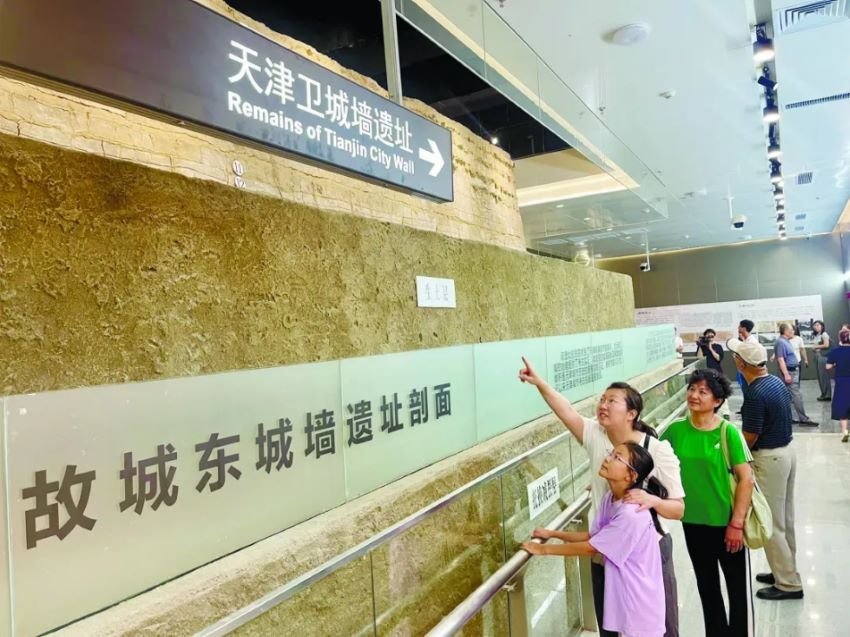
Tianjin (TDI): Commuters on Tianjin Metro Line 4 are now able to experience a remarkable piece of history at Dongnanjiao Station, where a newly opened exhibition showcases a fragment of the city’s ancient eastern wall.
This discovery, dating back over 600 years, offers a tangible link to Tianjin’s urban evolution and has become a focal point for public admiration and reflection. The ruins were uncovered in 2017 during metro construction, immediately recognized by heritage authorities as one of Tianjin’s most significant urban archaeological finds of the 21st century, according to People’s Daily.
The challenge was unprecedented: preserving the historic site in situ while completing a major transit hub eight meters underground. Relocation was ruled out, as it would have disrupted the wall’s historical layering and broken the continuity of the city’s archaeological record.
Engineers, designers, and heritage experts collaborated closely to achieve a delicate balance between modern infrastructure and preservation. Given the station’s location beneath major thoroughfares and its role as a key transfer hub, workspace was extremely limited. Through iterative design, computer simulations, and phased construction alternating with archaeological work, the team successfully protected the ancient wall without compromising metro operations.
Read More: China Sees Tourism Boom Over Dragon Boat Holiday
Preserving a non-stone wall in a soft, waterlogged environment presented exceptional technical challenges. Confined spaces, complex soil conditions, and vibrations from passing trains threatened the structure. In response, the team devised a five-stage engineering process.
Using advanced technology, the wall was lifted onto custom spring-mounted supports, safeguarding its integrity while isolating it from vibrations, a feat described as a “mission impossible” in harmonizing urban development with heritage conservation.
Beyond preservation, the project transformed the wall into a living cultural exhibit. Commuters can now observe the exposed cross-section of the wall and explore the innovative techniques that ensured its survival, effectively turning the subway station into an underground museum. The exhibit provides a dual experience: a glimpse into Tianjin’s historical past and a showcase of contemporary engineering excellence.
Read More: China’s Relaxed Policies Boost Tourism
Planners emphasized a careful balance between public utility and heritage stewardship, demonstrating how respect for cultural values can coexist with urban progress. The project embodies the principles of protection, responsible use, and minimal intervention, creating a model for integrating historical preservation into active urban infrastructure.
Tianjin’s achievement stands as a global example of how cities can harmonize development and culture, proving that even in the midst of rapid modernization, history can be preserved and celebrated within everyday urban life.