
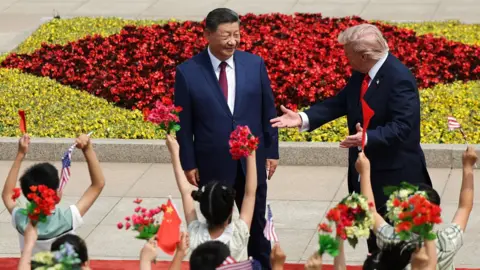
The structural architecture of the international system is undergoing a critical realignment, signaling a profound shift in contemporary global governance. The state visit of US President Donald Trump to China constitutes the first bilateral summit of this magnitude in nearly a decade, representing an institutional departure from conventional diplomatic protocol.
Academically, this summit marks the formal deconstruction of the ideologically driven containment strategies that previously dominated Washington’s foreign policy, replacing them with a highly calculated, transactional framework reminiscent of a Group of Two (G2) condominium.
The preceding period was characterized by Washington’s strategic emphasis on values-based coalitions designed to counter Beijing’s expanding influence, alongside a policy of aggressive economic decoupling. This confrontational paradigm culminated in the systemic trade instabilities and heightened tariff regimes of 2025.
By 2026, however, severe systemic shocks—specifically the escalation of the Middle East crisis, the systemic disruption of critical maritime supply chains, and widespread macroeconomic exhaustion—altered the strategic calculus of both hegemonies.
Consequently, these structural pressures forced a pragmatic return to bilateral negotiations, illustrating that systemic interdependencies continue to override unilateral ideological agendas.
The foreign policy paradigm of the current White House administration under Donald Trump marks a definitive departure from liberal internationalism and the promotion of democratic norms, shifting instead toward a framework of transactional diplomacy.
Read More: Xi Calls for China, US to Be ‘Partners Not Rivals’
Grounded in a neo-mercantilist strategy, this approach posits that geopolitical conflicts and strategic interests can be resolved through bilateral, commercial-style trade-offs. Concurrently, President Xi Jinping has demonstrated a calculated willingness to pursue pragmatic trade and technological compromises, aimed at mitigating global market volatility and safeguarding China’s domestic macroeconomic stabilization programs.
The Beijing summit substantiates that, despite prevalent discourse regarding multipolarity, the management of systemic global risks remains concentrated within a de facto bipolar structure dominated by the world’s two largest economies.
Washington and Beijing are transitioning from uncoordinated confrontation to a model of managed rivalry. Within this framework, the trajectory of the international order is determined not by the normative principles of international law, but by the balance of power, mutual utility, and strategic reciprocity.
Consequently, this state visit functions as a structural mechanism to stabilize bilateral relations amid the acute security crisis in the Middle East and protracted geo-economic competition. The primary catalyst for this diplomatic engagement was the imperative to mitigate the escalating conflict surrounding Iran and the de facto blockade of the Strait of Hormuz, which severely jeopardized global maritime transit and energy market stability.
In this context, Washington’s transactional foreign policy intersected with Beijing’s long-term strategic presence in the Middle East, culminating in a complex, high-stakes geopolitical exchange.
For the White House, the Iranian geopolitical crisis in 2026 constitutes an absolute foreign policy priority. Aiming to contain Tehran’s regional ambitions while avoiding direct military confrontation, the Trump administration has heavily relied on secondary economic sanctions and financial isolation.
However, this strategy remains structurally ineffective without Beijing’s cooperation; China functions as the primary consumer of Iranian hydrocarbons, absorbing up to 90% of Iran’s crude oil exports. Consequently, the clearing of energy transactions in Chinese yuan has provided Tehran with a critical macroeconomic buffer.
Read More: Trump Praises Xi, Voices Hope for Stronger US-China Relations
The architecture of the “Iran swap” proposed by Washington to Beijing is grounded in the principles of strategic reciprocity and asymmetric concessions. The United States’ stipulations require China to drastically curtail or entirely freeze its imports of Iranian crude oil, and to halt the transfer of dual-use technologies, specifically electronic components for unmanned aerial vehicles (UAVs), missile guidance systems, and telecommunication infrastructure.
Furthermore, Washington demands that Beijing block the deployment of Chinese-manufactured air defense systems within the Middle Eastern theater. In return, the United States offers significant economic concessions, including the phased reduction of the 100% tariff regimes imposed on specific Chinese commodities in 2025, and the removal of select Chinese technology conglomerates from the U.S. Entity List.
For the Chinese leadership, this bilateral framework introduces a profound diplomatic dilemma. Beijing seeks to preserve its strategic alignment with Tehran and maintain its normative role as a security guarantor within the Global South.
However, China’s economic stability remains deeply integrated with and dependent on access to consumer markets in the United States. Amidst decelerating domestic GDP growth, macroeconomic pragmatism and tariff mitigation evidently supersede geopolitical solidarity with Iran.
This bilateral negotiation exemplifies the structural shift toward a trans-governmental, G2-centric global order. Within this framework, regional powers are increasingly subordinated to the overarching strategic calculations of the dominant global actors.
The institutionalization of this U.S.-China arrangement effectively forces the diplomatic isolation of Tehran, thereby demonstrating the capacity of the two core polar powers to execute systemic global management independently of regional alliances.
The Sino-American summit in Beijing generates significant structural implications for the Central Asian regional security complex, defining the parameters of strategic maneuvering for post-Soviet states within an emerging polycentric architecture. Foremost, a stabilized Washington-Beijing trade regime substantially mitigates the risk of secondary sanctions for regional economies.
This stabilization preserves the viability of their multi-vector foreign policies, allowing Central Asian republics to avoid a zero-sum choice between integration into Western financial systems and participation in China’s Belt and Road Initiative (BRI). Furthermore, geo-economic stabilization enhances the predictability of global supply chains, accelerating the development of the Trans-Caspian International Transport Route (TITR) and trans-Eurasian rail corridors.
Read More: President Trump Is Leading High-Powered CEO Delegation in Beijing
Conversely, Washington’s counter-sanctions framework introduces new regulatory pressures. The U.S. Department of the Treasury, under Secretary Scott Bessent, enforces rigorous monitoring of Central Asian financial institutions and transit hubs to intercept sanctions evasion channels linked to Iran. Simultaneously, the summit recalibrates the U.S.-China-Russia strategic triangle.
The anticipation of Russian President Vladimir Putin’s subsequent visit to Beijing intensifies the competitive dynamic over Central Asia, compelling Chinese leadership to meticulously balance its strategic partnership with Moscow against its newly established economic understandings with the White House.
In institutional terms, the U.S.-China summit in May 2026 solidifies the transition from a liberal-normative global architecture to a highly transactional, neo-mercantilist international order. The transition from uncoordinated confrontation to a systemic model of managed competition demonstrates that deep economic interdependencies between the United States and China continue to constrain frontline military-strategic escalation.
Rather than a definitive economic decoupling, the structural outcome of the summit represents an institutionalization of managed rivalry, establishing what can be theoretically defined as a dynamic balance of power or a “fragile peace.” This order lacks normative consensus and operates on shifting matrices of mutual utility.
Nevertheless, it temporarily restores systemic predictability to global maritime and terrestrial supply chains. The emerging global configuration confirms that the contemporary international order is governed primarily by geo-economic capabilities and bilateral threat-mitigation mechanisms rather than multilateral international law.
While structurally volatile and inherently transactional, this framework functions as a critical de-escalation mechanism, reducing the immediate probability of direct kinetic conflict between the core superpowers.
*The views presented in this article are the authors’ own and do not necessarily reflect the views of The Diplomatic Insight.
Shamsiddin Karimov
Shamsiddin Karimov is the Chief Researcher at the Institute for Asian and European Studies of the National Academy of Sciences of Tajikistan. He is a doctorate of Political Science.