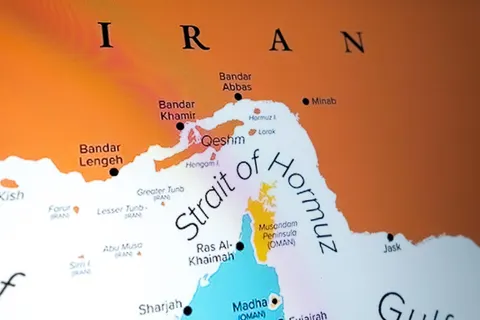
The Strait of Hormuz holds unparalleled strategic importance to the world economy due to its position as a waterway connecting the Persian Gulf and Arabian Sea and one of the most important energy transit routes in the world. The latest military developments involving the US, Israel, and Iran have re-emphasized the importance of the Strait in world trade routes.
The volume of maritime trade through the waterway has reduced substantially in response to security warnings, tanker incidents, and withdrawal of insurance schemes, which has raised concerns over the threat to world energy trade in crude oil and natural gas.
The Strait of Hormuz is located between Iran to the north and Oman and the UAE to the south. Despite being 100 miles (160 kilometers) long, it is only 21 miles (34 kilometers) across at its narrowest point. In this confined channel, designated shipping lanes are only 2 miles or 3.2 kilometers wide in each direction, with a buffer zone separating these lanes. This situation has made it vulnerable to disruptions.
Read More: Iran Claims ‘Full Control’ of Strait of Hormuz as Missile Strikes Escalate Across Region
The strategic value of the Strait of Hormuz can be attributed to the large volume of oil and energy products passing through it. According to data obtained from the USA’s Energy Information Administration, 2 million barrels of oil and oil products pass daily through the Strait of Hormuz, accounting for 20% of global oil products and a quarter of global oil shipments.
This waterway is also a critical route for the export and import of natural gas. One out of every five global exports of liquefied natural gas passes through the Strait of Hormuz, mostly from Qatar, which is one of the largest exporters of liquefied gas.
Other products passing through this waterway include refined oil products such as diesel, naphtha, and gasoline, as well as petrochemical products, aluminum, fertilizers, and agricultural products. This situation indicates the economic value of this waterway.
Oil-exporting countries such as Saudi Arabia, Iraq, Kuwait, Qatar, Bahrain, the UAE, and Iran depend on it to transport oil to global destinations. Most of these products are exported to Asian countries. In recent years, over 70% of oil passing through this waterway has been exported to Asian countries such as China, India, Japan, and South Korea.
Oil Market Reacts
The current disturbance has been caused by military strikes by the US and Israeli governments on Iranian targets. As a response to the strikes, the Iranian government has issued a warning that ships passing through the strait may face risks of attacks by missiles, drones, or other forms of assault.
As a consequence of the attacks, the number of ships passing through the strait has significantly reduced. According to statistics, the number of ships passing through the strait has reduced by 60 to 70 percent in the days following the escalation of the attacks, leaving many ships loaded and empty awaiting passage in the Persian Gulf.
As a result of the attacks, ships passing through the strait face the risk of losing ships valued at $50 million to $150 million in addition to the value of the cargo, which can be as high as $100 million for a fully loaded oil tanker. The current disturbance has been described by energy analysts as an “insurance-driven shutdown.”
The world energy market responded quickly to the decline in maritime traffic. Oil prices have risen in the days following the disruption, with Brent crude above $80 per barrel and WTI above $70 per barrel. This indicates concerns over whether the decline in shipping activity may constrain global energy supply.
The same has been seen in the case of natural gas prices. Prices in Europe and Asia have risen due to concerns over whether there would be any issues with shipments out of Qatar. The effect of energy price increases does not stop at crude oil prices alone. Oil and gas are basic commodities used in transportation, manufacturing, agriculture, and energy production. Any rise in energy prices over time may have an effect on inflation.
Limited Alternatives to the Strait
This is, however, a very important aspect and has a great impact on the overall trade between the countries in the region, considering that a number of players in the region are forced to rely on this chokepoint almost exclusively. Kuwait, Qatar, and Bahrain are some of the countries in the region that cannot afford to bypass the Strait of Hormuz, given that they do not have a pipeline that would enable them to do so.
Saudi Arabia is in a better position, given that it has the East-West pipeline that connects the Persian Gulf and the Red Sea, and this has the ability to carry around 5 million barrels every day to the port city of Yanbu. This is, however, still limited and cannot be relied on to cover all the exports, given that there is still a need for the Strait of Hormuz.
In addition, the United Arab Emirates has been able to build a bypass, given that there is a pipeline from Habshan to Fujairah, and this has the ability to carry around 1.5 million barrels every day from the landlocked fields to the Gulf of Oman.
Maritime international law has given some level of protection to ships that pass through strategic waterways. The United Nations Convention on the Law of the Sea has given a “right of transit passage” to all ships passing through straits that are used for international navigation. This is supposed to ensure that shipping activities continue in straits that are in the territorial waters of a state.
In practical terms, it depends on the naval capabilities and the political situation. The United States has a large military presence in the Persian Gulf and has escorted tankers in the area in the past during conflict.
In the Iran–Iraq War in the 1980s, there were so many attacks on oil tankers that the United States initiated escort operations to protect the ships. The period in the Iran–Iraq War is known as the Tanker War, where there were hundreds of attacks on ships between 1984 and 1988.
In the current situation, there has been a suggestion from U.S. authorities that escort operations and insurance guarantees from the government could help in resuming shipping activities in the area. However, experts note that escort operations require a lot from naval forces and cannot guarantee safety.
Broader Economic and Geopolitical Implications
The crisis thus points to the strong relationship that exists between the global economy and the routes of energy supply. The Asian countries have been identified as having a strong dependence on the supply of oil and gas from the Persian Gulf region. In aggregate form, China, India, Japan, and Korea import millions of barrels of crude oil every day through the strait.
The European energy markets may also be impacted by the crisis, specifically in the LNG markets. As the European markets continue to diversify the import of natural gas, the role of Qatar’s natural gas supply in the balancing of the equation cannot be ignored.
At the same time, the rising cost of oil may also have a positive impact on the economies of the United States, Canada, and Brazil, which lie outside the Middle East region. However, the impact of the rising cost of oil may be negated by the overall uncertainty in the economy.
The Strait of Hormuz has been recognized for centuries as one of the world’s key geographic chokepoints. The limited space and the pixel density of key energy-producing countries in the Persian Gulf make the Strait of Hormuz essentially irreplaceable in the flow of international trade.
Read More: What Happens If Iran Closes the Strait of Hormuz?
Despite advances in technology, the establishment of strategic petroleum reserves, and the improvement in energy diversity, the Strait of Hormuz still represents a key vulnerability that can cause significant market volatility with even minor disruptions, given the sheer volume of trade passing through this key chokepoint.
Recent developments in international shipping passing through the Strait of Hormuz demonstrate how easily tensions in the region can spread into the global economy. Approximately a fifth of the world’s total petroleum output and a significant percentage of LNG exports must pass through this narrow channel.
Going forward, the specific route that international shipping takes passing through the Strait of Hormuz will depend on the security situation and the progress made in negotiations. The key lesson that can be taken from this situation is that the international energy market is still a highly interconnected and volatile market that is easily disrupted.
As a result, stability in this key chokepoint will continue to be a key issue for all countries in the region and the international community, given the sheer percentage of international trade passing through the Strait of Hormuz.
*The views presented in this article are the authors’ own and do not necessarily reflect the views of The Diplomatic Insight.

A passionate International Relations student with a strong interest in diplomacy, policy, and global affairs. Dedicated to contributing thoughtful analysis and research on international issues.