New York (TDI): Islamabad has cautioned the United Nations that New Delhi’s decision to place the Indus Waters Treaty on hold poses a serious threat to Pakistan’s water security and could undermine regional stability.
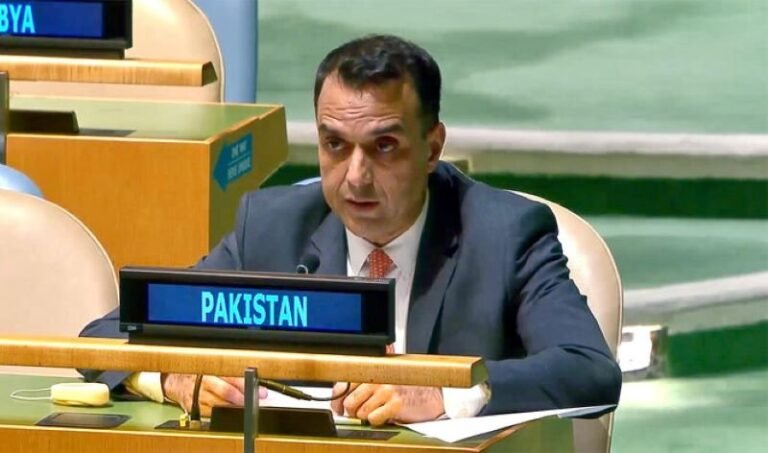
Addressing a Global Water Bankruptcy Policy Roundtable organised by Canada and the United Nations University, Pakistan’s Representative to the UN, Ambassador Usman Jadoon, described India’s move as a deliberate attempt to “weaponise water.” He said the unilateral action amounted to a material violation of the landmark 1960 agreement.
According to Ambassador Jadoon, India has carried out several treaty breaches since April last year, including disrupting downstream water flows without prior notice and withholding essential hydrological data needed for effective water management.
“Pakistan’s stance is clear and unambiguous,” he said. “The Indus Waters Treaty remains legally binding and does not allow any party to suspend or alter it unilaterally.”
He noted that for more than six decades, the treaty had served as a reliable mechanism for the fair and predictable sharing of the Indus River system, which underpins one of the largest irrigation networks in the world. The basin supplies more than 80 percent of Pakistan’s agricultural water and supports the livelihoods of over 240 million people.
Read More: Zardari Rejects India’s IWT Violation, Warns Against Weaponizing Water
Ambassador Jadoon warned that water insecurity has become a global systemic risk, with far-reaching consequences for food security, energy production, public health, and overall human security. For Pakistan, he said, this challenge is not theoretical but deeply real.
Describing Pakistan as a lower-riparian, semi-arid, and climate-vulnerable country, he pointed to mounting pressures from floods, prolonged droughts, rapid glacier melt, falling groundwater levels, and population growth, all of which are straining the country’s water resources.
He outlined Pakistan’s efforts to build water resilience through integrated planning, flood mitigation, irrigation upgrades, groundwater recharge, and environmental restoration. National initiatives such as Living Indus and Recharge Pakistan, he said, reflect the country’s commitment to long-term water sustainability.
Read More: Pakistan’s UN Mission Event Highlights Grave Humanitarian Fallout of India’s IWT Suspension
However, Ambassador Jadoon stressed that no country can address systemic water risks on its own, particularly where rivers are shared across borders. Predictability, transparency, and cooperation in transboundary water management, he said, are essential for the survival of downstream communities.
He urged the international community to formally recognise water insecurity as a global systemic risk ahead of the 2026 UN Water Conference and called for stronger adherence to international water law to safeguard vulnerable populations dependent on shared river systems.