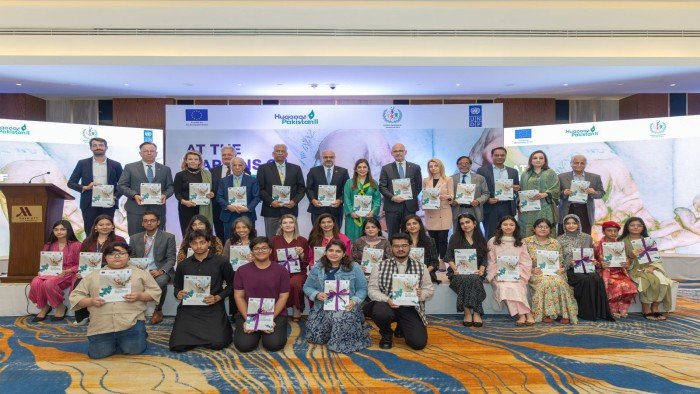
Islamabad (TDI): A new report, launched under the European Union-funded Huqooq-e-Pakistan II project, spotlights the widespread yet often concealed child labor in Pakistan’s private sector.
Titled “At the Margins of Protection: Child Labor in Pakistan’s Private Sector,” the publication was unveiled by the National Commission on the Rights of Child (NCRC) in collaboration with the United Nations Development Program (UNDP).
The report underscores a stark reality that one in every ten children in Pakistan is engaged in labor, often under hazardous and exploitative conditions that remain largely outside formal oversight.
It estimates that 8.6 million children are affected nationwide, many working in informal sectors or lower tiers of production networks where regulation is weakest.
Speaking at the launch, Philipp Oliver Gross, Deputy Head of Mission of the European Union to Pakistan, described the report as a “key stepping stone” in tackling child labor. He emphasized that eliminating the practice remains central to Pakistan’s international commitments, particularly under its GSP+ trade status.
Advancing child rights through evidence and action.
Through the #HuqooqePakistanII project financed by @EUPakistan 🇪🇺, @UNDP_Pakistan partnered with NCRC to launch the report “At the Margins of Protection: Child Labor in Pakistan’s Private Sector”.
The findings highlight the… pic.twitter.com/AbFiH1PH9z— National Commission on The Rights of Child (NCRC) (@NCRC_Pakistan) April 8, 2026
Drawing on consultations across provinces, interviews with key stakeholders, and an analysis of legal frameworks, the report identifies persistent structural drivers behind child labor.
Poverty, limited access to education, and weak enforcement mechanisms continue to push children into work. It also highlights systemic gaps, including fragmented data systems, inadequate labor inspections, and poor coordination between federal and provincial authorities.
Dr. Samuel Rizk, Resident Representative of United Nations Development Program, stressed the urgency of institutional reform. He noted that child labor remains deeply embedded in informal economies and supply chains, requiring stronger data systems and policy responses to protect vulnerable children.
The report calls for a shift from isolated interventions to a coordinated, systems-based approach. Key recommendations include harmonizing legal standards across provinces, strengthening labor inspection regimes, improving data integration, and enhancing private sector accountability.
These measures align with Pakistan’s National Action Plan on Business and Human Rights, which identifies child labor as a priority concern.
Ayesha Raza Farooq, Chairperson of National Commission on the Rights of Child, described the report as a “roadmap for action,” reaffirming the Commission’s commitment to translating its findings into concrete policy measures.