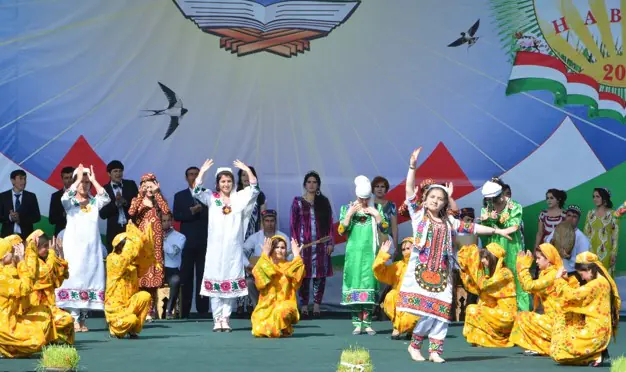
Indeed, Navruz stands as a symbol of reverence and respect for supreme national values and the safeguarding of national interests; it is the greatest national holiday, embodying tolerance, unity, security, and peace throughout the world.
Navruz boasts a history spanning more than 3,000 years and is regarded as one of the oldest and most magnificent national celebrations inherited from our ancestral forebears. It is precisely thanks to the endeavors of our predecessors, who made tremendous sacrifices over the centuries, that our language, culture, and national identity as Tajiks have remained steadfast and resilient to this day.
Despite the vicissitudes of life, devastations, and the influence and pressure of foreign powers, our ancestors have bequeathed these supreme national values from the depths of millennia to future generations as an invaluable treasure.
Navruz is a celebration of spring and the revival of nature, and it is considered one of the most cherished holidays of the Aryan peoples, inherited from our distant ancestors since time immemorial.
In the era of independence, Navruz is celebrated not only in the countries of the Navruz region but also by other nations with a renewed vision and traditions specific to their respective regions. The civilized and learned Tajik people have, since ancient times, welcomed the festival of Navruz as the celebration of the New Year’s commencement – a new day filled with hopes and aspirations, with pure hearts and benevolent intentions, and in festive attire. They prayed that the footsteps of the new year would be blessed with prosperity and abundance.
The celebration of Navruz and the concepts of independence and freedom – both dear and sacred to every individual – have become deeply and inseparably intertwined in the modern history of the Tajik people. For Navruz has served as a testament to the history and culture of the Tajik nation, an ancient and civilization – building people, introducing it to the world.
Conversely, it was precisely the blessing of independence that enabled Navruz, with all its grandeur, magnificence, and benevolent, constructive customs, to be revived and celebrated once again in our land. Therefore, it is incumbent upon each of us to utilize the noble traditions and customs of our nation to strive henceforth for the prosperity and development of our beloved country and to consolidate the achievements of the state independence era, directing all our capabilities and energies toward the construction and development of our beloved homeland–Tajikistan (from the address of the Founder of Peace and National Unity, Leader of the Nation, President of the Republic of Tajikistan, His Excellency Emomali Rahmon, Navruz 2024).
Indeed, turning to the customs of our ancestors and reviving ancestral traditions can, without doubt, exert a profound influence upon the upbringing of young people. It safeguards them from involvement in any perilous and terrorist groups.
In fact, turning to the rituals of ancestors and reviving ancient customs can undoubtedly have a profound impact on the upbringing of youth and young people. It protects them from joining any dangerous and destructive groups and movements.
It is a matter of pride that observing and implementing Navruz rituals in life is a unique and unparalleled guide for the future of the nation and the survival of humanity. In truth, feelings of patriotism and love for the homeland, national identity, self-awareness, and self-knowledge also originate from respect for history and culture.
It is worth mentioning that Navruz 2026 differs from other national celebrations with its distinctive characteristics in that the 20th Session of the Intergovernmental Committee for the Safeguarding of the Intangible Cultural Heritage of UNESCO (India, New Delhi, December 8-13, 2025) inscribed the ritual of preparing Sumalak, a traditional Tajik food, on the UNESCO Representative List of the Intangible Cultural Heritage of Humanity.
The cultural tradition of preparing Sumalak has attained international recognition, marking a positive milestone that falls on the threshold of the Nowruz festivities and the celebration of Tajikistan’s 35th anniversary of State Independence.
It is particularly noteworthy that the Founder of Peace and National Unity – Leader of the Nation, President of the Republic of Tajikistan, His Excellency Emomali Rahmon, has a visionary and serious approach to resolving and evaluating the most important issues concerning the future of humanity. It is a source of pride and dignity for Tajiks around the world that, with the aim of honoring national traditions and reviving the ancient rituals of the Tajik people, an amendment has been made to the Law of the Republic of Tajikistan “On Holidays,” according to which “Tirgon” is celebrated annually on July 1st.
The civilized and culture-loving Tajik people will continue to preserve the moral, spiritual, social, and cultural traditions of “Shab-i Yalda,” “Sada,” “Navruz,” “Tirgon,” and “Mehrgon” with all the distinctive Aryan nuances and pass them on to future generations as a legacy.
The Founder of Peace and National Unity, Leader of the Nation, President of the Republic of Tajikistan, His Excellency Emomali Rahmon, states that “History is instructive, and no people or nation can appreciate independence and its statehood traditions without honoring its past.”
Thus, it can be said that celebrating International Navruz serves as a reliable foundation for the future generation to enhance the sense of national self-awareness and self-knowledge, self-identification, and to revive and adapt the rituals of ancestors to modern times.

Davliyorova Safargul Teshaevna
Davliyorova Safargul Teshaevna is a candidate of Philosophical Sciences; associate professor and leading researcher at the Department of Commonwealth of Independent States, Institute for Asian and European State Studies, Academy of Sciences of Tajikistan.