At the invitation of US President Donald Trump, on November 4-6, President of Uzbekistan Shavkat Mirziyoyev paid a working visit to Washington DC to participate in the C5+1 Summit, and hold high-level talks with President Trump.
Upon his arrival, President Mirziyoyev was welcomed by the U.S. Deputy Secretary of State Christopher Landau, Chairperson of the American-Uzbek Chamber of Commerce Carolyn Lamm, and other officials. The visit’s agenda was dense, composed of high-level meetings with congressional leaders, heads of major U.S. companies, and representatives of key financial institutions. The visit reflected the growing partnership between the two nations across political, economic, and cultural spheres, as well as within the framework of Central Asian regional cooperation.
On November 5, President Mirziyoyev met with members of the U.S. House of Representatives Bill Huizenga, Carol Miller, and Sydney Kamlager-Dove to discuss strengthening strategic cooperation and enhancing inter-parliamentary dialogue. The parties noted the successful activities of the Caucus on Cooperation with Uzbekistan in Congress, including the annual “Uzbekistan Days,” which promote bilateral understanding. Agreements were reached to organize reciprocal visits by U.S. lawmakers and business delegations to Uzbekistan, particularly from West Virginia, Michigan, and California.
Later the same day, the Uzbek leader held talks with Senator Steve Daines, Co-Chair of the U.S. Senate Central Asia Caucus. Both sides praised the unprecedented momentum in bilateral trade and investment, noting the recent signing of record-breaking contracts. They also discussed plans to send a business mission from Montana to Uzbekistan, demonstrating the importance of regional partnerships between U.S. states and Uzbek regions.
President Mirziyoyev’s economic diplomacy continued with a series of meetings with American financial institutions. Discussions with John Yovanovitch, head of the U.S. Export-Import Bank (Eximbank), focused on financing major joint projects in energy, critical minerals, transport, and agriculture. An agreement on project financing was signed between Uzbekistan’s Ministry of Investment, Industry, and Trade and Eximbank, paving the way for long-term cooperation, including the modernization of Uzbekistan’s national aircraft fleet and the supply of Boeing planes.
Read More: ‘Made in Uzbekistan’ Products Draw Visitors at PIMEC 2025
Another key meeting was held with Ben Black, CEO of the U.S. International Development Finance Corporation (DFC). Both sides highlighted the rapid growth of trade and investment cooperation and discussed establishing a joint investment platform to support small businesses and infrastructure projects. Plans were also advanced to open a DFC regional office in Tashkent, a move expected to deepen U.S. engagement in Central Asia.
During a meeting with the U.S. Secretary of Commerce Howard Lutnick, President Mirziyoyev talked about the progress of economic ties that have grown fourfold in recent years, with trade turnover nearing $1 billion. More than 300 American companies are now operating in Uzbekistan, contributing to projects in energy, agriculture, and innovation. Both sides agreed to establish a Coordination Council and an investment platform to promote new joint ventures, including in advanced irrigation and agribusiness.
At a large roundtable with representatives of leading U.S. corporations, including Google, Meta, Amazon, Boeing, McKinsey, and Cargill, the President outlined Uzbekistan’s ambitious development plans. He announced that by 2030, Uzbekistan aims to generate over half of its electricity from solar and wind energy, supported by strong collaboration with American investors and technology firms.
The modernization of transport infrastructure and the expansion of digital cooperation with U.S. tech giants were also highlighted. Uzbekistan’s commitment to building reliable supply chains for critical minerals and advancing industrial processing using American technologies was emphasized by the President.
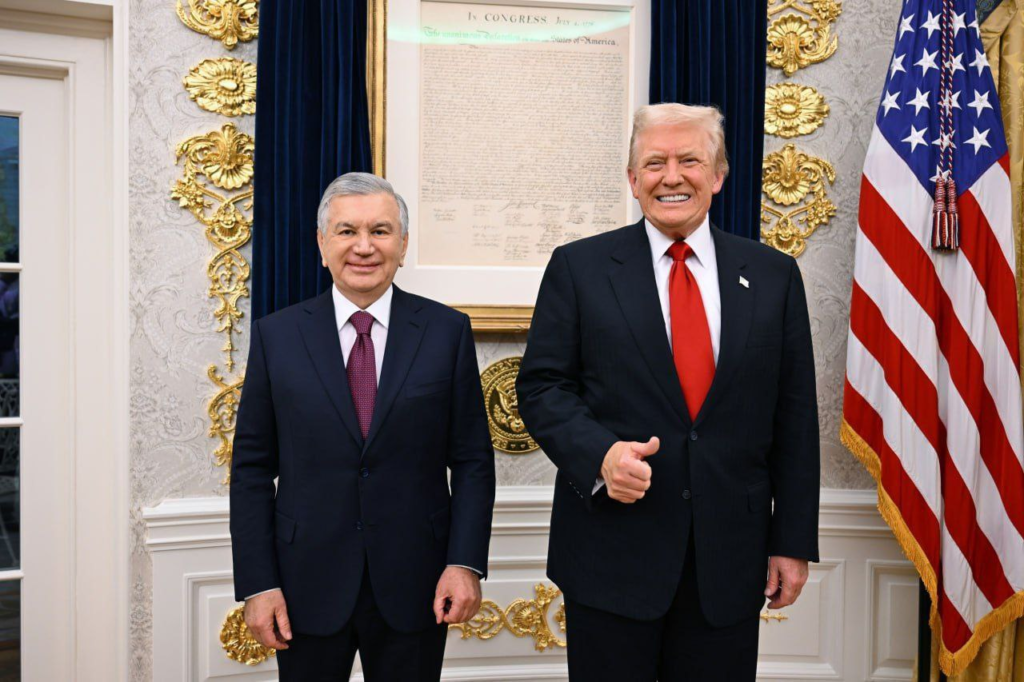
One of the highlights of the visit was President Mirziyoyev’s meeting with the U.S. President Donald Trump at the White House on November 6. In the Oval Office, the leaders reaffirmed their shared commitment to strengthening the Uzbek-American strategic partnership. Discussions covered expanding trade, investment, and cultural exchanges, as well as addressing global and regional issues within the “C5+1” cooperation format. President Mirziyoyev congratulated President Trump on his leadership in promoting peace and stability, and extended an invitation to visit Uzbekistan officially.
Read More: UNESCO Samarkand Summit Recognizes Uzbekistan’s Role in Preserving World Heritage
Later that day, President Mirziyoyev participated in the C5+1 Summit of Central Asian and U.S. leaders, chaired by President Trump at the White House. Joined by the Presidents of Kazakhstan, Kyrgyzstan, Tajikistan, and Turkmenistan, the Uzbek President proposed several forward-looking initiatives to strengthen regional collaboration. Among them were establishing a permanent C5+1 Secretariat, creating a Coordinating Council on Investment and Trade, and launching a Central Asian Investment Partnership Fund.
He called for establishing a Special Committee on critical minerals, a Regional Partnership for Agro-Technological Innovations, and a joint exhibition of Central Asian cultural heritage in top American museums. President Mirziyoyev also proposed holding the next C5+1 Summit in Samarkand, demonstrating Uzbekistan’s willingness to foster regional unity.
After the visit, President Trump made a post on his Truth Social about successful trade agreement with Uzbekistan. In his announcement, President Trump mentioned Uzbekistan’s plan of purchasing and investing almost 35 billion USD over the next three years and over 100 billion USD investment in key American Sectors, including Critical Minerals, Aviation, Automotive Parts, Infrastructure, IT and others.
President Mirziyoyev’s working visit to Washington marked a new chapter in US – Uzbekistan relations.. Through new economic agreements, intergovernmental cooperation, and shared regional initiatives, the visit laid a foundation for long-term collaboration based on mutual trust and shared aspirations for progress and prosperity.

Nuzhat Rana is the Managing Editor (website) at The Diplomatic Insight.