The Middle East is sliding toward a level of instability it has not seen in decades. Great-power rivalry is intensifying, military confrontations are multiplying, and the broader regional security architecture is fraying at the seams. This deepening crisis has already inflicted enormous humanitarian suffering, while simultaneously triggering a global economic slowdown, severe disruption to energy markets, and mounting pressure on international supply chains, all of which strike at the very foundations of peace and development worldwide.
Amid this volatile environment, one truth stands out with unmistakable clarity: any military strike by the United States or Israel against Iran would not resolve the crisis, it would plunge the entire region into the catastrophe of open, all-out war, running completely counter to the core interests of the Middle East, the broader Islamic world, and Pakistan.
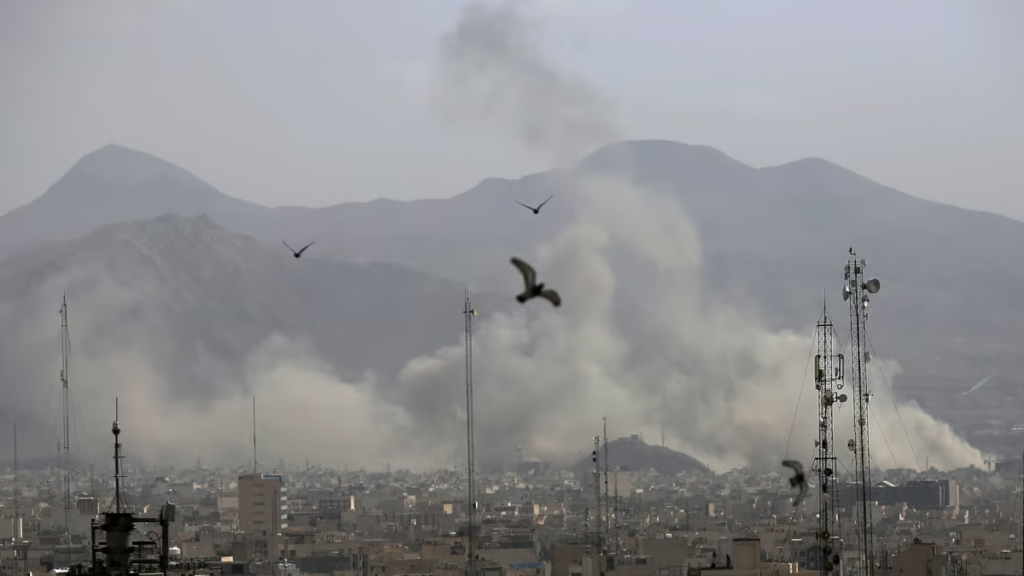
According to reports from the media, since the start of 2026, violent incidents targeting sensitive facilities and civilian-populated areas across the Middle East have surged at an alarming rate, leaving at least 2,000 civilians dead and a casualty toll that continues to climb with each passing week.
The attack on Iran’s South Pars gas field alone has caused the country’s natural gas output to fall by approximately 12%, setting off acute energy shortages that ripple outward across the region. These are not abstract statistics buried in policy reports. They represent shattered families, collapsed livelihoods, and a humanitarian catastrophe that, with genuine political will, could have been avoided entirely.
The turmoil engulfing the Strait of Hormuz has ensured that this crisis reaches far beyond the region’s borders. According to reports from the media, this narrow but indispensable waterway, which under normal circumstances handles approximately 20% of the world’s oil and liquefied natural gas shipments—has been brought to a near-standstill by the escalating tensions.
Daily oil exports from the Middle East have reportedly plummeted from 25 million barrels to fewer than 10 million barrels, a collapse of more than 60%. International crude oil prices have surged to $120 per barrel, shipping costs have skyrocketed by nearly tenfold, and global LNG supplies have contracted by around 20%, marking the most severe supply disruption the world has witnessed in years.
For Pakistan, a country that is acutely dependent on energy imports and whose industrial sector and household consumers are already under severe strain—this is not a distant geopolitical abstraction. It is a lived reality, felt in the rising price of fuel at every petrol pump, in the mounting electricity bills of ordinary families, and in the squeezed margins of local businesses fighting to stay afloat.
The economic fallout is not contained within the region. According to reports from the media, the World Trade Organization has projected that persistently elevated energy prices will drag global trade growth down from 4.6% to as low as 1.9%. The knock-on effects are already visible: food prices are climbing, fertilizer supplies are tightening, manufacturing costs are rising across multiple sectors, and industrialized economies such as Japan and South Korea have been forced to implement fuel rationing and cut working hours.
For developing nations, the burden is even heavier and more immediate. With roughly 80% of world trade dependent on maritime shipping, any prolonged disruption to key sea lanes generates cascading supply chain failures and cost spikes that ultimately fall hardest on working people and the poor, the very populations least equipped to absorb them.
At a moment when risks are compounding, military action would achieve precisely the opposite of stability. It would narrow every remaining opening for diplomacy, dramatically raise the probability of catastrophic miscalculation, and push an already fragile situation to the very edge of collapse.
A military strike against Iran may be marketed as a “decisive solution” by those who advocate it, but the real-world consequences would be devastating: the systematic destruction of the pillars of regional stability, a sharp intensification of religious, ethnic, and sectarian divisions, and the ignition of a cascade of terrorism, mass refugee displacement, and economic disintegration.
Iran is not a peripheral actor in this equation, it is a cornerstone of the region. It shares a long land border with Pakistan, and the two countries’ political, economic, and social interests are bound together in ways that cannot simply be severed. An Iran consumed by war and internal chaos would directly threaten Pakistan’s own security environment, destabilize border communities, disrupt bilateral trade, and cut off an overland corridor that Pakistan has long sought to develop. No country in the region stands to benefit from a war-torn Iran. Pakistan, above all others, cannot afford one.
History offers a lesson that keeps repeating itself, yet too often goes unheeded: military force cannot resolve the underlying sources of conflict. Bombs and airstrikes do not purchase lasting peace, they purchase temporary silence followed by deeper resentment and longer wars. A ceasefire, followed by genuine de-escalation and a return to meaningful dialogue and negotiation, remains the only path that leads somewhere constructive.
A ceasefire will not dissolve every grievance overnight, nor will it immediately dismantle the structural tensions that have been building for years. But it can open a critically needed window for humanitarian relief to reach those who have been cut off from it, for temperatures to fall on all sides, and for skilled diplomatic mediation to gain traction, thereby creating the conditions under which the countries of the region can begin to work out their differences on their own terms, without the barrel of an outside power’s gun held to their heads.
Against this backdrop, China calls solemnly and urgently on all parties to immediately halt military operations and commit to resolving their differences through political and diplomatic channels. The United Nations must be empowered to play the central mediating role that its founding mandate envisions, driving a comprehensive and durable de-escalation of the crisis.
Regional countries, for their part, must strengthen their solidarity and cooperative frameworks, resist the pressure of external military interference, and take collective ownership of their shared future. China’s position on this matter is rooted in consistent principle, not tactical calculation. Beijing has always upheld a neutral and impartial posture, championed the sovereign equality and territorial integrity of all states, insisted on resolving international disputes through peaceful means, and firmly supported the right of Middle Eastern peoples to chart the course of their own region without external diktat.
China’s commitment to a peaceful, secure, and prosperous Middle East is not rhetorical, it is reflected in sustained diplomatic engagement and a genuine readiness to contribute constructively to any process that moves the region toward stability. A stable Middle East serves not only the aspirations of its own people; it is also an essential enabler of global economic recovery and of the kind of long-term international order in which all countries can develop and thrive.
There are no victors in chaos, there are only degrees of loss. Preventing further escalation and bringing tensions back from the brink are not merely the most urgent imperatives of this moment; they are a shared moral and strategic responsibility that every country in the region, and beyond, must accept. The window for avoiding catastrophe is still open, but it will not remain so indefinitely. The time to act is now.
*The views presented in this article are the author’s own and do not necessarily reflect the views of The Diplomatic Insight.

Zhuoyue Yan
Zhuoyue Yan is a scholar at the Baize Institute for Strategy Studies, Southwest University of Political Science and Law, China.
Ying Jin
Ying Jin is a scholar at the Baize Institute for Strategy Studies, Southwest University of Political Science and Law, China.
Hongmei He
Hongmei He is a scholar at Yunnan Academy of Social Sciences, China.