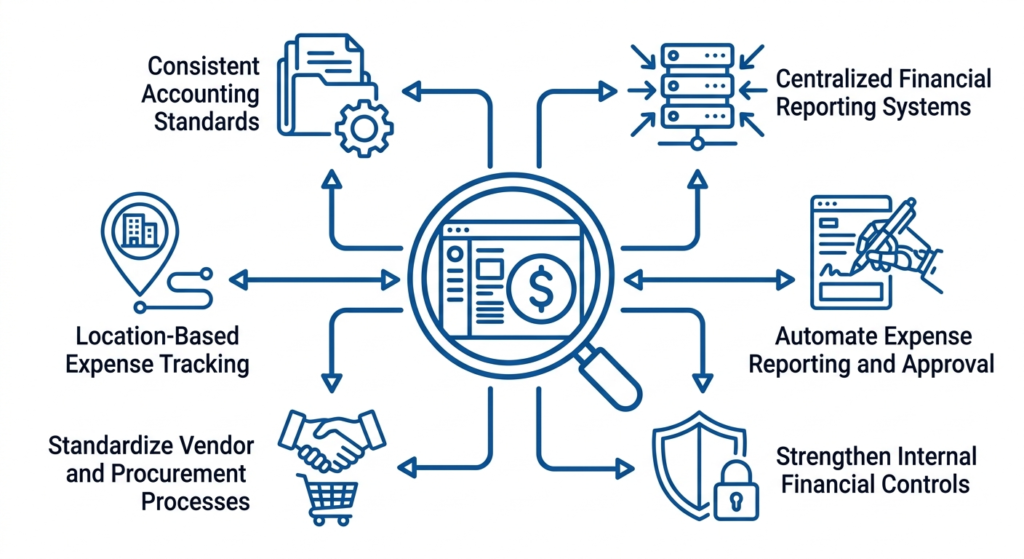
Businesses operating across multiple locations face complex expense management challenges. Each site generates its own operational costs, vendor payments, and staffing expenses. Without structured financial systems, tracking and allocating these expenses becomes difficult. Inconsistent reporting across locations can lead to inaccurate financial statements, budgeting errors, and compliance risks.
Effective multi-location expense management requires standardized accounting procedures, centralized reporting systems, and clear financial oversight. When businesses implement structured financial controls, leadership teams can monitor spending patterns while maintaining accurate financial reporting across all locations.
Establish Consistent Accounting Standards
The first step in managing expenses across multiple locations is establishing uniform accounting policies. Each location must follow the same expense classification rules and reporting procedures.
Standardized accounting practices ensure that financial data from different locations can be compared accurately. Without consistency, expense reports from separate locations may categorize costs differently, making financial analysis unreliable.
Accounting principles such as the matching principle in accounting help maintain accurate reporting by ensuring that expenses are recorded in the same period as the revenue they support.
Applying this principle across all locations prevents misaligned financial records and improves the accuracy of consolidated financial statements.
Centralize Financial Reporting Systems
Multi-location businesses benefit from centralized accounting platforms that consolidate financial data from every location. Instead of maintaining separate reporting systems, centralized platforms allow finance teams to monitor expenses from a single interface.
Centralized reporting provides several operational advantages:
- Real-time visibility into location-level expenses
- Standardized financial reporting formats
- Faster reconciliation across locations
Finance departments can evaluate operational performance across sites without waiting for manual reports from each location.
Centralized systems also reduce the risk of reporting discrepancies between locations.
Implement Location-Based Expense Tracking
Even though financial reporting is centralized, expense tracking should still capture location-specific data. Businesses must understand how costs vary between sites in order to evaluate operational efficiency.
Expense tracking systems should categorize transactions based on location identifiers. These identifiers allow finance teams to compare performance metrics such as labor costs, facility expenses, and supply purchases.
Location-based tracking enables organizations to identify unusual spending patterns.
For example, higher equipment costs at one location may signal operational inefficiencies or maintenance issues.
Accurate location tagging improves financial analysis and supports better operational decisions.
Standardize Vendor and Procurement Processes
Vendor management becomes more complex when businesses operate multiple locations. If each site independently selects vendors or negotiates pricing, the organization may lose opportunities for cost control.
Centralized procurement policies help standardize vendor relationships.
Businesses can negotiate organization-wide contracts with preferred vendors, allowing locations to access consistent pricing structures.
Standardized procurement also simplifies expense tracking because invoices follow predictable formats.
For example, businesses with field teams may purchase uniform equipment such as Salomon tactical boots through centralized purchasing agreements to maintain consistent pricing and inventory management across locations.
Vendor standardization strengthens cost control and improves financial predictability.
Automate Expense Reporting and Approval
Manual expense reporting processes become inefficient when businesses operate multiple locations. Employees may submit expense reports in different formats, increasing the workload for accounting teams.
Automated expense management systems streamline this process.
Employees submit expense reports through standardized digital forms. These systems route reports through approval workflows before final recording in the accounting system.
Automation provides several benefits:
- Faster expense processing
- Reduced administrative workload
- Clear approval documentation for audit purposes
Automated systems also improve compliance by enforcing expense policies consistently across all locations.
Monitor Budget Performance by Location
Each business location should operate within a defined budget. Budget monitoring allows finance teams to compare planned spending with actual expenses.
Location-level budgets typically include categories such as staffing costs, facility expenses, and operational supplies.
Finance teams should regularly review budget performance reports to identify deviations.
If a location consistently exceeds budget limits, management can investigate operational practices and identify corrective actions.
Regular budget reviews support financial discipline across the entire organization.
Strengthen Internal Financial Controls
Strong internal controls protect the accuracy of financial records. Multi-location businesses must implement controls that prevent unauthorized spending and reduce the risk of reporting errors.
Effective financial controls include:
- Segregation of financial responsibilities across employees
- Approval requirements for large expenses
- Periodic financial audits of location-level accounts
These safeguards ensure that financial transactions follow company policies.
Internal controls also help organizations detect irregularities early before they affect consolidated financial reporting.
Use Data Analytics to Evaluate Cost Trends
Data analytics tools help businesses analyze expense trends across multiple locations. Financial dashboards can display cost patterns, vendor spending, and operational efficiency metrics.
Analytics platforms allow finance teams to compare locations based on key performance indicators such as:
- Cost per employee
- Operational expenses per location
- Vendor spending distribution
Identifying patterns helps management determine which locations operate most efficiently. Data-driven insights support informed decisions about cost reduction and resource allocation.
Managing expenses across multiple business locations requires structured accounting practices, centralized financial systems, and clear oversight. Standardized accounting policies ensure consistent reporting, while centralized platforms consolidate financial data for analysis. Automated expense tracking, vendor standardization, and strong internal controls improve operational efficiency and financial accuracy. By combining disciplined financial management with data-driven analysis, businesses can maintain control over multi-location expenses while supporting sustainable growth.

Established in December 2008, The Diplomatic Insight is Pakistan’s premier diplomacy and foreign affairs magazine, available in both digital and print formats.