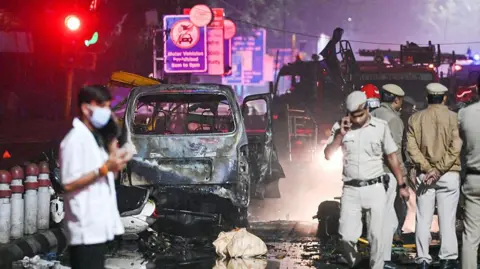
A devastating car explosion in Delhi has shattered a decade of relative calm, thrusting the fragile security equilibrium of South Asia back into the spotlight. The attack near the historic Red Fort, which killed at least 12 and wounded over 30, has not only reignited tensions between nuclear-armed rivals India and Pakistan but also forced a recalibration of strategic doctrines in New Delhi.
Following an emergency cabinet meeting, the Indian government formally declared the incident a “terrorist attack” by “anti-national forces,” condemning the “dastardly and cowardly act.” The National Investigation Agency (NIA) has assumed control of the probe, filing a case under the stringent Unlawful Activities (Prevention) Act (UAPA).
Subsequent police raids across northern India, concentrated in the Pulwama district of Indian-administered Kashmir, led to multiple detentions. Authorities claim to have disrupted an “interstate and transnational terror module” with alleged links to Ansar Ghaza Tul Hind.
The seizure of nearly 2,900 kilograms of explosive materials and the arrest of two Kashmiri doctors accused of aiding the plotters were cited as evidence. A primary suspect, Dr. Umar Nabi of Pulwama, remains at large and is believed to have been the driver of the explosive-laden vehicle.
Preliminary intelligence, as reported, suggests logistical support originated from Afghanistan-based networks, though the execution appears to have been “locally organized and self-radicalized.”
Read More: Delhi Car Explosion Investigated Under India’s Anti-Terror Law
Modi’s ‘Red Line’ and the Calculus of Restraint
The attack places Prime Minister Narendra Modi’s government in a delicate strategic position. In May 2025, following a significant military clash with Pakistan, Modi had publicly declared that any future terrorist attack would be treated as an act of war. This “red line” now constrains New Delhi’s options.
Analysts argue that “the government has trapped itself in its own doctrine.” Officially attributing the blast to Pakistan would create immense domestic pressure for a military response—a costly and potentially untenable path. This has prompted a visible, and likely calculated, restraint. India has so far avoided directly implicating the Pakistani state, a marked shift from previous incidents.
According to Michael Kugelman, a Washington-based South Asia expert, this reflects a learned pragmatism. “If India designates the attack as state-sponsored terrorism, it will face tremendous domestic and strategic pressure to respond militarily. That’s a costly path New Delhi seems keen to avoid.” The international skepticism that followed India’s airstrikes in May 2025, which were seen as lacking clear evidence, has likely informed this more cautious approach.
A Shifting Regional Chessboard
Complicating the regional dynamic, a suicide bombing in Islamabad a day after the Delhi attack killed 12. While the Tehreek-e-Taliban Pakistan (TTP) claimed responsibility, Pakistani Prime Minister Shehbaz Sharif swiftly accused India of “state terrorism,” a claim dismissed by New Delhi as baseless.
These tit-for-tat underscores a broader regional realignment. Pakistan’s relationship with the Taliban-led government in Afghanistan has deteriorated, with Islamabad accusing Kabul of sheltering TTP militants. Concurrently, India’s deepening diplomatic and developmental engagement with Kabul is viewed with deep suspicion by Pakistan.
“The regional balance has shifted,” by political analyst. “Pakistan once viewed the Taliban as its proxy, but now perceives Kabul as tilting toward India—a strategic reversal that fuels mutual distrust and creates a permissive environment for proxy conflicts.”
Read More: PM Shehbaz Links Terror Wave to Kabul–Delhi Collaboration
From AQIS to Ansar Ghazwa al-Hind
Beyond the established threat from groups like JeM and Lashkar-e-Taiba, Indian intelligence is increasingly focused on the ideological and operational inroads made by Al Qaeda in the Indian Subcontinent (AQIS) and, more specifically, its proclaimed subsidiary, Ansar Ghazwa al-Hind.
While AQIS’s operational footprint within India remains limited, its digital propaganda, which frames India as an oppressor of Muslims, has sought to radicalize and recruit. The arrest of Dr. Ishtiaq Ahmed in August 2024, accused of leading an AQIS-affiliated “Ranchi Radical Group” and attempting to establish a training camp, highlighted these efforts.
This network is understood by security analysts to be a manifestation of the Ansar Ghazwa al-Hind concept—a call to action for localized, grassroots jihad within India, inspired by Al Qaeda’s ideology but often operating with a degree of autonomy.
These groups represent a distinct, though sometimes overlapping, threat compared to cross-border-centric actors like JeM. While JeM operates with a primary focus on the Kashmir conflict, Ansar Ghazwa al-Hind and AQIS propagate a global jihadist narrative that directly targets the Indian state, aiming to incite sectarian violence and undermine the secular fabric of the nation. Their strategy often relies on inspiring “lone-wolf” attacks or facilitating small, self-sufficient cells, making them a persistent and complex challenge for counterterrorism agencies.
Fragile Equilibrium
India’s confirmation of the Red Fort blast as a terror incident underscores the enduring volatility of the region. Both India and Pakistan are navigating a complex landscape of public pressure, geopolitical caution, and an evolving militant threat.
“For now, a policy of calculated restraint aligns with India’s strategic and economic interests,” Analyst of the Observer Research Foundation. “New Delhi wants to focus on development, not perpetual confrontation.”
As investigators untangle the connections linking Pulwama, Ranchi, and Islamabad, the Red Fort blast serves as a stark reminder that South Asia’s security remains perilously contingent, where a single act of violence can test the red lines of nations overnight.
*The views expressed in this article are the author’s own and do not necessarily reflect the editorial policy of TDI.

Usman Anwar
Usman Anwar is a prospective M.Phil. scholar in Politics and International Relations. His research interests include security studies, maritime affairs, comparative politics, human rights, and climate change. His academic portfolio includes 7 published articles in reputable journals (Category Q-2 and Y) and a book review (Category Q-3). He can be reached at usmananwar2023@gmail.com