France is facing an unusual situation with regard to its defense policy in the European region. This is due to the fact that France is a relatively powerful military force in Europe as far as the European Union is concerned. Furthermore, France is also a state with nuclear capability that covers the entire world.
It also plays an active part in the Alliance, NATO, which has seen some controversy due to the role France played in its formation. All of this has resulted in a constant struggle for France between strategic autonomy and reliance on NATO.
In fact, the strategic thinking of France since the beginning of the Fifth Republic was based on two major concepts. First, it was necessary to secure the sovereignty of France and secondly, at the same time, it was necessary to secure French influence within Europe. In the process, France was very selective as far as the issue of its membership in NATO or CSDP in Europe was concerned.
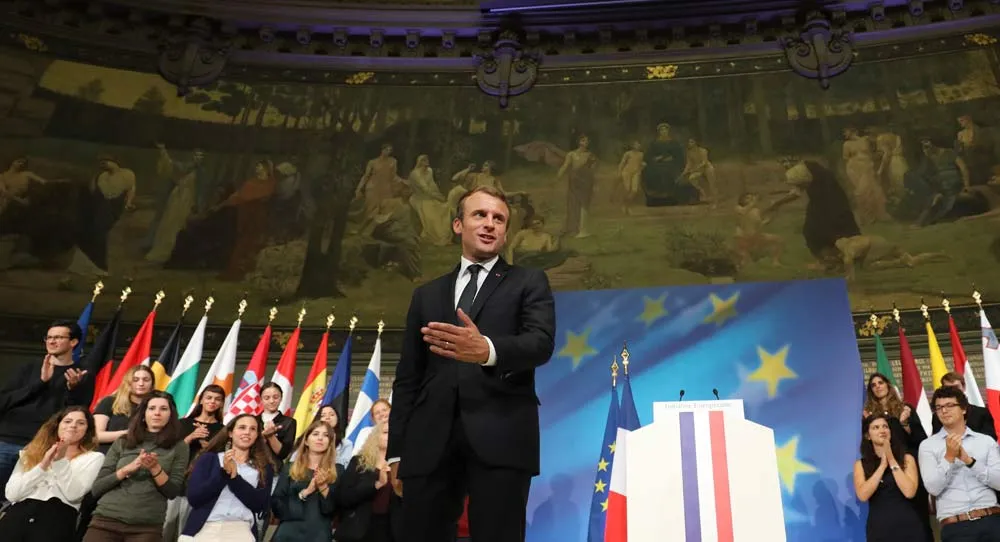
Dual stance issue gets further elaborated in relation to presidency of Emmanuel Macron. Within his speech held at Sorbonne University on September 26, 2017, Macron has advocated for creation of “European defense union.”
At the same time, Macron is resolute regarding maintaining French position within NATO as well as maintaining exclusivity of nuclear armaments that are being held by France. It should be pointed out that duality of foreign policy strategy conducted by France has existed throughout the period of Gaullism.
Doctrinal Foundations
The genesis of the problem being experienced today in France lies in the strategy espoused by President Charles de Gaulle. On 7th March 1966, De Gaulle wrote to President Lyndon B. Johnson notifying him of the French withdrawal from the military control structure of NATO.
In particular, De Gaulle wrote to Johnson saying, “I propose that France should restore fully in her own territory the exercise of her sovereignty, currently limited by the presence of allied military elements or by her air space constantly being used; cease to participate in any ‘integrated’ commands; and withdraw her armed forces from NATO.”
The message conveyed clearly shows that De Gaulle felt that it was impossible for France to maintain its sovereignty considering that she was under the command of an allied officer.
On the other hand, De Gaulle espoused the idea of “a Europe of Europeans”, which could provide for itself without having to rely on either the United States or the Soviet Union.
Read More: France to Boost Nuclear Arsenal, Invites European Allies into Deterrence
President François Mitterand is the creator of this doctrine in the post-Cold War period. One such doctrinal statement was the Saint-Malo Declaration published on 4 December 1998 between France and the UK. This doctrine asserted that “The Union must have the capacity for autonomous action, backed by credible military forces, the willingness to deploy them, and the readiness to use them, in order to respond to international crises.”
But at the same time, it stated that “the defense commitments of member states as defined in Article 5 of the Washington and Brussels Treaties must be maintained.” In simple terms, the doctrine can be stated as “defense autonomy of Europe alongside its commitment to NATO.”
These following presidents have adopted a similar doctrine, although their emphasis differs somewhat from each other. For instance, President Jacques Chirac supported the policy of the European Security and Defense Policy while also aiding France in returning to the command structure of NATO in 2009.
Similarly, President François Hollande also continued with the same policies concurrently. President Emmanuel Macron, who is currently serving his term as the President of France, has advocated for the strategic autonomy of Europe; however, he continues the same principle of Gaullism.
Institutional Positions
Institutions’ positions with respect to CSDP and NATO cooperation reflect a common tendency in selectively cooperating with international institutions. In such context, France is one of the most advanced countries advocating for the enhancement of CSDP since its introduction at the European Council of Cologne back in June 1999.
First, for example, French politicians have always been focused on the need to develop autonomous military troops within the scope of the EU that would not depend on the existence of NATO. Such position of France was clearly illustrated through its active participation in establishing Permanent Structured Cooperation (PESCO), as described in Council Decision (CFSP) 2017/2315 dated 11 December 2017.
Also, France has always demonstrated its willingness to be actively involved into activities conducted within the framework of the European Defense Fund introduced according to Regulation (EU) 2021/697 of the European Parliament and of the Council. The main idea behind EDF is providing funding for joint researches aimed at fostering competitive environment within the European defense market. Apart from other companies, France has greatly benefited from the financial opportunities provided by EDF.
Read More: Macron to Outline France’s Nuclear Policy as Europe Questions US Deterrence
Conversely, France maintains a strong support for the Alliance as the pillar of collective security. In particular, the return of France back to NATO command in 2009 under President Nicolas Sarkozy was seen as a reasonable decision through which France will be able to get more influence in NATO.
After that, France joined NATO’s military operations and became one of the key members contributing to the Alliance’s deterrence policy towards eastern flanks amid the full-scale attack carried out by Russia against Ukraine in February 2022. While stressing that “NATO is the backbone of the collective defense of its members,” France also emphasizes the importance of enhancing the autonomous power of Europe.
This two-sided policy regarding the engagement with two institutions can contradict the interests of other members of the alliance. Namely, many Central and Eastern European member states of the alliance see concerns that the strengthening of Europe’s strategic autonomy could weaken NATO precisely at the time when it is needed.
On the contrary, France argues that the establishment of a strong pillar of defense in Europe would be the way to reinforce NATO as a union with strong allies.
Macron’s Initiatives and their Limits
President Emmanuel Macron is the one who has taken more steps compared to other presidents before him in order to realize strategic autonomy for Europe. Addressing a lecture at the Sorbonne University in September 26, 2017, he proposed forming a “defense union of Europe” through a number of proposals.
He said that, “We need to make sure that Europe has a joint intervention force, joint defense budget and joint doctrine of action.” In addition to that, he highlighted that there was a great need for forming the European Defense Fund and Permanent Structured Cooperation, which would further be complemented with an intervention proposal.”
Such policies were later complemented by very ambitious language about the question of sovereignty in Europe. However, while all this was happening, there appeared several serious restrictions in terms of the readiness of Macron to Europeanize French defense policies.
Specifically, referring to his speech on the issue of nuclear deterrence delivered at the École de Guerre on 7 February 2020, Macron stated that “French vital interests have a European dimension” and proposed a discussion about the place of French nuclear deterrence in the context of collective security through a strategic dialogue.
Speaking about conducting the exercise to enforce deterrence policy, Macron promised that France would invite other countries, willing to do so, to join it in such an exercise with France. However, at the same time, Macron stated that French nuclear deterrence forces will operate only nationally.
Contrast of Macron’s optimism about Europe’s strategic autonomy and its stance on retaining national control of nuclear arms suggests the structural nature of the French predicament. Despite the French eagerness to contribute to various initiatives related to European security when it comes to the conventional part of their military arsenal, they have drawn their “red lines” with respect to nuclear deterrence.
The inconsistency of the French policy brings to question the possibility of developing Europe’s strategic autonomy in view of the fact that the strongest means available for Europeans is beyond their control.
Tensions with European Partners
There have been a number of disputes between France and other European allies because of the ideologies and organizations which France follows. The basic reason for such disputes lies in the fact that all these nations find NATO as their sole means of protection against any attacks from the Russian government.
These nations were inducted into NATO as well as into the European Union after the fall of the communist governments, which existed at that time. These nations have been highly loyal towards the US for their security under NATO.
In particular, it emerged as an especially serious issue in 2017 amidst debates about PESCO. On the one hand, France pushed for implementing even a more aggressive strategy, which presupposes very high degrees of involvement from member states.
On the other hand, there was a cluster of states from Eastern Europe, calling for implementing a more flexible strategy that provides for involvement of more states into this process. Polish and Baltic officials were concerned that Europe might be divided into two different types in terms of speed due to the fact that the states feeling threatened by Russian aggression would not be able to exhibit great ambitions.
At the same time, the place of Germany in the process needs to be mentioned as well. Although being the key advocate of enhancing Europe’s defensive capabilities, Germany has demonstrated its uncertainty concerning the issues related to adopting some position concerning either NATO or the USA.
It needs to be acknowledged that considering the characteristics of German strategic culture that stem from its experience after the WWII period and willingness to find common grounds in decision-making processes, such a strategy could hardly match the selective approach taken by France. In other words, concerning their negotiations on PESCO, Germany preferred broader criteria while France insisted on stricter criteria.
Read More: France Must Not Appear ‘Weak’ Against Russia: Macron
Another example of differences between French and German strategic culture can be considered their negotiations concerning the way European strategic autonomy would appear in the future and cooperation of these two nations in this respect. The reason is that while Germany strives to establish a strong partnership with the USA, France prefers to develop Europe independently.
In their turn, these contradictions led to difficulties in developing a consistent policy regarding security in Europe. Despite the implementation of such measures as PESCO and European Defense Fund, their functioning suffered from contradictions connected with interests of individual countries, threat assessment, and strategic culture.
The selective stance of France concerning the question of cooperation of NATO and EU in terms of their defense systems can be explained by the specifics of the country, which attempts to take the leading role globally and in relation to its nuclear potential.
The issue of French attitude towards these two alliances could be considered in regard to France’s history and its strategic culture. Thanks to Gaullist-Mitterandist heritage, France managed to develop such strategy which enabled it to maintain its sovereignty and to play the role of the leader among other countries both in Europe and internationally.
In other words, the solution of this strategic dilemma implies selective approach of the country which provoked numerous conflicts with other member states of the EU.
Despite the fact that Macron places special emphasis on the issue of the strategic autonomy of Europe more than any other previous presidents, there have not been any alterations in relation to the fundamental concepts of French policy of independence, including, in the first place, the concept of an exclusive right for the state to have its nuclear arsenal under the state’s sole control.
Considering the fact that the current policy of the French government has not changed, it becomes clear that this dilemma of the state is caused by some other reasons.
The relevance of this problem can be justified by the fact that the security situation in Europe becomes worse; therefore, this problem is important because it will play a crucial role in the future European security system.
*The views presented in this article are the authors’ own and do not necessarily reflect the views of The Diplomatic Insight.

Atuf Guliyev
Atuf Guliyev is an international relations specialist with extensive interest in diplomacy, global affairs, and humanitarian project management. He is a student of Diplomacy and Global Governance at the Brussels School of Governance (Vesalius College, Vrije Universiteit Brussel) and is currently preparing a doctoral research proposal on the selective Europeanisation of French foreign policy since 2010 and its implications for European strategic autonomy. His research focuses on French foreign policy, EU Common Security and Defense Policy (CSDP), norm entrepreneurship in European crisis management, and the intersection of security and humanitarian policy in the Mediterranean and Sahel regions. He can be reached at [email protected]