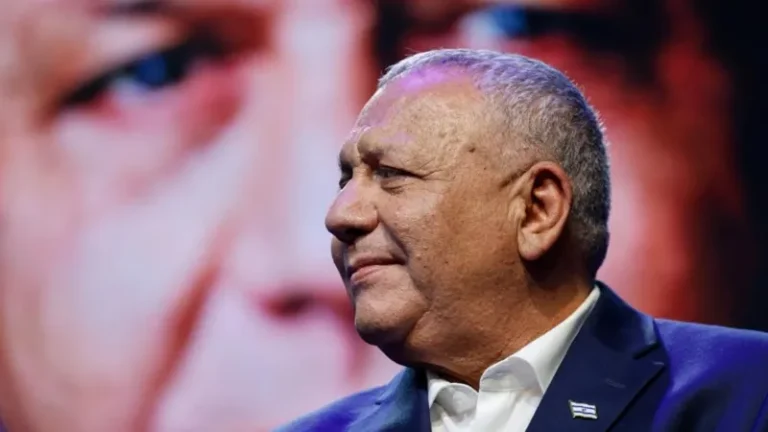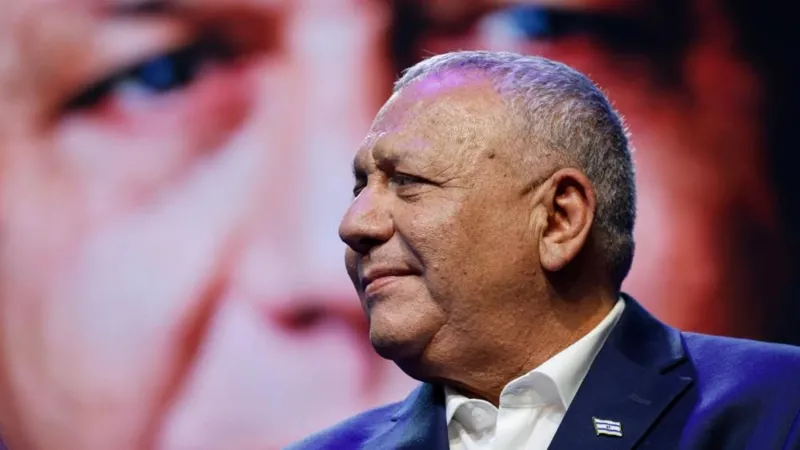
Tel Aviv (TDI): Former Israeli military chief Gadi Eisenkot on Sunday began efforts to form a new government, warning that Israel was facing a historic diplomatic and political crisis under outgoing Prime Minister Benjamin Netanyahu.
Eisenkot, 66, formally received a mandate from President Isaac Herzog, giving him 28 days to assemble a governing coalition, despite his political bloc lacking a clear parliamentary majority.
Speaking at the presidential residence, Eisenkot described the situation as an emergency and warned that Israel was approaching a critical point. “We are in a state of emergency, approaching a point of no return for the State of Israel,” he said.
He also pointed to Israel’s growing international isolation, saying even its closest allies were reconsidering their relations with the country. “We are in the midst of a devastating diplomatic crisis. Even our closest friends and strategic allies are saying their relationship with Israel must be reassessed,” Eisenkot said.
Calling for a national emergency government, he said the country needed new leadership capable of addressing its internal divisions and mounting external challenges. “There is great urgency for new leadership, leadership that people can look in the eye and trust,” he added.
Eisenkot has reached out to Netanyahu’s Likud Party and the far-right party led by Finance Minister Bezalel Smotrich, inviting them to join a coalition under his leadership. “My door is open and my hand is extended, wholeheartedly and willingly, to anyone who understands the gravity of this moment,” he said.
Read More: Ballots & Bombs
However, Netanyahu has not indicated whether he would accept a government led by Eisenkot. He has instead called for a unity government comprising Zionist parties, describing it as necessary to preserve Israel as a Jewish state. Netanyahu also ruled out a coalition with Arab parties, which represent a significant segment of Israel’s population.
President Herzog highlighted several challenges facing the incoming government, including tensions with Iran, the future of Gaza, negotiations with Lebanon and other regional neighbours, and Israel’s diplomatic difficulties.
He also referred to the need to advance the 20-point agreement concerning Gaza and address political challenges arising from recent developments in the United States.
The United States, Israel’s most important ally, has also seen growing political debate over its relationship with Israel. Democrats made significant gains in the November 3 midterm elections, campaigning in part on calls to reconsider US support for Israel amid the destruction in Gaza and the Iran war.
Eisenkot faces several possible routes to securing a parliamentary majority, but each presents significant political obstacles. One option is to form a minority government with outside support from Arab-Israeli parties. Another involves reaching an agreement with ultra-Orthodox parties, which Eisenkot and his allies have previously opposed. A third possibility is a national unity arrangement with Netanyahu’s Likud.
Eisenkot has indicated that he could initially pursue a minority government, relying on support from Arab parties on key parliamentary votes while seeking to expand his coalition.
He said he would invite parties that accept his core principles, including recognition of Israel as a Jewish and democratic state, mandatory national service to strengthen the military, and a commitment to dismantling Hamas’s military and governing capabilities.
Read More: Netanyahu’s Quiet Visit: Abu Dhabi’s Delicate Dance Between Israel and Iran?
“I am convinced that it is possible and right to form a new government quickly, one that will win a large majority in the Knesset,” he said. Eisenkot has 28 days to complete the process, with a possible 14-day extension. If he fails, Netanyahu could receive another opportunity to form a government. Failure by both candidates could lead to fresh elections.