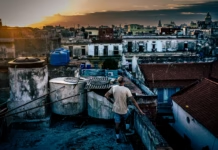
On this Independence Day of Cuba, let us take a look back at how the Cuban Missile Crisis exposed the weakness of the newly formed state, whose destiny was determined not in Havana, but by the will of global superpowers. Cuba is a country whose rich identity is built on a diverse mix of Caucasian descendants of Spanish settlers, Black descendants of African slaves and Chinese workers.
Yet, its modern history is a story of compromised sovereignty leading to an existential crisis. The path from the struggle for independence to the brink of nuclear war, culminating in the Cuban Missile Crisis, illustrates how a newly independent nation was forced to bend to the will of global superpowers, permanently reshaping its destiny.
Cuba’s long fight for self-determination began with the Ten Years War 1868–1878 and was reignited by the Cuban War of Independence in 1895. The war against Spain was finally concluded by the US intervention in 1898. Though the Republic of Cuba was established in 1902, its independence was never complete. The US imposed the Platt Amendment, which fundamentally limited Cuban sovereignty by granting the US the explicit right to intervene to maintain order and requiring the leasing of naval stations.
This lack of true self-rule bred decades of political instability and corruption under presidents and dictators alike, including figures like Gerardo Machado. This compromised foundation set the stage for later conflict, proving that external influence would determine Cuba’s stability.
The Shift in Allegiance
The instability peaked with the dictatorship of Fulgencio Batista, who ruled intermittently until 1959. Growing popular dissent, exacerbated by a crucial US decision to curtail Cuban sugar imports hurting the core of the economy and fueled the revolutionary uprising. Led by Fidel Castro the 26th of July Movement, the Cuban Revolution gained strength through a guerrilla campaign from the Sierra Maestra mountains, with the decisive loss of cities like Santa Clara forcing Batista to flee in January 1959.
The new revolutionary government quickly adopted radical policies, most notably the expropriation of US assets through agrarian reform, which caused a rapid breakdown in relations. Following the US severing diplomatic ties in 1961 and backing the failed Bay of Pigs invasion, Castro secured a critical new patron: the Soviet Union. This alliance, sealed by a trade pact and public endorsement of Premier Nikita Khrushchev, immediately transformed Cuba from a politically dependent nation in the US sphere to a strategic proxy for a rival superpower.
Read More: Revisiting 6 Decades of Life in Cuba on the Day Against Unilateral Coercive Measures
Cuban Missile Crisis: The Ultimate Exposure of Weakness
Cuba’s alignment directly led to the Cuban Missile Crisis in October 1962. Khrushchev, seeking to deter any further US invasion following the Bay of Pigs, secretly agreed with Castro to place Soviet, Medium and intermediate-range ballistic missiles (MRBMs and IRBMs), in Cuba. The discovery of these sites by a US surveillance flight instantly escalated the situation to a global confrontation. President Kennedy’s response, a naval quarantine and a clear threat of full retaliatory response against the Soviet Union, pushed the world to the highest state of military readiness.
This crisis became the ultimate expression of Cuba’s vulnerability. The final resolution was not secured by Cuban diplomacy but was a deal brokered exclusively between Washington and Moscow: the Soviets removed the missiles in exchange for a public US pledge not to invade Cuba, along with removing its own missiles from Turkey. This negotiation, conducted entirely over the head of the Cuban government, revealed the weakness of the newly formed state, demonstrating that its security and fate were merely bargaining chips in the Cold War dynamic.
A Permanently Altered Trajectory
The outcome of the Cuban Missile Crisis permanently dictated Cuba’s relationship with the rest of the world. The US non-invasion guarantee was conditioned on Cuba’s loyalty to the Soviet bloc, instantly locking the nation into a decades-long trajectory of hostility toward the United States. This forced alliance meant Cuba became dependent on the Soviet Union for economic support, military protection and ideological direction for the next thirty years.
Furthermore, while the crisis ensured Cuba’s permanent isolation from the West, it also ironically became the catalyst for a slight de-escalation of superpower tensions, as the near-catastrophe compelled the US and the USSR to install the “Hotline” and begin working toward the Nuclear Test Ban Treaty. Thus, Cuba, a nation compromised from its birth, was forced to assume a destiny of an isolated state and becoming the world’s most dangerous nuclear flashpoint.