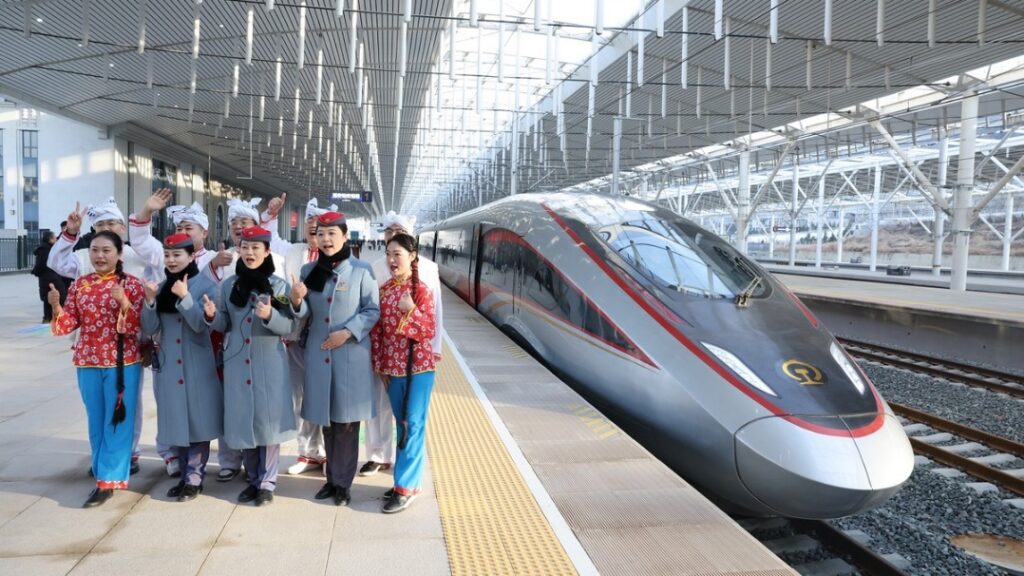
China opened four high-speed railway lines on Monday, adding more than 1,100 kilometers of track. The lines span the country’s northern, northwestern, central and northeastern regions and extend fast rail service to smaller cities and counties.
The longest is the 552-km Xiong’an-Shangqiu line. It links Xiong’an New Area in Hebei province, south of Beijing, with Shangqiu in Henan province via Shandong.
Trains run at up to 350 km/h, and the fastest end-to-end trip takes 2 hours and 27 minutes. Several counties and smaller cities along the route gain high-speed service for the first time.
With connecting railways, the line also links Beijing with Hefei and Huangshan in Anhui province, and Xiong’an with Shanghai.
It forms part of the Beijing-Hong Kong high-speed corridor, which is partly in service, with other sections still under construction or planned.
Read More: China Trains Two Pakistani Astronauts for Historic Tiangong Mission
In the northeast, the 318-km Harbin-Yichun line in Heilongjiang becomes China’s northernmost high-speed railway. Trains run at up to 250 km/h, and the fastest Harbin-Yichun trip takes 1 hour and 46 minutes.
The line brings Suihua and Yichun into the national high-speed network. Yichun West station, at its northern end, is the country’s northernmost high-speed station. Winter temperatures in the region can fall to minus 40 C, which left construction crews a short working season each year.
In the northwest, the 171-km Xi’an-Ankang line crosses the Qinling Mountains to bring southern Shaanxi closer to the provincial capital. The fastest Xi’an East-Ankang West journey takes 45 minutes.
Ankang and the counties of Zhashui and Zhen’an get high-speed service for the first time. The line is part of the Xi’an-Chongqing high-speed railway, whose Ankang-Chongqing section is still under construction.
Read More: AU Envoy to China Proposed 5-Point Digital Trade Pact at Hangzhou Expo
In central China, the 101-km Yichang-Xingshan line in Hubei is the shortest of the four. By connecting two high-speed corridors, it gives some Wuhan-Chongqing trains a faster route and cuts the fastest journey from 4 hours 56 minutes to 3 hours 54 minutes.
Environmental protection featured in the Xiong’an-Shangqiu project. Li Yongqing, its chief engineer at China Railway Design Corporation, said the route passes through nine ecologically sensitive areas and was realigned to avoid core protected zones. Bridges were chosen to limit disruption to existing roads and railways.
At Hengshui Lake, fully enclosed noise barriers reduce noise, block light and keep objects from falling, helping protect bird habitats.
The openings add to the world’s largest high-speed rail network, which passed 50,000 km in December 2025 and grew by nearly a third between 2021 and 2025. China Railway says it plans to expand the network to about 60,000 km by 2030.