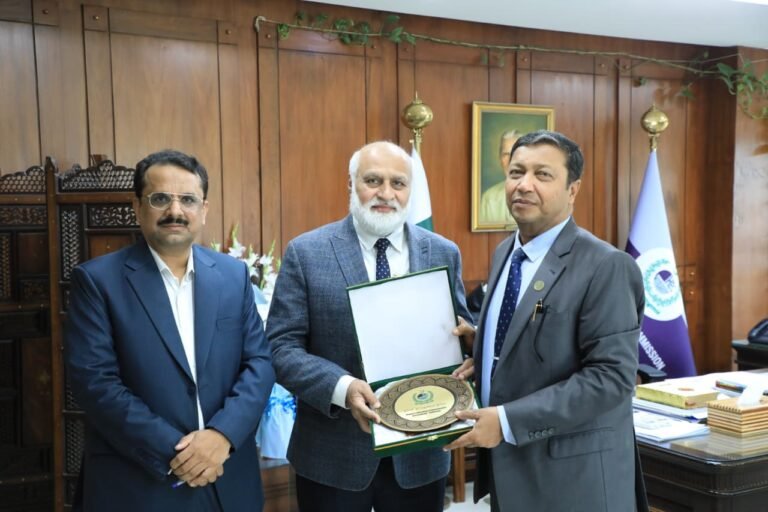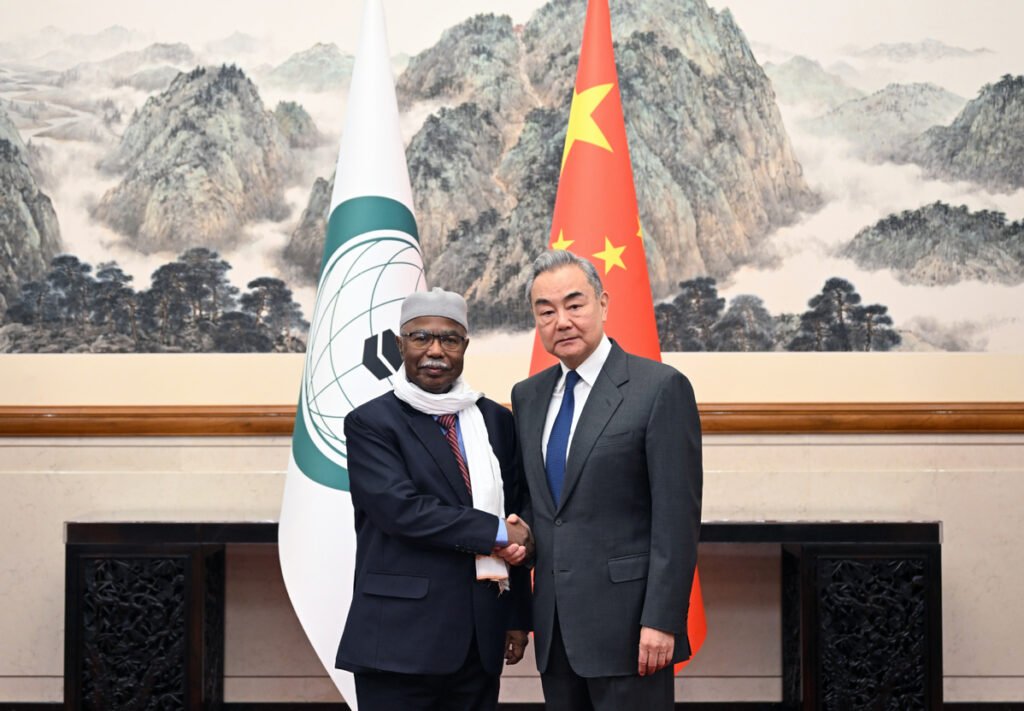
China’s vice president and foreign minister met in Beijing with Hissein Brahim Taha, the Chadian Secretary-General of the Organization of Islamic Cooperation (OIC), on Monday.
The OIC, while rarely in international news, is the world’s second-largest intergovernmental organization after the UN, representing a 57-nation bloc of mostly Muslim-majority countries.
Established in 1969 in Morocco to promote cooperation and shared values within the Muslim world, it is now headquartered in Jeddah, Saudi Arabia. China’s outreach signals a deepening interest and role in Middle East diplomacy.
The talks come amid heightened regional tensions. Following U.S. President Donald Trump’s declaration that an “armada” that includes an aircraft carrier and missile-equipped destroyers had arrived in the waters near Iran amid unrest and escalating tensions, Iranian officials warned that any attack would be treated as “an all-out war.”
Against this backdrop, China emphasized building a regional security partnership and advancing political solutions to ongoing conflicts, according to Beijing’s foreign ministry. China is Iran’s largest trading partner and primary purchaser of Iranian oil, a relationship that allows the Islamic Republic to receive an influx of cash and circumvent international sanctions.
Read More: Iran’s Turn Toward China and BRI Under US Sanctions
While Beijing would be unlikely to support Iran militarily if the crisis escalates, it seeks to preserve its mutually beneficial trade relationship, shaped in part by shared anti-Western interests.
During the meeting, Chinese officials highlighted a broad vision for cooperation with the OIC. Foreign Minister Wang Yi proposed four types of partnership:
- development, to align strategies
- security, to uphold peace in the Middle East
- civilization, to reject the notion of one culture’s superiority
- governance, to promote a more just global system.
Both sides reaffirmed support on core Chinese issues, including Xinjiang and Taiwan, and discussed the Palestinian question, with Taha praising China’s role in promoting fairness and stability.
China’s engagement with the OIC is significant for several reasons. It reflects Beijing’s strategy to position itself as a diplomatic alternative to Washington in global hot spots. It safeguards China’s economic and energy interests, as many OIC members are key suppliers of oil and gas, which China lacks domestically.
And it underscores China’s growing role in conflict mediation and multilateral diplomacy, contrasting with the increasingly unilateral approaches of other great powers.
While the OIC is a diverse bloc with often divergent interests, the talks signal China’s intent to cultivate strategic partnerships with the Islamic world. As the United States uses military might to pressure Iran, China is working behind the scenes through multiple channels to preserve its trade and financial relationships.