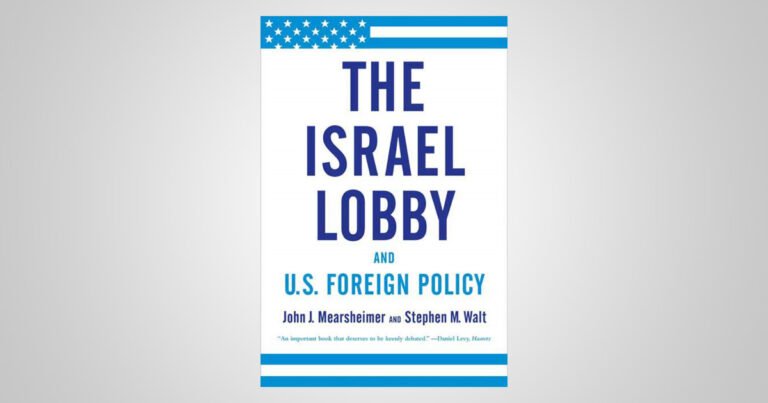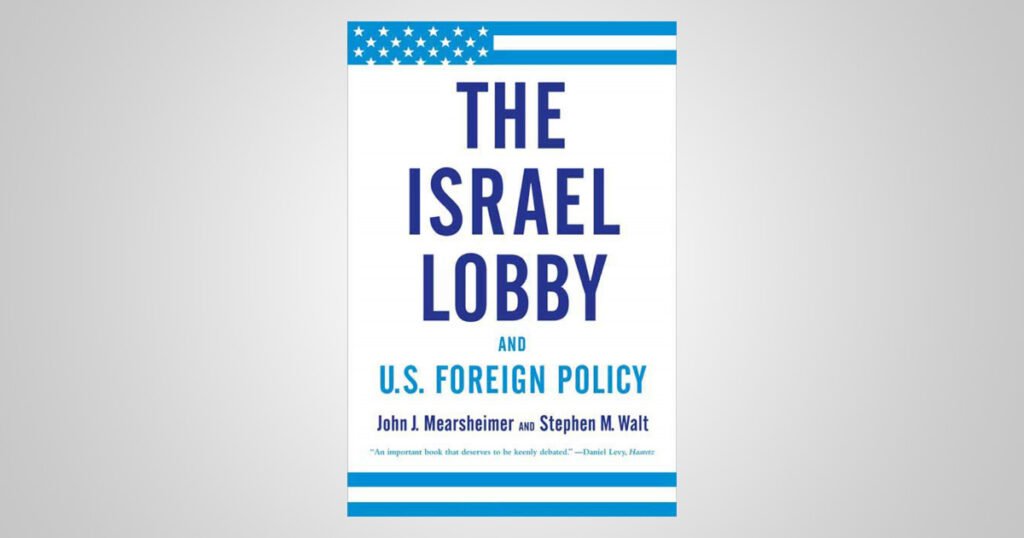
The book titled, ‘The Israel Lobby and U.S. Foreign Policy’ by John J. Mearsheimer and Stephen M. Walt is a remarkable work in academic literature. Written by two prominent scholars linked with the realist group of thought, the book, analyzes how pro-Israel lobbying networks in the U.S. influence Washington’s foreign policies. Published in 2007, the book is split into two broad sections.
The first section discusses the origin of the U.S. -Israel relations and the existence of Israeli lobby in U.S. foreign policy framework; while second section focuses on functionality of Israeli lobby and its overarching impact in the Middle East. Nearly two decades later—especially amid escalating conflict involving Israel, Iran, and the U.S.—the book’s fundamental arguments stay relevant and continue to be the source of intense debate between academia, media, and policy makers.
John Mearsheimer, a prominent realist theorist at the University of Chicago, and Stephen Walt, a leading scholar from Harvard University, examined the topic through the lens of structural realism. Realist group of thought argues that states pursue policies in accordance with national interests in an anarchic international order with no centerline authority.
The authors initiate the argument with a question: why does the U.S. provide Israel with overwhelming diplomatic, military, and economic support even when some policies appear to collide with divergent American strategic interests? To respond to this question, authors put emphasis on ‘Israeli Lobby’ – an umbrella term to represent a coalition of organizations, think-tanks, media groups, and influential individuals, who work in synergy to keep Washington’s foreign policy aligned with respect to Israel interest.
According to the authors, the lobby functions overtly within the democratic political system of the country rather than secret organizations. Its activities include lobbying the U.S. Congress, organizing policy-related events, running media campaigns, funding research institutions, and mobilizing voters and donors to shape public opinion and pressurize the U.S. governmental apparatus.
Read More: Biden’s Support for Israel: Strategic Stance and Political Impact
The central argument of the book is that the close bonding between Washington and Tel Aviv cannot be fully elaborated by shared democratic values or strategic necessity. Instead, the authors claim that domestic political pressures—especially the influence of pro-Israel lobbying groups—play a defining role in molding U.S. foreign policy framework.
The book highlights several mechanisms through which this influence operates including: political lobbying and campaign financing to motivate legislators to follow pro-Israel approach; influencing public discourse; and shaping foreign policy agendas particularly regarding conflicts involving Israel and its regional rivals.
As per Mearsheimer and Walt, these mechanisms allow formulation of a political environment in which condemning or even criticizing Israeli hostile actions become politically too costly for U.S. policymakers. As a result, White House pursues policies which pre-dominantly support Israel’s interests rather than regulations of rule-based-order.
One of the book’s most interesting assertions is that unconditional U.S. assistance for Israel sometimes even undermines its own strategic interests. The authors aptly highlight that this support has significantly contributed to rise of anti-American sentiment across the Globe particularly within Muslim majority states leading to complication of U.S. diplomatic relations with key regional powers.
The book also develops linkages between Israel-led lobbying and U.S. involvement in various regional conflicts in the Middle East. The authors emphasize that pro-Israel advocacy played a centerline role in adding assertiveness in U.S. policy towards the Palestinian issue as well as other Middle Eastern nations including Lebanon, Syria and Iran.
According to the book, the Israeli lobbying crafted the political environment that facilitated the U.S. decision to invade Iraq in 2003 under a false pretext of neutralizing Weapons of Mass Destruction. This decision removed Saddam Hussain from Israel’s path but also gravely destabilized the entire Middle East for decades – a situation which benefited Tel Aviv interests only.
In addition, Washington’s persistent support to augment Israel’s military capacity by supplying high-end combat systems without putting regional balance of power into much consideration is another indicator that Washington’s policy continues to reflect strong alignment with Israeli security concerns.
Read More: Iran War Started on Israel Pressure, US Counterterrorism Director Resigns
Despite its significant contribution in exploring a highly sensitive topic, the book has faced intense criticism – ironically primarily from pro-Israel segments. Critics claim that the authors have exaggerated the influence of the Israeli lobby and overlooked other important drivers of U.S. policy, such as energy security, counterterrorism concerns, and broader strategic interests in maintaining regional stability.
Others also contend that the authors’ have oversimplified the complex process of foreign policy formation in Washington. Some commentators have even blamed the authors of reviving controversial narratives about Jewish political power.
Despite all criticism, ‘The Israel Lobby and U.S. Foreign Policy’ remains significant for several reasons. First, the book challenges conventional explanations of U.S.–Israel relations by highlighting the role of domestic political dynamics in shaping foreign policy.
Second, it provides a detailed account of lobbying mechanisms and the ways interest groups influence democratic policymaking. Third, the authors attempt to evaluate U.S. policy from a realist perspective, asking whether the strategic costs of unconditional support outweigh its benefits.
But perhaps the most important aspect is the validity of the main thesis of the book which has been proven by recent geo-strategic transformations in the Middle East. Although the book was written in 2007, the authors predicted that growing pressure from the Israeli lobby would push the U.S. towards confrontation with Iran – particularly if Tehran’s nuclear ambitions were regarded as an existential threat to Israel’s security.
U.S. direct involvement in the 2025 Iran-Israel war in the form of ‘Operation Mid-Night Hammer’ which resulted in precision targeting of Iran’s nuclear enrichment facilities by U.S. stealth bombers is the first illustration in this regard. Similarly, current U.S. and Israel conflict with Iran, characterized by missile strikes, aerial bombardments, drone attacks, and proxy operations to target political leadership, military assets, nuclear facilities, and civilian infrastructure, reaffirm the relevancy and authenticity of book’s central argument.
In nutshell, the book’s core question remains highly relevant: to what extent do domestic political forces shape the foreign policy decisions of great powers? Whether one agrees with the authors or not, the work stands as a significant scholarly contribution which is highly recommended for academia, policy-makers, strategic analysts, and practitioners.

Ahmad Ibrahim
Ahmad Ibrahim is a Research Associate at Maritime Centre of Excellence, Pakistan Navy War College, Lahore.