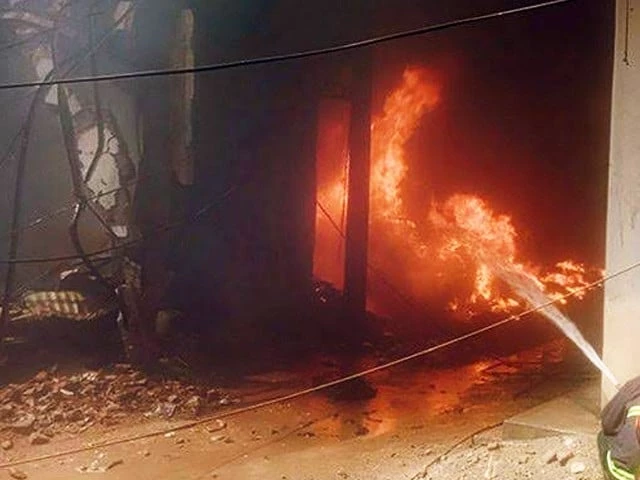
Artificial intelligence is quietly revolutionizing warfare, and far faster than global norms can adapt. Take Gaza, for example, from where reports reveal that Israeli forces are already using AI algorithms to sift intelligence and suggest strike targets.
One former IDF analyst noted that “a team of around 20 intelligence officers” once needed “250 days” to select 200-250 targets, whereas AI can now do “that in a week.” Experts warn that this unprecedented tempo is establishing dangerous new norms of war unless checked. The message is clear: machines are making life-and-death decisions today, yet no international body has firm rules to control them.
The problem is that our old arms control frameworks were built for bombs and missiles, not for algorithms. Autonomous weapons systems that, once activated, can identify and engage targets without human intervention raise novel risks. The Red Cross cautions that losing human judgment in this loop “raises profound humanitarian, legal and ethical concerns” and that AWS “raise challenges for compliance with international law.”
In practice, today’s AI-enabled drones struggle to distinguish combatants from civilians in dense urban fighting. They can make targeting mistakes invisible to operators, creating an “accountability void,” as one analysis puts it. Unlike nuclear or chemical weapons, which have long, detailed treaties, fully autonomous weapons have none. As a result, programmers, manufacturers, and commanders all share blurred responsibility when an AI system commits a war crime.
Read More: Geopolitics of Artificial Intelligence: How Countries Are Competing for AI Dominance
Some proponents insist AI will make war more precise. The US Undersecretary for Arms Control has argued that military AI “will increase accuracy and precision in the use of force,” potentially strengthening humanitarian protections. Yet this rosy view depends on ideal conditions. In reality, current AI tools in Gaza and Ukraine have already revealed their limits: they flag targets quickly, but often make errors. (One evaluation found roughly a 10% error rate in AI-suggested strikes.)
In the fog of conflict, even “smarter” weapons can kill innocents without warning. Not surprisingly, analysts warn that voluntary norms alone are insufficient. As the Hamburg-based GIGA Institute bluntly concludes: “States must negotiate binding prohibitions on unpredictable AWS… Existing voluntary measures… are clearly insufficient”. Without hard law, it warns that proliferating autonomous systems will “entrench systems incapable of complying with the laws of war”.
The costs of delay are high. Autonomous weapons can be extremely cheap and easy to mass-produce, spreading to non-state actors and rogue regimes. A Brookings study notes that rapid AI progress may soon allow “small, inexpensive drones” to locate, track, and strike targets on their own, all while eluding air defenses. In other words, terrorists or militias could deploy swarms of lethal robots without a pilot.
The same analysis warns that AI could also be used by adversaries to devise blitzkrieg-like swarms of autonomous attackers, potentially overwhelming defenses. In such a future, even small border incidents could instantaneously snowball into major crises before humans can react.
Contrary to these risks, some countries still cling to outdated thinking. India, for example, has emphasized only a “responsible use” of AI under existing international law and avoids outright bans. Islamabad, by contrast, has been a vocal advocate for new rules. Pakistan was the first country to call for a ban on fully autonomous weapons back in 2013, and it continues to push for a binding treaty.
Pakistani diplomats remind the UN that AWS are “perhaps the defining concern on the international arms control agenda” and urge states to commit to “a legally binding instrument stipulating appropriate prohibitions and restrictions” on such weapons. In fact, Islamabad voted in favor of recent UN resolutions calling on the Convention on Certain Conventional Weapons (CCW) to draft a protocol on AWS.
Both India and Pakistan agree on one fundamental point: humans, not machines, must retain control over any nuclear weapons. That emerging norm that nuclear launch authority will always rest with a person could provide a bridge for wider arms control efforts in the region. So what can be done? The answer is a mix of global action and regional confidence-building:
Negotiate a binding global treaty. States should resume and redouble talks at the UN’s CCW forum to draft new rules for autonomous weapons. Many governments, from Canada and Germany to Pakistan and Sierra Leone, now support “prohibitions and regulations” on killer robots. In 2023 the CCW extended its expert group’s mandate to 2026 to build consensus on an instrument.
This process should be accelerated so that by 2026 the end of the current mandate, a clear protocol exists. Such a treaty could ban the most dangerous AI systems that are unable to meet basic humanitarian standards and strictly regulate others under a “two-tier” approach.
Clarify and update the laws of war. Even while talks proceed, governments and international bodies should spell out what existing law already requires. The ICRC and experts urge states to codify the concept of “meaningful human control.” This could take the form of a UN General Assembly resolution or joint political declaration clarifying that all uses of force must remain under human judgment.
Militaries should integrate these principles into their rules of engagement and weapon review boards. For example, explicit standards could be set for how much human oversight is required before an AI weapon is fielded. Technical standards such as reliability tests and safety audits could help ensure weapons behave predictably on the battlefield.
Strengthen export and development controls. Governments should limit the spread of sensitive AI weapons tech. Just as 19th-century powers tried and often failed to control poison gas or submarines, modern arms regulators must grapple with dual-use AI. However, unlike nukes, AI relies on open software and commercial chips, making traditional verification hard.
To counter this, states could tighten export restrictions on key AI chips and weapons-grade autonomy software. They could also fund public scrutiny: think tanks and auditors could analyze open-source AI code for potential weaponization. Transparency measures, such as sharing information on AI military projects in confidence-building forums, can also reduce mistrust.
Adopt regional confidence-building steps. In tense regions like South Asia, practical bilateral moves can avert accidental wars. For instance, analysts propose that India and Pakistan publicly reaffirm that no launch authorization will ever be ceded to a machine. Both could also establish an “AI incident” hotline devoted to drone or automated-weapon events.
Read More: AI Warfare and South Asia’s Vanishing Margin for Error
In practice, this might mean rapid confirmation channels if one side detects an unidentified swarm or receives an AI-generated threat. Such arrangements akin to the “red telephone” of the Cold War would help defuse confusion during fast-paced conflicts. Importantly, they could be promoted as sensible military safeguards rather than adversarial concessions, making cooperation easier politically.
None of these ideas is fairy-tale idealism. History shows that even partial arms control can significantly reduce suffering. U.S.-Soviet treaties did not end nuclear weapons, but they did prevent even larger stockpiles. Likewise, agreements like the Chemical Weapons Convention are imperfect but save countless lives.
Crucially, one expert notes that “it may be easier, in some cases, to ban weapons that militaries have not yet integrated into their arsenals.” The time for that easier option is now. Autonomous weapons are on the cusp of becoming as ingrained in armies as rockets and jets. The longer we wait, the harder it will be to limit them.
Policymakers face a simple choice: regulate AI weapons today or risk an out-of-control arms race tomorrow. If the world truly values civilian protection and regional stability, it must treat autonomous weapons as a special case that demands urgent, internationally coordinated action. Otherwise, we will have allowed a runaway tech revolution to write the future of war unchecked.
*The views presented in this article are the author’s own and do not necessarily reflect the views of The Diplomatic Insight.*