Pakistan’s civil–military leadership has increasingly articulated a security narrative linking domestic terrorist violence to cross-border militancy originating from Afghan territory, and crucially, to segments of the Afghan diaspora residing within Pakistan. Director General Inter-Services Public Relations (ISPR), Lieutenant General Ahmed Sharif Chaudhry, has repeatedly stated that “illegal Afghan nationals are involved in acts of terrorism and serious criminal activity within Pakistan,” framing refugee populations as potential security threats rather than vulnerable humanitarian subjects.
In an interview with a European magazine, he emphasized that Pakistan hosted millions of Afghan refugees for over four decades due to foreign intervention and civil war in Afghanistan—conditions which, according to Islamabad, no longer justify large-scale refugee presence (ISPR, 2025). From a Critical Terrorism Studies (CTS) perspective, this discourse reflects the securitization of mobility and the transformation of humanitarian protection into a policing imperative.
Official narratives have reinforced these claims by attributing responsibility in high-profile attacks. Interior Minister Mohsin Naqvi confirmed that the suicide bombers involved in the Islamabad District Judicial Complex attack on 11 November 2025 were Afghan nationals. The bombing killed at least twelve individuals and injured more than thirty. Counterterrorism operations by the Rawalpindi-based Counter-Terrorism Department (CTD) led to seven arrests, including suspects in Rawalpindi’s Fauji Colony and Dhoke Kashmirian, and additional raids in Khyber Pakhtunkhwa (Dawn, 2025).
A separate vehicle-borne suicide attack occurred on 9 November 2025 at Cadet College, South Waziristan, near the Afghan border. Police reports indicate that two attackers were killed at the main gate, while three others managed to enter before being neutralized. These incidents are cited by Pakistani authorities as evidence that Afghan nationals and diaspora-linked networks play a central role in facilitating terrorism, including recruitment, sheltering, and logistical support.
As ISPR stated, “The movement of terrorists from Afghan territory into Pakistan underscores the continued use of Afghan soil as a launchpad for destabilizing activities” (ISPR, 2025).
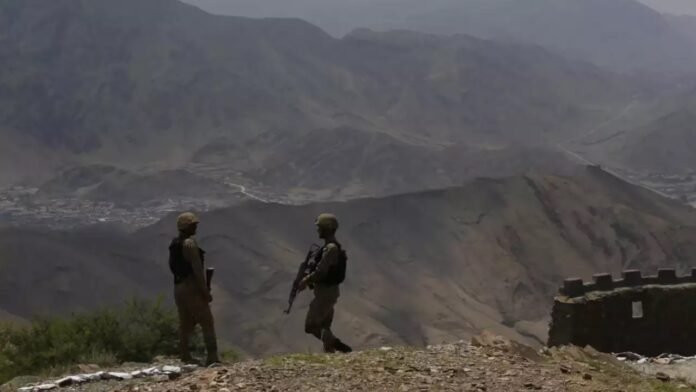
Tensions along the Pak–Afghan border have escalated in tandem with such attacks. In October 2025, Pakistan reported coordinated assaults by Afghan-based militant factions along the border. The military claimed to have repelled these attacks and destroyed infrastructure allegedly used to plan terrorist operations.
Read More: Terrorism in Afghanistan: Rising Jihadist Threats and Human Atrocities
Islamabad justified these actions under the doctrine of self-defense, asserting that measures were taken to minimize civilian casualties (DG ISPR Press Release, 2025). CTS scholars interpret this framing as a form of legitimizing violence, in which cross-border threat narratives are used to rationalize both domestic and extraterritorial military action.
Pakistan’s military leadership has further linked diaspora involvement to the circulation of advanced weaponry abandoned after the United States’ withdrawal from Afghanistan in 2021.
According to DG ISPR, these arms—including night-vision equipment, automatic rifles, and communication devices—have been used in terrorist attacks inside Pakistan, sometimes moving through informal cross-border networks that intersect with refugee routes (ISPR, 2025). Such claims reinforce perceptions of Afghan nationals not only as potential perpetrators but also as vectors for post-withdrawal instability.
In a further development, Pakistan repatriated the body of Muhammad Khan Ahmedkhel, an Afghan national killed during an intelligence-based operation in Zhob on 11 January 2025. The ISPR described this case as “irrefutable evidence” of Afghan involvement in terrorism within Pakistan and emphasized that Afghan authorities must prevent the use of their territory for attacks (ISPR, 2025). CTS perspectives highlight that such symbolic acts transform individual cases into collective proof, thereby legitimizing surveillance, restrictions, and deportations targeting Afghan populations.
Beyond Afghanistan, Pakistan’s security discourse increasingly situates Afghan-linked militancy within a regional threat framework. DG ISPR has accused India of sponsoring terrorist activities inside Pakistan, claiming that evidence implicating serving Indian military officers has been shared internationally. He also linked rising internal violence in India to extremist domestic policies, asserting that New Delhi “externalizes internal governance challenges” (ISPR, 2025). Kashmir remains central to Pakistan’s narrative, with officials calling for sustained international engagement while rejecting all non-state armed actors.
Domestically, the perceived threat environment has justified legal and institutional transformations. Following the attacks, Pakistan’s leadership declared the country in a “state of war,” and the 27th constitutional amendment was passed, expanding military authority and granting lifetime immunity to the army chief (Parliament of Pakistan, 2025). CTS frameworks interpret such measures as part of the deepening securitization of the state, where counterterrorism imperatives reshape constitutional norms and civil–military relations, particularly in contexts involving diasporic populations.
Read More: Terrorism’s Second Wind in Pakistan
In response to Pakistan’s repeated claims of Afghan nationals’ involvement in terrorism, the Afghan Taliban leadership, under Supreme Leader Mullah Hibatullah Akhundzada, has publicly urged Afghan citizens to refrain from carrying out attacks in neighboring Pakistan. According to reports, Akhundzada stated:
“Afghan nationals must not engage in acts of terrorism outside our borders. Those who break this directive will be considered violators of Afghan law and the principles of Islam” (Tolo News, 2025).
This statement represents an official attempt by the Taliban to distance the Afghan state apparatus from transnational militancy targeting Pakistan, signaling recognition of Islamabad’s security concerns. However, Pakistani authorities, including DG ISPR Lieutenant General Ahmed Sharif Chaudhry, have expressed skepticism about the practical enforcement of such directives, citing repeated incidents of cross-border attacks facilitated by militants allegedly using Afghan territory as a safe haven.
Pakistan’s official discourse frames terrorism as a transnational phenomenon rooted in Afghan instability and mediated through diasporic networks, while simultaneously invoking humanitarian credentials, legal sovereignty, and international norms. From a CTS lens, this narrative is less about empirical verification than about producing governable subjects, legitimizing coercive policies, and reshaping political authority.
Whether this securitized framing will facilitate meaningful regional cooperation or further entrench militarized governance, exclusionary policies, and suspicion toward refugee populations remains a critical question for scholars examining terrorism, migration, and state power in South Asia.
*The views presented in this article are the author’s own and do not necessarily reflect the views of The Diplomatic Insight.

Usman Anwar
Usman Anwar is a prospective M.Phil. scholar in Politics and International Relations. His research interests include security studies, maritime affairs, comparative politics, human rights, and climate change. His academic portfolio includes 7 published articles in reputable journals (Category Q-2 and Y) and a book review (Category Q-3). He can be reached at usmananwar2023@gmail.com