Mianyang (TDI): President Asif Ali Zardari on Sunday underscored Pakistan’s commitment to further deepening defense and strategic cooperation with China, during a visit to one of the country’s leading aviation complexes and a first-hand experience of its world-class high-speed rail system.
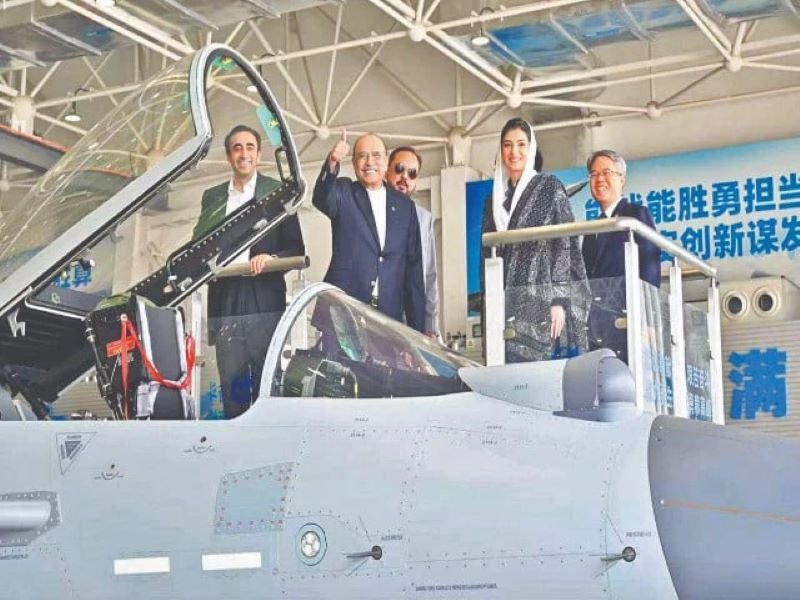
As Supreme Commander of Pakistan’s Armed Forces, the president toured the Aviation Industry Corporation of China (AVIC), becoming the first foreign head of state ever to do so. He hailed the visit as a milestone in Pakistan-China defense collaboration and reaffirmed Islamabad’s resolve to expand joint work in defense production and aviation.
Zardari was briefed on AVIC’s advanced capabilities, including the J-10C fighter jet, co-production of the JF-17 Thunder, progress on the J-20 stealth aircraft, and the latest unmanned aerial vehicles and integrated command-and-control systems. He praised AVIC as a symbol of China’s technological progress and a pillar of the “all-weather” partnership between the two countries.
Read More: President Zardari Visits Memorial of CPC’s First National Congress in Shanghai
The president also highlighted the contribution of the J-10 and JF-17 fighter jets in strengthening Pakistan’s Air Force, particularly during the recent “Marka-e-Haq” and “Operation Bunyanum Marsoos.”
Earlier in the day, Zardari travelled from Chengdu to Mianyang aboard a high-speed train, completing the journey in just 30 minutes. He was briefed on the system’s operations, safety, and environmental benefits. With more than 45,000 kilometers of track and 2 billion passengers annually, China operates the world’s largest high-speed rail network, with trains reaching 350 km/h.
Read More: President Zardari Highlights Role of Culture in Pakistan-China Friendship
The president lauded China’s advances in sustainable transport, citing electric propulsion and earthquake warning technologies as global benchmarks in railway engineering. He noted that Pakistan could draw valuable lessons from such innovations.
Zardari arrived in Shanghai later in the evening, where he was warmly received by senior Chinese officials.
Pakistan and China established diplomatic ties in 1950, which have since evolved into an “all-weather strategic cooperative partnership.” With bilateral trade exceeding $23 billion in 2024 and China serving as Pakistan’s largest defense supplier, advancing the $64 billion China-Pakistan Economic Corridor (CPEC) remains a central theme of the president’s 10-day visit.
The president was accompanied by PPP Chairman Bilawal Bhutto Zardari, First Lady Aseefa Bhutto Zardari, Senator Saleem Mandviwalla, and the ambassadors of both countries.