The current unstable situation in global geopolitics, disruptions and problems arising in transport and logistics systems, have a direct impact on trade relations between states, as well as on the stability of national economies and the standard of living of the population. In such conditions, the strategically rational organisation of the country’s foreign trade transport corridors and their resilience to various unforeseen changes, and ensuring economic stability and strengthening food security for the population, are of great importance.
Due to its unique geographical location, the Republic of Uzbekistan is one of the countries that requires the passage of at least two states to reach the sea. At the same time, our country has long been at the crossroads of important trade routes due to its location in the centre of the Eurasian region. This circumstance has led to our country being regarded as a strategic space where cargo flows for transport networks are concentrated and distributed. Currently, the rational and full use of this geographical and transit potential contributes to the development of foreign trade relations not only in our country, but also throughout the region.
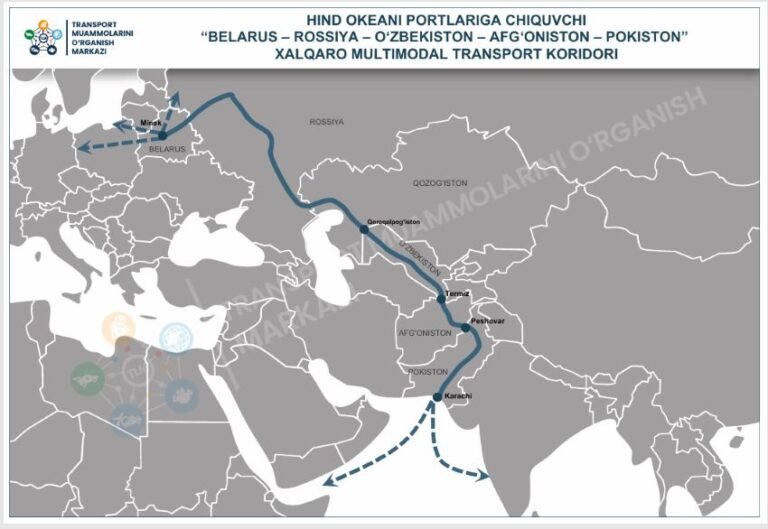
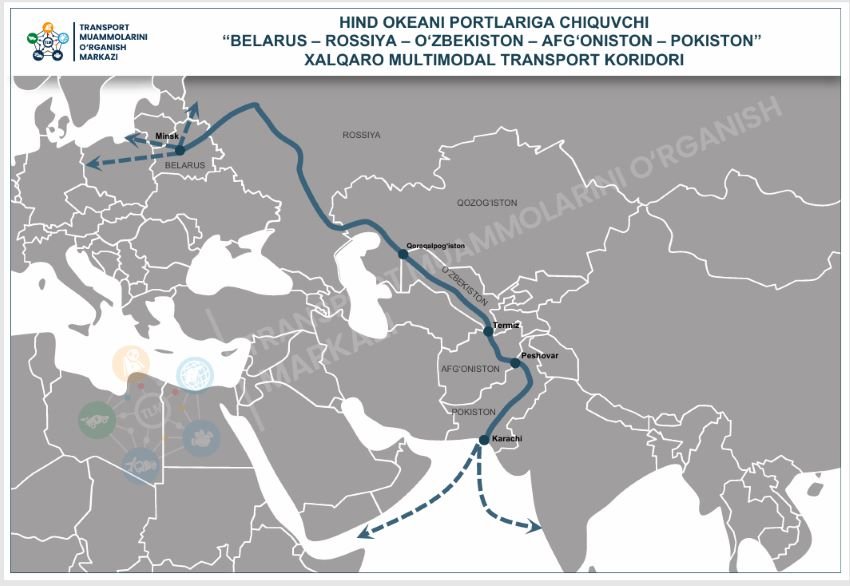
The Government of Uzbekistan is leveraging this potential by implementing several initiatives in the transport sector. These include the project to build the Uzbekistan–Afghanistan–Pakistan railway, as well as the international multimodal transport corridor Belarus–Russia–Kazakhstan – Uzbekistan – Afghanistan – Pakistan. This multimodal transport corridor is being promoted as part of the wider project. These projects will connect Uzbekistan with the nearest seaports and provide the shortest sea route to the markets of South Asia, the Middle East, Africa and the Asia-Pacific region.
By the end of 2025, the volume of cargo transported along the Uzbekistan-Afghanistan-Pakistan corridor exceeded 400,000 tonnes, representing a 11 per cent increase on last year. Notably, the volume of imports from foreign countries surged by 22 per cent, reaching 243,000 tonnes. This underscores the escalating significance of transport through Pakistani ports for the domestic market of Uzbekistan.
Read More: Uzbekistan, Pakistan Creating a New Architecture of Strategic Partnership
The strong ties of mutual trust between Uzbekistan and Pakistan have resulted in the establishment of transport and logistics cooperation. In particular, in 2022, an intergovernmental agreement on transit trade was signed, as a result of which by the end of 2025, the volume of export and import cargo transportation between the two countries reached 450,000 tonnes. This figure has increased by 37% since 2024 and by almost 60% since 2021.
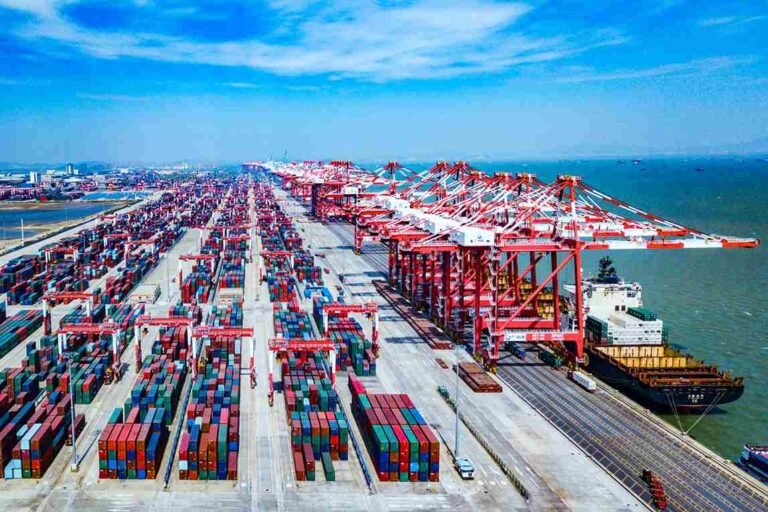
These figures are indicative of the increasing strategic importance of Pakistan in Uzbekistan’s foreign trade. This route provides Uzbekistan with access to three key seaports in Pakistan. Karachi, Kasim and Gwadar. These ports provide direct sea links to hundreds of ports around the world. This facilitates the delivery of our country’s export products to markets in South Asia, the Middle East, Africa and the Asia-Pacific region, ensuring efficiency and cost-effectiveness.
Preliminary analysis indicates that transportation through Pakistani ports can reduce delivery times by 10-15 days and total logistics costs by 20-30% compared to traditional routes. This is a significant advantage, particularly when it comes to the export of agricultural and textile products.
Current geopolitical situation (as of the end of 2025 and the beginning of 2026): freight routes between the two countries have been suspended due to the closure of the border between Pakistan and Afghanistan since October 2025. This situation has worsened since October, when trade between the two sides fell by 40% (from $2.46 billion in 2024 to $1.77 billion in 2025).
Read More: Pakistan, Uzbekistan Strengthen Strategic Partnership for Regional Integration
This has resulted in a redirection of trade routes. In particular, some of the cargo flows between Afghanistan and Pakistan have been reoriented towards routes to seaports through the territories of Central Asian states – Uzbekistan, Turkmenistan and Tajikistan – as well as through Iran. At the same time, Pakistan’s well-developed port infrastructure will continue to play a pivotal role as the primary maritime gateways for regional trade and transit in the long term.
In light of the current geopolitical landscape and the closure of traditional transport routes, it is recommended that temporary (alternative) international transport corridors be established. It should be emphasised that the Uzbekistan – Afghanistan – Pakistan transport corridor is the shortest route, reducing the total distance of freight transport from the European Union, CIS countries and China to South Asian countries by an average of 20-30% compared to traditional sea and rail routes.
Finally, it should be noted that Pakistani ports function not only as a transit point for Uzbekistan, but also as a significant strategic base. This contributes to the diversification of foreign trade, the reduction of logistics costs and the expansion of the geography of exports.
The transport projects currently being implemented and the steady growth in freight volumes clearly confirm that this direction is one of the most promising in our country’s foreign trade. It is also clear that the transport infrastructure and seaports in this direction are of strategic importance for Uzbekistan’s foreign trade.

Botir Zokir Ugly Ergashev
Botir Zokir Ugly Ergashev is a leading specialist at the Centre for the Study of Transport and Logistics Development Issues, Uzbekistan