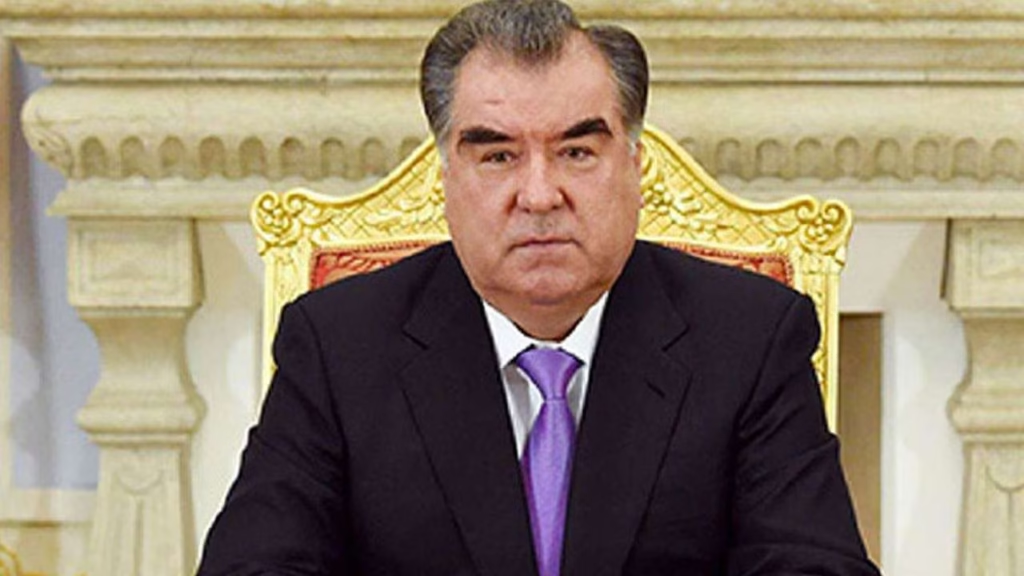
“Our country has identified issues related to water resources, their rational and efficient use, as well as the protection of glaciers, among the priorities of its state policy.”
~Emomali Rahmon, President of Tajikistan
It is no secret that member states of the United Nations have been paying special attention to global issues of water and climate protection in the interconnected world over the past two decades. It is clear that addressing ecological challenges on a global scale is one of the most outstanding initiatives of the Government of the country, and at the same time — of the Founder of Peace and National Unity, Leader of the Nation, President of the Republic of Tajikistan, Emomali Rahmon.
It is particularly worth noting that the Founder of Peace and National Unity, Leader of the Nation, President of the Republic of Tajikistan, Emomali Rahmon, takes a far‑sighted and serious approach to the most important issues concerning the future of humanity.
At the initiative of President of the Republic of Tajikistan, the esteemed Emomali Rahmon, the United Nations declared:
- 2003 as the International Year of Freshwater
- 2005–2015 as the International Decade for Action Water for Life
- 2013 as the International Year of Cooperation in Water
- 2018–2028 as the International Decade of Water for Sustainable Development
- 2025 as the International Year for the Protection of Glaciers.
The UN Water Conference was held in New York City on March 22–24, 2023, co‑chaired by Tajikistan and the Netherlands. This event is recognized as the second international conference on water issues.
It is worth noting that the first international conference on water was held in Argentina in 1977. Fortunately, approximately 50 years later, such a high‑level event was organized once again — this time at the initiative of the Founder of Peace and National Unity, the Great Leader of the Nation, President of the Republic of Tajikistan, the esteemed Emomali Rahmon. This conference is considered a source of pride for Tajiks and Tajik citizens around the world.
Furthermore, according to a resolution of the UN General Assembly, starting from 2025, March 21 will be celebrated annually as the World Day of Glaciers.
The United Nations Water Conference is being held within the framework of achieving the Sustainable Development Goals, aiming to engage the global community in addressing water and climate issues.
If we consider global water challenges, today more than 2 billion people on the planet suffer from a lack of drinking water. At the same time, nearly 3.6 billion people do not have access to sanitary water, and currently one‑third of the world’s population lacks even basic access to water for handwashing.
Furthermore, due to global warming, natural disasters — including droughts — are becoming more frequent. The financial losses over the past 20 years are projected to exceed 200 billion US dollars.
It is very encouraging that this latest initiative of the Leader of the Nation has also received global recognition.
In this regard, the esteemed President of the country, Emomali Rahmon, already in 2021, at the first meeting of the leaders of the Water and Climate Alliance, spoke about:
- the rapid melting of glaciers
- the growing population of planet Earth
- increasing water consumption
- the negative consequences of climate change
The designation of March 21 as the World Day of Glaciers and 2025 as the International Year for the Protection of Glaciers, along with the establishment of the International Fund for the Protection of Glaciers and the planned high‑level conference on glacier protection in Dushanbe in 2025, constitute one of the four key pillars of the resolution.
As a result, we, the citizens of the republic, are rightfully proud that four initiatives of the Republic of Tajikistan were included in a single resolution and endorsed by the global community. The implementation of these measures is being carried out step by step by the Environmental Protection Committee — as the authorized body — which is a source of pride.
In the republic, glacier protection is being implemented within the framework of the State Program for Glacier Protection for 2010–2030. Expeditions to various river basins and glaciers across the country are organized by specialists from the Hydrometeorological Agency under the Environmental Protection Committee at the Government of the Republic of Tajikistan.
For this purpose, in 2014, the Glaciological Center was established under the Hydrometeorological Agency. The center’s specialists are engaged in:
- studying glaciers
- measuring snow cover thickness
- forecasting natural disasters such as avalanches, mudflows (sel), and monitoring glacial lakes — which pose significant risks due to glacier melting
- promptly providing necessary information to ministries, departments, and the public.
Currently, key glaciers in river basins have been designated as monitoring glaciers. With observation points — including benchmarks — water levels and glacier fluctuations are regularly measured by field specialists. Additionally, the Hydrometeorological Agency conducts aerial observations twice a year, in March–April and May–June, in the basins of the Panj and Vakhsh rivers and the Kanask region.
Glacier studies by specialists from the said agency also take place on foot in some areas. One important factor to consider is that in countries with glaciers, protection and conservation efforts are carried out according to the location of the glaciers.
In our country, since glaciers are situated at altitudes of up to 4,000–5,000 meters above sea level, their protection and monitoring are conducted through research and aerial observations. On the other hand, the construction of small and large hydropower plants and other water and energy infrastructure contributes significantly to the protection and preservation of water resources in the country.
In the Zeravshan River basin, long‑term observations show that glacier melting is becoming increasingly noticeable. The Zeravshan Glacier, which covers a volume of 38.7 cubic kilometers and has a length of 27.8 square kilometers, is now experiencing decline. The glacier’s tongue has retreated by an average of 1,700 meters, and its area has decreased by 1.3 square kilometers.
According to observations by the Zeravshan Hydrometeorological Station, the glaciers in the Zeravshan Valley — given their location — are among the most vulnerable glaciers over the long‑term average period, and their melting is proceeding rapidly. In the Republic of Tajikistan, the National Climate Adaptation Strategy is being implemented. It identifies six priority areas: energy, water resources, transportation, agriculture, social issues, environmental protection.
Within the framework of implementing this strategy, the Environmental Protection Committee under the Government of the Republic of Tajikistan, together with development partners, regularly develops necessary measures to attract investment. The activities of the Project Implementation Center under the Committee — in cooperation with development partners and through the development of plans and project concepts — are highly effective.
Furthermore, at the initiative of the Government of the Republic of Tajikistan and the Chair of the Environmental Protection Committee, the largest funding body for climate adaptation — the Green Climate Fund — has been established and is currently operational. To date, the said Committee has already prepared an investment program totaling 400 million US dollars. The implementation of projects under this program will cover the priority sectors of the republic.
Thus, the comprehensive cooperation of the Republic of Tajikistan with United Nations member states on numerous economic and social issues — including the resolution of water and climate problems — will be beneficial. We believe that organizing such a major conference on water and climate issues will provide a significant impetus.
It is a source of pride that the Republic of Tajikistan is internationally recognized as a pioneering country in addressing water and climate issues. Specifically, on December 14, 2022, the UN General Assembly unanimously adopted a resolution on the International Year for the Protection of Glaciers for 2025 and March 21 as the World Day of Glaciers — both proposals submitted by Tajikistan. The adoption of this resolution on a global scale is a significant and historic step, enabling the world community to take joint measures to protect the largest sources of drinking water.
Leader of the Nation, esteemed Emomali Rahmon, at the 27th Conference of the Parties to the UN Framework Convention on Climate Change, held in Egypt on November 7, 2022, stated:
“It is clear that climate change has a direct impact on the economic, social, and ecological processes of countries in various regions of the world. From our perspective, one of the main indicators of this phenomenon is the rapid melting of glaciers due to global warming. To date, out of 13 thousand glaciers in Tajikistan, one thousand have completely melted, and the volume of the largest glacier on land — the Fedchenko Glacier — has noticeably decreased.”
During his speech at the conference, Leader of the Nation Emomali Rahmon expressed concern about the adverse consequences of rapid glacier melting and urged the global community to consider necessary measures:
“Rapid glacier melting — which is one of the main sources of fresh water — along with increased water consumption due to population growth and economic development, can lead to extremely negative consequences. It is evident that this pressing issue should be at the center of special attention of the global community and particularly political leaders.”
The global initiatives of the Great Leader of the Nation on water issues are not based on simple solutions, but on in‑depth research, evidence, and scientifically grounded conclusions aimed at solving humanity’s problems. Precisely on the basis of these influential initiatives, the most authoritative global organization — the United Nations — has adopted five resolutions over the past 20 years to address water‑related issues.
This serves as clear evidence of high recognition and respect, demonstrating the firm and dignified standing of the Republic of Tajikistan on the international stage. Moreover, at the initiative of the Great Leader of the Nation, issues concerning the improvement of drinking water quality — which holds top priority in water resource management, use, and protection — as well as other matters related to water, climate, and glacier protection, have been included in the new development agenda.
These efforts are recognized as significant achievements of recent years in the global community and will undoubtedly open a new chapter in the history of human development.
It is undeniable that one of the most urgent and critical issues of our time — which concerns all inhabitants of the planet — is the impact of global climate change on water resources and the rapid melting of glaciers. It should be noted that this issue has always been at the forefront of the Great Leader of the Nation’s attention.
To address these challenges, esteemed Emomali Rahmon has taken decisive actions through global platforms. These initiatives have received comprehensive support from all nations worldwide. The Leader of the Nation has repeatedly emphasized that water‑related problems, along with other threats currently facing the global community, are of utmost importance.
The Founder of Peace and National Unity — Leader of the Nation, esteemed Emomali Rahmon — has devoted all his efforts not only to solving the country’s internal problems, but also to addressing regional and global challenges, consistently proposing effective measures. Analysis of the outcomes of Tajikistan’s initiatives has shown that further decisive action is needed to mobilize the global community more comprehensively in solving water‑related issues.
At the same time, the Great Leader of the Nation, Emomali Rahmon, based on comprehensive observations and studies of climate issues and water resources in Central Asia, proposed establishing the International Glacier Protection Foundation. This initiative is specifically aimed at addressing regional challenges. The proposal to establish the International Glacier Protection Foundation was directly initiated by the Leader of the Nation. It was first presented:
- on August 31 and September 4, 2009, at the Third World Climate Forum in Geneva
- on December 7–8, 2009, at the 15th Conference of the Parties to the UN Framework Convention on Climate Change in Copenhagen.
This is because the Republic of Tajikistan is among the countries that have experienced rapid glacier melting within their borders since the 1980s — a direct consequence of atmospheric pollution and climate change.
Of course, this does not mean that glacier melting affects only Tajikistan. Today, this process is unfolding at an unprecedented rate worldwide, and its consequences for the future will undoubtedly be catastrophic.
According to experts, if all the world’s glaciers melted, the sea level on Earth would rise by 64 meters — which would lead to the destruction of life in a vast portion of our planet [6]. Thus, the adoption of such a beneficial resolution is a source of pride and joy for all Tajik people and the interconnected global community.
In our view, the negative impact of climate change is already clearly felt in most regions of the world — including the Arctic, Antarctica, and Central Asia. According to satellite measurements, the ice cover in the Arctic Ocean has been steadily declining. In the period 2019–2021, it reached a record low — a phenomenon we ourselves have witnessed, as noted by Academician Farhod Rahimi in his writings.
The Rapid Melting of Glaciers: A Global Challenge
According to observations by glaciologists, glaciers in Central Asia — as well as in other regions of the world — are rapidly shrinking and melting at an accelerating rate. This trend is raising growing concerns that climate change could exacerbate water scarcity, with serious consequences for: ecosystems, food production, human health.
Nearly 20 years have passed since Tajikistan first proposed its landmark initiative, yet the issue of ensuring access to clean water for the world’s population is becoming increasingly urgent.
Indeed, water resources — particularly Tajikistan’s glaciers — represent unique and irreplaceable reserves that call for international collaborative research.
Scientists are now focused on addressing pressing issues related to: sustainable water management, water conservation, glacier protection.
In line with Tajikistan’s global initiatives and conceptual frameworks, as well as the implementation of scientific and technical programs, researchers are working to develop evidence‑based solutions and share them with the global community.
Leadership of the Nation and International Action
As we all know, under the initiative of the President of Tajikistan, the esteemed Emomali Rahmon, numerous scientific research programs, political measures, and technical efforts to combat climate change have been developed and are actively being implemented at the global level.
Four key Tajik initiatives on water and climate issues have already gained significant international attention. However, greater participation is still needed: all countries must engage consistently and impartially in protecting glaciers and our planet.
The Government of Tajikistan has taken concrete action to protect glaciers, including establishing the International Day for Glacier Protection through institutional and legal measures.
To date, the country has adopted:
- one state program
- two direct strategies aimed at addressing glacier melting.
These documents are designed to achieve clearly defined goals. One such document is the State Program for the Study and Protection of Tajikistan’s Glaciers (2010–2030), approved by government resolution on May 3, 2010. The program outlines:
- clear objectives for glacier protection
- specific measures
- the designation of a dedicated Day of Glacier Protection.
The Threat of Rapid Glacier Melting
The accelerated melting of glaciers due to climate change poses a serious threat to:
- livable conditions for populations
- protection of water resources
Of Tajikistan’s approximately 14 thousand glaciers — vital for the entire region — more than 1 thousand have disappeared over the past 31 years. The rapid melting, driven by rising temperatures, has led to:
- an unprecedented increase in natural disasters
- degradation of aquatic ecosystems.
According to specialists’ forecasts, if climate change continues to intensify, by 2050 the number of people worldwide suffering from drinking water scarcity could reach 9 billion. Furthermore, depending on current water use trends, 30 % of the global population may be unable to meet their water needs. This was highlighted by Academician F. Rahimi during a party gathering.
Climate Change and Its Impact on Water Resources: The Central Asian Context
It is well established that climate change negatively affects human health, the environment, agriculture, transportation infrastructure, and other areas of sustainable development. However, its most severe impact is on water resources.
This issue is particularly acute in Central Asia, where water is not only the foundation of socio‑economic development, but also a critical factor in ensuring national and regional security.
Research findings reveal:
- Between 1956 and 1990, the volume of Central Asia’s glaciers decreased more than threefold.
- Annually, glacier area and volume shrink by an average of 0.6–0.8 % and 0.1 %, respectively.
- Tajikistan’s glaciers — the primary source of Central Asia’s rivers — have lost more than one‑third of their volume during the 20th century.
- If current trends continue, thousands of glaciers in Tajikistan could disappear entirely.
A temperature rise of 2–3 °C is projected to accelerate glacier retreat and reduce snow reserves. Initially, glacier melt may increase river flow — a trend already being observed. However, in the longer term, many rivers could experience significant water shortages. Forecasts for Central Asia are not reassuring:
- River water volumes may decline by 5–10 % to 10–40 % in the long term.
- Population growth (1.0–1.5 % annually) and sustained economic development (7–10 % annual growth) further strain water resources.
- By 2030, water demand in the region is projected to rise by 15–20 %.
Urgent Need for Collaborative Action
Given the critical socio‑economic importance of water resources, immediate measures are required:
- protecting glaciers and snow reserves in the region
- conducting joint scientific research
- monitoring the impact of climate change on glaciers
- raising global awareness about these trends.
Historical experience in Central Asia shows that unsustainable use of natural resources can lead to severe consequences. The Aral Sea disaster serves as a stark warning: we must not allow the destruction of glaciers, which are the lifeblood of Central Asia.
In this context, there is a pressing need to establish the International Glacier Protection Fund. Such a fund could:
- unite the efforts of regional countries
- mobilize the global community
- address this strategically critical issue through coordinated action
The world community clearly understands that the decline and degradation of freshwater resources threaten humanity with severe humanitarian, social, and economic disasters. Addressing these challenges requires collective commitment and timely intervention to safeguard the planet’s water future.
*The views presented in this article are the author’s own and do not necessarily reflect the views of The Diplomatic Insight.

Davliyorova Safargul Teshaevna
Davliyorova Safargul Teshaevna is a candidate of Philosophical Sciences; associate professor and leading researcher at the Department of Commonwealth of Independent States, Institute for Asian and European State Studies, Academy of Sciences of Tajikistan.