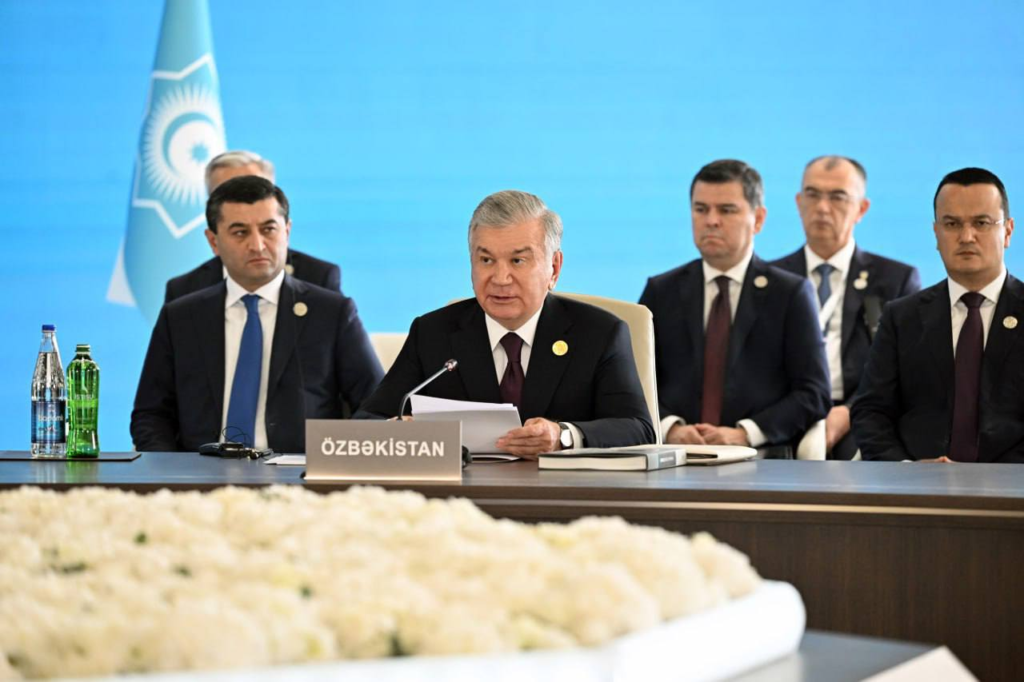
On October 6-7, President of Uzbekistan Shavkat Mirziyoyev paid an official visit to Azerbaijan to participate in the 12th Summit of the Organization of Turkic States in the city of Gabala. In the beginning of his speech President Mirziyoyev thanked the President of Azerbaijan for organizing this summit and congratulated his Azerbaijani colleague on the recent peace agreement with Armenia, calling it an achievement of all Turkic states. During his speech, the President of Uzbekistan focused on six points to develop the organization and Uzbekistan’s contributions.
The first point Uzbek President focused on is strengthening political and economic unity among Turkic states. President Mirziyoyev emphasized that the Organization of Turkic States has become a strong and rapidly developing international organization as these countries are more connected than ever. He called for adopting a Treaty on Strategic Partnership and Brotherhood to make the cooperation framework more solid. This treaty, he said, would bring nations closer and ensure long-term trust among Turkic peoples. He also proposed creating a Development Strategy until 2030, which would guide cooperation in areas like trade, investment, and innovation.
To manage this better, Uzbekistan suggested setting up a Permanent Council for Economic Partnership in Tashkent. The council would coordinate new projects and promote an Industrial Alliance covering industries such as energy, engineering, and construction. The president also mentioned creating systems like Turkic Green Corridors and Green Transformation programs to support eco-friendly industries and move toward sustainable economic growth.
The second point was about food security and the potential of Turkic countries to become global leaders in organic production. President Mirziyoyev said the global organic market is growing fast and is already worth over $225 billion. With their vast lands and favorable climates, Turkic nations can play a major role in this field. He called for stronger cooperation in agricultural science, logistics, and production to ensure the supply of high-quality organic products.
Read More: Central Asia’s Craftspeople Are at the Center of First Art Biennale in Uzbekistan
Uzbekistan proposed forming an Expert Working Group led by the ministers of agriculture to identify pilot projects and begin implementation. The president also suggested creating a single shared brand under which all Turkic countries could sell their organic products worldwide. This, he said, would not only strengthen their economic power but also improve their image as reliable suppliers of healthy and environmentally friendly food.
The third point addressed the importance of improving transport connectivity among Turkic states. President Mirziyoyev underlined that strong transport links are key to trade and economic development. He expressed full support for the Middle Corridor initiative, which connects Europe and Asia through Turkic countries. For this route to succeed, he said, it must be competitive and offer fair transit tariffs. He also mentioned the need to develop infrastructure, simplify customs procedures, and introduce digital systems.
The president highlighted the China-Kyrgyzstan-Uzbekistan railway and the Trans-Afghan Corridor as key projects that could connect the entire region and create a vast, multi-route trade network. These developments would make the Turkic world a central hub in Eurasian trade. He announced that Tashkent will host the International Forum on Multimodal Transportation on November 12, inviting transport ministers, logistics companies, and experts to discuss these major opportunities.
The fourth point focused on financing large-scale industrial and infrastructure projects. The president noted that to successfully launch such projects, the Turkic states need reliable financial mechanisms. He expressed support for expanding the work of the Turkic Investment Fund, which can help fund important regional initiatives. However, he also said additional sources of funding are essential. For that, he proposed establishing strategic cooperation with major international financial institutions like the Islamic Development Bank and the European Bank for Reconstruction and Development.
By combining the resources of these banks with national funds, the Turkic states could attract more investment for shared priorities such as green energy, transport, and manufacturing. This financial cooperation, according to Mirziyoyev, would help turn the Organization’s economic plans into real, long-term results that strengthen the economies of all member countries.
Read More: Uzbekistan’s Pilgrimage Tourism Is Gaining Momentum
The fifth point was about embracing the future through technology and creativity. President Mirziyoyev said artificial intelligence, digitalization, and the creative economy are becoming new engines of sustainable growth. To coordinate progress, he proposed adopting a joint Roadmap for AI and creative industry projects. This plan would encourage innovation, cooperation among tech experts, and the sharing of best practices across Turkic states. He also announced Uzbekistan’s initiative to host an International Exhibition of the Turkic World.
The exhibition would showcase achievements in technology, culture, and design, encouraging collaboration between creative minds and businesses. The president stressed that focusing on these modern industries will make the Turkic world more competitive globally, help diversify economies, and prepare young people for the digital era. By combining creativity and technology, Turkic nations can position themselves as forward-looking economies of the future.
The sixth point was about education, science, and youth. President Mirziyoyev talked about the importance of education among Turkic nations. Uzbekistan will chair the Union of Turkic Universities in 2025–2026, uniting over 100 institutions. During this time, Tashkent will host the Union’s General Assembly and organize Days of Turkic Science and Innovation. He also announced the opening of the International University of Turkic States in Uzbekistan, which will focus on joint research and support talented scientists.
Additionally, the president proposed creating an Action Plan to prevent extremist and radical ideologies among youth and promote tolerance. He called for environmental education initiatives and cooperation to combat Islamophobia. Finally, he suggested holding a conference celebrating the 585th anniversary of Alisher Navoi and 885th anniversary of Nizami Ganjavi to honor their shared legacy of humanism and cultural unity in the Turkic world.
The speech of the President of Uzbekistan in Gabala demonstrates Uzbekistan’s willingness to contribute to the development of further closer ties among Turkic nations. His proposals reflect a strong vision for unity built on shared economic growth, innovation, and cultural values.
*The views expressed in this article are the author’s own and do not necessarily reflect the editorial policy of TDI.

Nuzhat Rana is the Managing Editor (website) at The Diplomatic Insight.