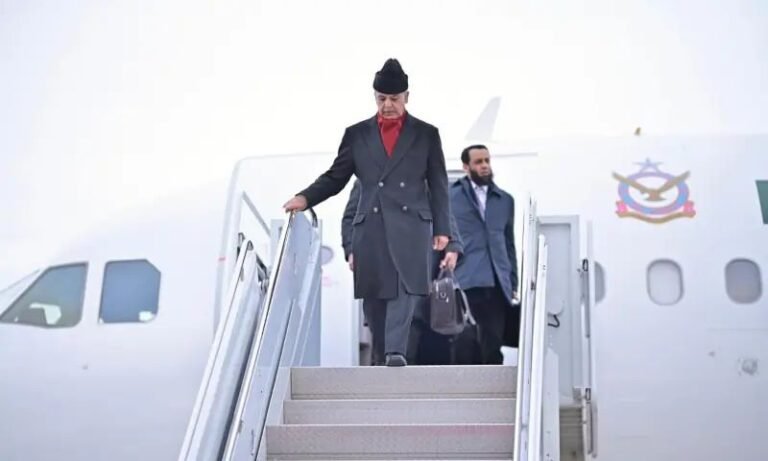
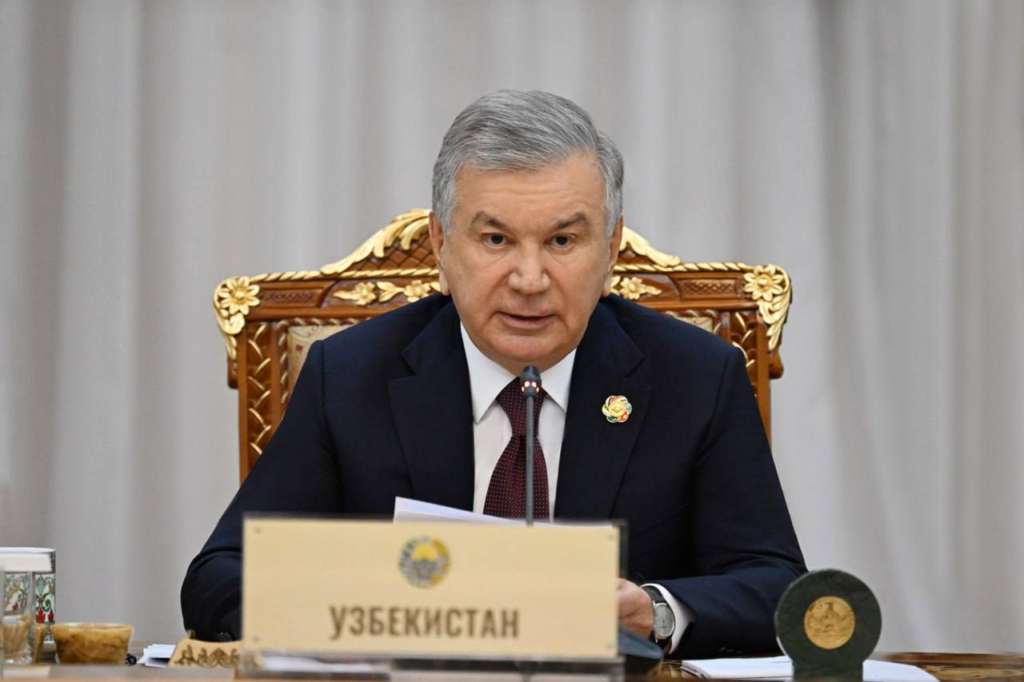
Dushanbe (TDI): President of Uzbekistan Shavkat Mirziyoyev arrived in Dushanbe on October 9 for a working visit to Tajikistan to participate in the second “Central Asia–Russia” summit and the next edition of CIS Council of Heads of State meeting.
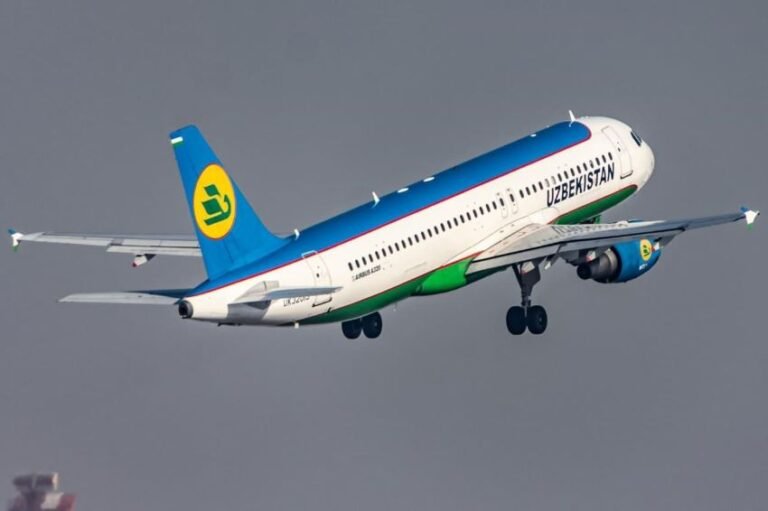
During the meeting with Tajik President Emomali Rahmon, the two leaders discussed strengthening the Uzbek-Tajik strategic partnership. They highlighted positive progress in trade, transport, and regional connectivity, with growing volumes of mutual trade and the number of direct flights.
The presidents also agreed to deepen cooperation in industry, energy, agriculture, and culture, highlighting the importance of maintaining close regional dialogue and preparing for the upcoming Central Asian Consultative Meeting in Tashkent.
At the Central Asia–Russia summit, President Mirziyoyev began his speech by expressing gratitude to President Emomali Rahmon for his hospitality and to President Vladimir Putin for his consistent support in advancing full-scale cooperation with Central Asia.
He commended Russia’s historical role as a key ally and strategic partner, emphasizing the centuries-old ties and cultural closeness between their nations.
President Mirziyoyev noted that the current global geopolitical tensions and economic challenges demand greater regional coordination. He proposed strengthening political dialogue, expanding practical cooperation, and holding annual high-level meetings between Central Asian and Russian leaders.
Mirziyoyev supported adopting a Joint Action Plan until 2027 and suggested creating a detailed roadmap to monitor and accelerate the implementation of regional projects through a new Coordinating Council of deputy prime ministers.
Read More: Uzbekistan Outlines Vision for a More Connected Turkic Region
Economically, Mirziyoyev stressed the need to deepen trade and industrial ties with Russia. He mentioned the 15% growth in trade turnover and called for measures to simplify market access, reduce barriers, and launch the “Agroexpress Central Asia–Russia” project.
The Uzbek president also highlighted the strategic importance of the North–South transport corridor and proposed integrating national transport programs to form a unified, resilient regional logistics network.
Industrial cooperation was identified as another key area. Uzbekistan is expanding partnerships with major Russian firms, including in the gas-chemical and mining sectors.
Mirziyoyev proposed establishing a Central Asia–Russia Industrial Engineering Hub in Bukhara to develop and replicate advanced engineering solutions, as well as granting the “Innoprom. Central Asia” exhibition in Tashkent official status as the main industrial and innovation platform for the region.
Energy collaboration, Mirziyoyev said, remains a cornerstone of regional stability. He announced the imminent launch of historic projects including constructing Uzbekistan’s first nuclear power plant reactor unit and a Nuclear Medicine Center.
He proposed establishing a Regional Center of Excellence for Nuclear Energy and launching a joint training program at the Tashkent branch of the Moscow Engineering Physics Institute. He also urged developing a comprehensive “Central Asia–Russia Energy Partnership Program.”
Read More: Uzbekistan, Kazakhstan Enhances Cooperation in Telecommunications
In innovation and technology, the Uzbek leader proposed opening branches of the Skolkovo Innovation Center across Central Asia, which is known as Russian “Silicon Valley” and forming a Regional Expert Council on Artificial Intelligence and Digital Technologies to encourage collaboration among research centers and IT firms.
Humanitarian and educational cooperation also featured prominently. Mirziyoyev suggested organizing an annual ethnocultural forum celebrating the peoples of Central Asia and Russia, as well as creating the “Engineers of the Future” consortium to unite leading universities in dual education and scientific research.
He proposed establishing a joint grant program for young scientists, promoting maternal and child health, improving labor migration adaptation, and boosting regional tourism.
Addressing security, Mirziyoyev called for closer cooperation among regional law enforcement and security agencies to combat terrorism, extremism, organized crime, and cyber threats. He also proposed holding high-level consultations focused on Afghanistan’s security and socioeconomic development to enhance regional stability.
Following the summit, leaders adopted a Joint Communiqué and a Joint Action Plan for 2025–2027, charting a new stage in deepened regional collaboration.

Nuzhat Rana is the Managing Editor (website) at The Diplomatic Insight.