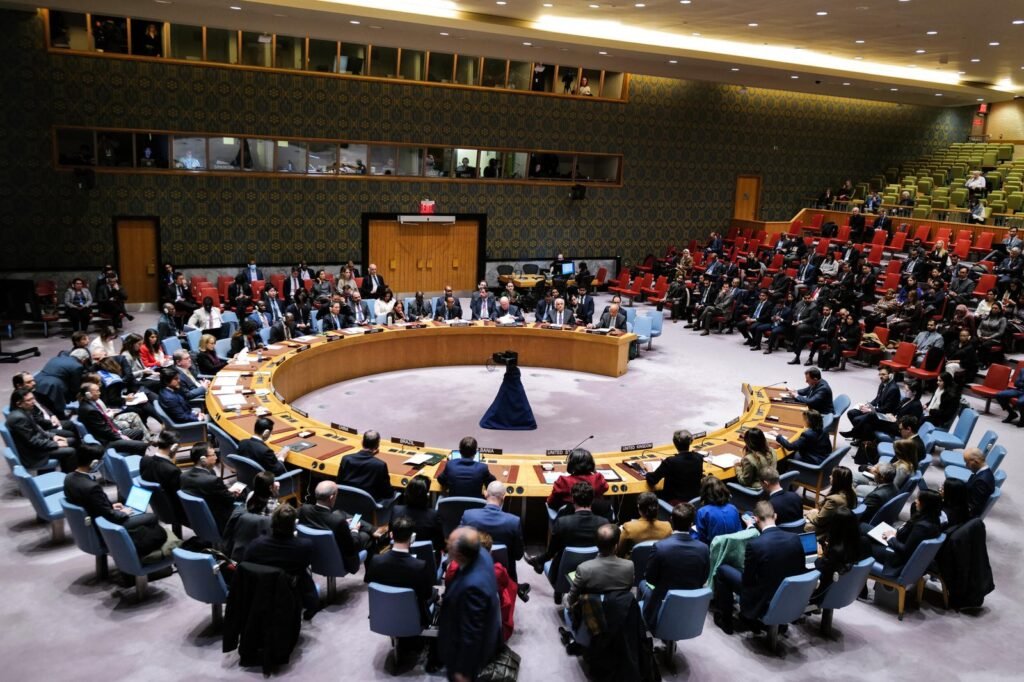
New York (TDI): The United Nations Security Council has approved a US-drafted resolution that endorses a controversial peace plan for Gaza and authorizes an international stabilization force to operate in the region.
The resolution, backed by 13 Security Council members and passed without a veto while Russia and China abstained, supports Donald Trump’s 20-point Gaza plan.
Under the deal, a Board of Peace, led by Trump, will act as a transitional governing body for Gaza, overseeing reconstruction, security, and demilitarization.
After the vote, US Ambassador to the UN Mike Waltz welcomed the outcome, saying the resolution marked an important step toward helping Gaza rebuild and creating conditions in which Israel could live in security.
Hamas, which is excluded from any administrative role under the resolution, rejected the move, arguing that it fails to address the political and humanitarian rights of Palestinians.
The resolution outlines the operational framework of the Gaza peace plan, authorizing the establishment of an International Stabilization Force (ISF). The force will work alongside Israel, Egypt, and newly trained Palestinian police to secure border areas and oversee the demilitarization of Gaza.
Read More: Israel Destroys Gaza’s Historical Sites, Loots Over 20,000 Artifacts
According to the agreement, the ISF will be responsible for permanently removing weapons held by non-state armed groups, protecting civilians, and ensuring the safe functioning of humanitarian corridors.
The resolution also instructs UN agencies, the ICRC, and the Red Crescent to resume large-scale humanitarian aid deliveries into Gaza.
The resolution also addresses the long-debated question of Palestinian statehood, noting that a viable pathway to self-determination may emerge once the Palestinian Authority implements key reforms and reconstruction begins.
More than 153 UN member states have already recognized Palestine as a state, excluding the US, in the last General Assembly in September. The idea remains contentious, with Israel firmly opposing any two-state framework.
Russia, which abstained from the vote, circulated a competing draft, arguing that the US text did not go far enough. Moscow’s version urged the Council to reaffirm its “unwavering commitment” to a two-state solution, but avoided endorsing the Board of Peace or authorizing an international force, instead asking the UN Secretary-General to present alternative options.
Ahead of the vote, Washington secured backing from several Arab and Muslim-majority nations including Qatar, Egypt, Saudi Arabia, the UAE, Jordan, Türkiye, Indonesia, and Pakistan who collectively urged the Security Council to adopt the resolution without delay.

Minahil Khurshid holds a master’s degree in Peace and Conflict Studies from CIPS, NUST. She has a strong interest in current affairs, geopolitics, and policy analysis.