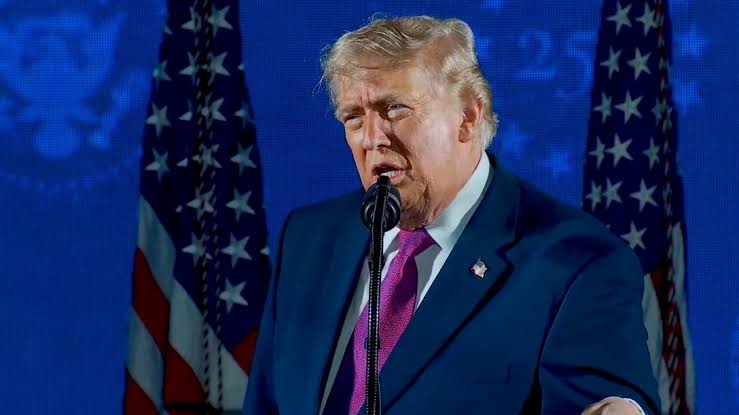
President Donald Trump delivered what could be his most pointed public message against Iran in his choice of one of the most symbolic moments in American political history: the granite faces of Mount Rushmore on the eve of the nation’s 250th birthday that the war is over in everything but in name, and Tehran knows it.
“They’re dying to settle. They want to settle so badly. We gave them a week off for a funeral because we’re nice,” Trump told the crowd on the evening of July 3, drawing loud cheers. The comment was short, almost throwaway, but it did hit home due to when and where it was made.
The President’s asserted that U.S. military pressure has “broken the spirit” of the Iranian leadership, which has helped persuade the nation’s leadership to seek terms. The “funeral” he mentioned was no figurative expression.
On Friday, senior foreign officials paid their final respect to the slain Supreme Leader, Ayatollah Ali Khamenei, the country launched a week of public mourning with the authorities estimating that millions of Iranians will attend funerals before Khamenei is interred — four months after being killed in the opening U.S.–Israeli strikes of the conflict at the age of 86.
Khamenei did not choose this war. After decades of his rule, the reported assassination of Khamenei seemed to leave Iran with a definite leadership void, as the Supreme Leader had the final say on all important policies and there was no known successor. Iranian foreign minister denounced the attacks as “unprovoked, illegal and absolutely illegitimate.”
But Iran’s citizens were split: People in parts of Iran cheered and celebrated on the news of Khamenei’s death, while pro-government supporters rallied in Tehran to mourn his death.
Trump, on the other hand, was in no mood for ambiguity. Below the historic monument, on the eve of July 4, he gave an almost half-hour speech denouncing communism, extolling the country, and lauding the spirit of the American Revolution – ending it with a note: “after two and a half centuries, we know that this is not an ending; this is only the beginning of the Golden Age of America.”
The Iran comments are worthy of note, although they may be ephemeral. On July 4, as the U.S. celebrates the 250th anniversary of the Declaration of Independence, Iran will finally start a funeral for the supreme leader, which will include days of mourning in Tehran and Qom before his burial on July 9 in his hometown of Mashhad.
Two countries and two extremely different July 4ths. It is still not clear if Trump’s public confidence will be followed with a permanent deal. The image he desires for the world on America’s birthday is one that is clear: a superpower celebrating and an enemy weeping.