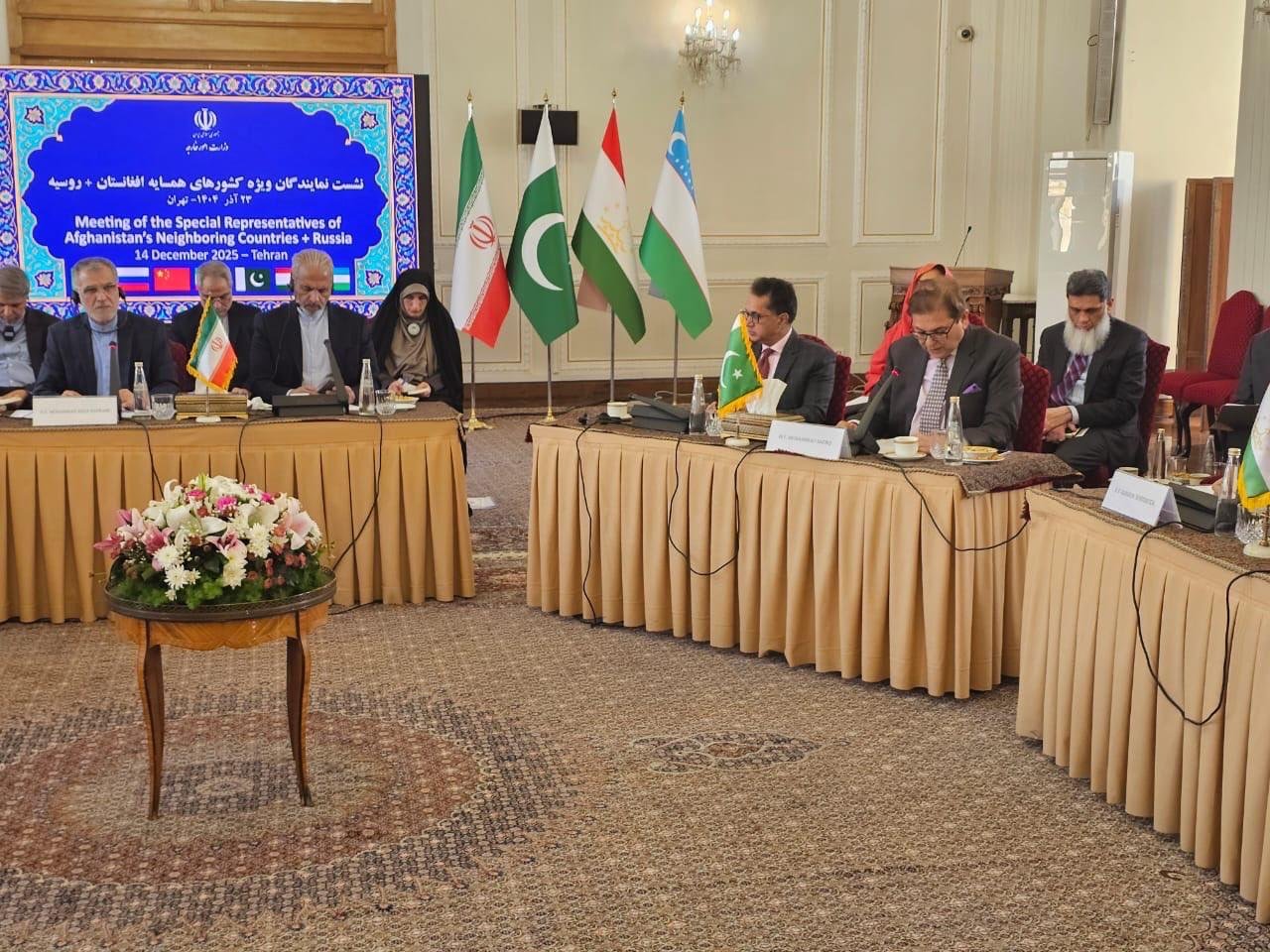
Tehran (TDI): Senior officials from Afghanistan’s neighboring states, together with Russian representatives, met in Tehran on Sunday to address the ongoing situation in Afghanistan. However, the high-level forum ended without issuing a joint statement, highlighting continuing disagreements over the Taliban’s role and broader regional security concerns.
Hosted by Iran, the forum brought together envoys from Pakistan, China, Russia, Tajikistan, Uzbekistan, and Turkmenistan. Notably, the Taliban declined to attend, complicating efforts to coordinate a unified approach.
While it was clear that terrorism originating from Afghan territory continues to pose a serious threat to the region, consensus on other issues remained elusive. Iran’s Foreign Minister Abbas Araghchi, who opened the meeting, highlighted the strategic importance of Afghanistan’s stability for all neighboring countries. “No extra-regional blueprint can resolve regional problems and crises,” he said, stressing the need for regular dialogue mechanisms to prevent misunderstandings and strengthen cooperation on economic, border, and humanitarian matters.
Iran also highlighted Afghanistan’s economic potential, suggesting that improved conditions could allow the country to serve as a vital corridor linking Central, South, and West Asia with the Asia-Pacific, facilitating trade and energy transit.
Pakistan, represented by Special Representative on Afghanistan Ambassador Muhammad Sadiq and Ambassador to Kabul Obaid Nizamani, stressed that terrorism originating from Afghanistan poses a “big challenge for the region.” Ambassador Sadiq underscored that the Taliban must take decisive steps to rid Afghan soil of all terrorist elements to inspire confidence among neighbors and unlock the country’s economic and connectivity potential.
The Pakistani delegation also highlighted Islamabad’s security concerns and reaffirmed its commitment to regional peace, development, and stability, despite strained ties with the Taliban.
During the forum, Iranian officials held bilateral discussions with Pakistan’s representatives. In a courtesy meeting, Ambassador Muhammad Sadiq met with Iranian Foreign Minister Abbas Araghchi, who reiterated Tehran’s commitment to strengthening ties with Islamabad. The talks reflected the growing coordination between the two neighbors on Afghanistan, as well as shared interests in trade, energy cooperation, and regional stability.
While China, Russia, and Central Asian nations focused on long-term regional stability and economic integration, Pakistan emphasized countering terrorism and addressing cross-border threats, reflecting its ongoing security concerns regarding militant networks operating from Afghan soil.
Iran’s role as the host signaled its intent to mediate Afghan affairs, yet the lack of a formal outcome demonstrated the challenges of regional coordination when key stakeholders, especially the Taliban, are absent or uncooperative.
Despite the inconclusive nature of the talks, the Tehran forum showcased a continued willingness among regional players to engage in dialogue, exchange perspectives, and coordinate on security and development matters. Pakistan’s strong emphasis on combating terrorism and demanding Taliban accountability is expected to remain central in future discussions.

Minahil Khurshid holds a Master's in Peace and Conflict Studies from NUST. She is passionate about current affairs, public policy, and geopolitics.