I’m not the first one to note that if one examines the dramas of Shakespeare, one notices that quite often in his plays the action turns entirely or partly on economic questions.
The comedy The Merchant of Venice (circa 1596) is a most striking example. While the plot of the story is generally well known, the deeper meaning of this play is often overlooked. The sequence of events (the story itself) is one level, what they reveal (the principles) is another.
The Narrative
To help out his protege Bassanio and enable him to engage with his beloved Portia, a Catholic Venetian merchant and shipowner named Antonio borrows money from a Jewish moneylender, Shylock. Shylock hates Antonio, the very archetype of the hypocritical Christian, because the latter treats him with contempt. Antonio, on the other hand, hates Shylock because he is Jewish and because he is a usurer: he lends at interest.
Shakespeare makes us understand that the prosperity of Venice is based on the mutual hatred fueled by the oligarchs between Jews and Christians, according to the famous principle of “Divide and rule.”
The oligarchy never lacks imagination in circumventing the standards it imposed on its adversaries. Indeed, among both Jews and Christians, financial usury is condemned and even punished. Interest, which is simply defined as the remuneration of a creditor by his debtor for having lent him capital, is a very ancient concept that probably dates back to the Sumerians and is also found in other ancient civilizations such as the Egyptians or the Romans.
Judaism clearly prohibits lending at interest. We encounter numerous passages that condemn interest in the Torah (Exodus 22:25-27, Leviticus 25:36-37 and Deuteronomy 23:20-21) However, this prohibition only applies to loans within the Jewish community.
Initially, the same rule applied among Christians. It was not until the First Council of Nicaea (in 325) that lending at interest was prohibited. While its condemnation had been relatively mild in Christianity before then, interest became a serious sin and was heavily punished from the 1200s onward.
Italy has been home to Jews since ancient times. They were dependent on popes, princes, or merchant republics. In the 13th century, some cities granted Jewish bankers with papal license, a monopoly on pawnbroking. Venice welcomed Jews but forbade them from practicing any profession other than lending for interest.
Initially, these Jews were allowed to get rich in Venice, a situation that drew the ire of the rest of the population. To “protect” the Jews, the Doge of Venice created the first ghetto (a Venetian word), offering, it must be said, the most unsanitary district of the lagoon to these Jews whom he detested while cherishing the financing they provided for his colonial expeditions and slave trade.
The Merchant of Venice
This is the essence of the Venetian system that Shakespeare unmasks in his comedy The Merchant of Venice. So, when Antonio goes to ask Shylock for a loan, the latter then replies: “You come to me and you say, ‘Shylock, I need money.’ You tell me this! You who spat on my beard and kicked me as you’d kick a stray dog away from your threshold! You ask for money. What should I say to you? Shouldn’t I say, ‘Does a dog have money?’ […] Or should I get bend to my knees and with bated breath humbly whisper, ‘Fair sir, you spat on me last Wednesday; you spurned me then; another time you called me a dog—and for all this courtesy you’ve shown me, I will gladly lend you this much money?’”
To which Antonio retorts: “I am likely to call you such names again, spit on you again, and spurn you, too. If you decide to lend this money, don’t do it as if we are friends. After all, when have friends ever charged each other interest? Lend me the money as your enemy and if I break my part of the agreement you can more happily punish me.” This principle would later be theorized by Nazi crown jurist Carl Schmidt to become the rule of today’s oligarchy: to exist, one needs an “existential enemy”, and if you lack one, hurry up to invent one!
Shylock then pushes his logic to the point of absurdity and, jokingly, suggests that if his debtor does not repay his debt on time, he would have the right to take a pound of flesh from him.
This is where Shakespeare poses a fundamental question and offers us a beautiful lesson in economics, in the form of a tragic and paradoxical metaphor. In most ancient civilizations, failure to repay a debt could lead you to slavery, cost you your life, or send you to prison for the rest of your life. From monetary slavery, we thus moved on to physical slavery, at least till the Renaissance.
Questioning this principle turns Shakespeare’s comedy into a drama. Little by little, we learn that Antonio’s ships have all been swept away by storms. As a result, he can’t pay back the loan and therefore has to accept that Shylock takes a pound of flesh from him, as specified in the legal loan contract.
The Doge of Venice, called on to mediate, requests Shylock’s clemency. Shylock says, that refusing his pound of flesh, would discredit all the laws of Venice.
Here Shakespeare introduces a woman, Portia. Disguised as a law doctor, she acts in the name of a higher principle and succeeds turning the tide with the kind of audacity we lack today. Regarding the claim, she acknowledges Shylock can have his pound of flesh, but underscores he cannot shed any drop of blood: “If in cutting it off you shed one drop of Christian blood, your lands and goods will be confiscated by the state of Venice by the city’s laws.”
This is another beautiful lesson Shakespeare teaches us. How many excellent laws are worthless simply because their authors didn’t bother to specify their implementation? Do you know the laws that allow you to defend yourself against the injustices the system inflicts on you?
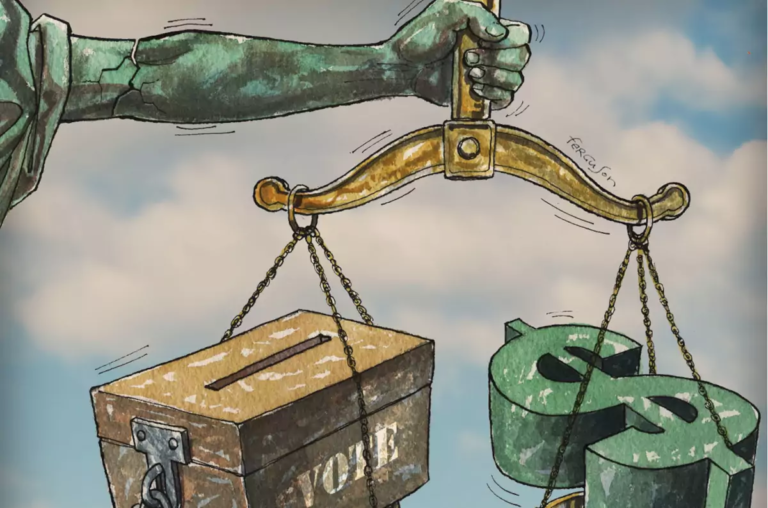
Shakespeare reminds us that economics is not limited to law and mathematics. Every economic choice remains a societal choice. In reality, only “political economy” should be taught in our universities and theaters. Presenting the science of economics and finance as an “objective” reality and not as a reality of human choices is the best proof that we are subject to propaganda.