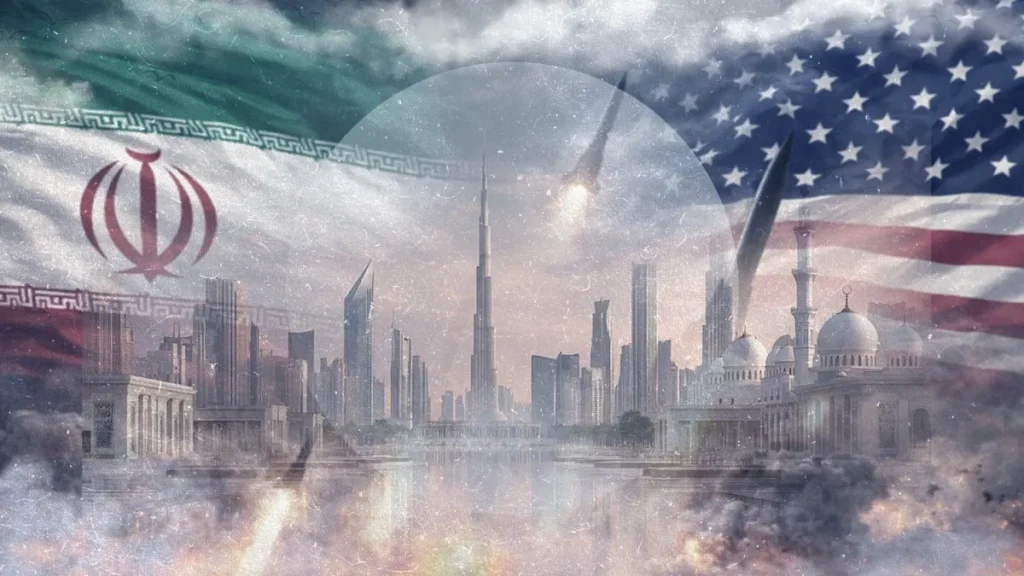
The presence of the United States Navy’s Abraham Lincoln carrier strike group near Iran once again highlighted how close the Middle East came to the brink of a major conflict. Tehran threatened that no US assault would pass without a response and could provoke a war in the region.
With this background of increased tensions, indirect discussions were conducted on 6 February 2026 between the United States and Iran in Muscat, Oman. Although the nuclear talk was presented as a good start. But it was more of a puzzle as to why Washington is now ready to negotiate with a state it has isolated and sanctioned over the years. More to the point, do the threats of a war of technology silently loom over the Middle Eastern region?
Iran has entered the negotiation table with a relatively strong position despite the unmatched US economic sanctions and sustained military pressure. This was echoed, first, by Tehran, a diplomatic win to have the talks location moved out of Istanbul to Muscat. Iran symbolically positions itself on more neutral and advantageous diplomatic terms.
Second, Iran has strongly opposed the need to have zero enrichment and has narrowed down the talks to nuclear matters only. It has not compromised on its missile program or regional networks. This position does not indicate a sign of weakness, but a mark of strategic confidence. The Iranian Foreign Minister Abbas Araghchi has constantly stressed resistance, rather than compromise, indicating that Tehran no longer views negotiations as a compromising act; instead, it views the talks as a means of strengthening its independence.
Read More: Tensions High as Trump Joins Iran Nuclear Negotiations Indirectly
Iran’s assertiveness is grounded in the internal developments of the Islamic Revolutionary Guard Corps (IRGC). A more risk-acceptant and mainly younger generation of commanders seems to be keen on proving the deterrent credibility of Iran. They have a point to make to Washington and Tel Aviv: Iran cannot be another Venezuela, Iraq, or Libya.
The US might, however, be underestimating the strength of the IRGC. In June 2025, Iran shot down several suspects and executed them, and retaliated militarily within 19 hours in a war after alleged Israeli intelligence intrusions. The IRGC has demonstrated institutional discipline and the ability to withstand shock in crises. Due to such rapid dynamics of retaliation, the risks of escalation are substantial.
The probability of a US military attack on Iran can never be dismissed. But if it ensues, then it would be much more risky and much less decisive than in previous wars. President Donald Trump’s coercive diplomacy cannot proof as an effective tool. Yet history can prove otherwise.
Starting in Afghanistan and Iraq and most recently in Ukraine and Gaza, military supremacy has seldom had a rapid or predictable political result. The superpower with the top military industrial complex also has a full history of suffering in wars. In the case of the US attacking Iran, the outcome would be instability, but not a strategic solution at any cost.
The definitive hurdle has always been the demand for zero enrichment by Washington. In the view of Iran, this demand breaks the sovereign rights of Iran and renders meaningful compromise politically unachievable. The case of the 2015 Joint Comprehensive Plan of Action (JCPOA) is a valuable learning point. The agreement worked specifically, as Iran was allowed to partially enrich under international scrutiny. The US withdrawal in 2018 shattered the framework. Resultantly, Tehran advances its nuclear program in the name of security and survival.
Read More: Iran Envoy Says War Unlikely Soon, Urges Regional Vigilance and Unity
The reasoning of zero enrichment is thus obsolete. There is a need for the US to decouple nuclear talks from regional matters like Iran’s role in Syria, Lebanon, Yemen, and Iraq. Under such conditions, nuclear diplomacy is unlikely to be successful. In the Iranian case, its regional networks are the strategic depth, not a bargaining chip.
It is like asking Pakistan to leave Kashmir because of the expectation that Tehran will leave Hezbollah, the Houthis, or Iraqi militias. It is against fundamental national security perceptions. As it has been experienced in the past, pressure only makes these networks stronger. Iran did not recede after 2018; on the contrary, it strengthened.
The greatest threat now is not the intentional war but the structural miscalculation in a more technological battle space. War has become structurally more perilous than it used to be. Compared to previous crises, the current conflict is defined by new technologies, such as drones, cyber-attacks, satellite monitoring, and AI-controlled targeting.
New military technologies reduce the time of decision-making and increase the probability of unintended escalation. When the US is ready to strike in a limited way, and Iran can quickly retaliate as an indicator of determination, the spiral can be out of control. In such a scenario, diplomacy does not keep the escalation at bay, but machines, algorithms, and false perceptions speed it up.
*The views presented in this article are the author’s own and do not necessarily reflect the views of The Diplomatic Insight.

Adeela Ahmed
Adeela Ahmed is a Research Fellow at the Centre for Security, Strategy Policy Research (CSSPR), University of Lahore, Pakistan. She can be reached at adeelaahmed6@gmail.com