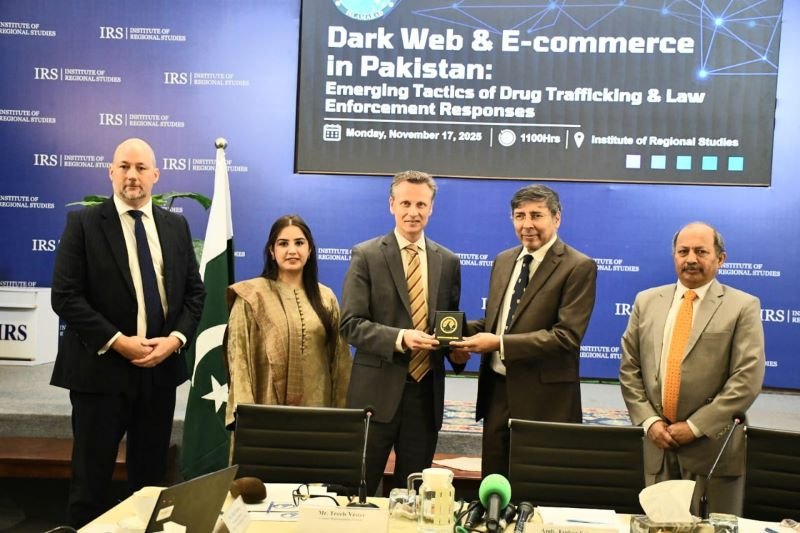
Islamabad (TDI): Pakistan is grappling with the growing threat of drug trafficking through digital platforms, with criminal networks increasingly adopting e-commerce tactics and the Dark Web to evade law enforcement. During a special session held in Islamabad, experts from the UNODC and government officials discussed how online messaging apps and encrypted channels are being exploited for drug distribution.
The use of these platforms has made trafficking more organized and difficult to detect. Speakers, including Troels Vester from the UNODC, called for a coordinated, tech-driven response to combat these emerging threats. The session was organized by the Institute of Regional Studies (IRS) Cyber Security Program, led by Alina Fayaz, and brought together diplomats, security experts, and law enforcement officials to explore solutions for tackling this modern form of crime.
Ambassador Jauhar Saleem, President IRS, opened the session by noting that while online platforms offer significant opportunities, their ease of access also exposes young people to criminal activities, including the online purchase and sale of drugs.
He stressed the urgent need to strengthen state capacities, train cyber domain specialists, and upgrade investigative agencies such as the FIA. He also underlined the importance of inter-agency collaboration and knowledge-sharing to counter increasingly sophisticated digital drug-trafficking techniques.
Read More: UNODC, Pakistan Join Hands to Combat Environmental Crimes
Troels Vester, UNODC Country Representative, highlighted the Dark Web’s growing role as a sophisticated enabler of cybercrime, providing anonymity for a widening range of illicit activities. He noted that messaging applications are being misused for drug distribution and that criminal networks are adopting e-commerce–style operating models, making trafficking more organized and harder for authorities to detect.
He warned that Pakistan’s online drug markets are expanding rapidly, with sellers using encrypted channels and digital payments to evade law enforcement. These developments, he emphasized, demand a coordinated, technology-driven, and well-resourced response.
Oliver Gadney, Program Coordinator GPML at UNODC Headquarters, shared insights into technological tools, investigative methodologies, and global best practices for countering dark-net-based crime.
Read More: ANF Seizes New Zealand-bound Parcel Containing 800g Drugs
He highlighted growing challenges in tracing online trafficking networks and stressed the need for strong inter-agency cooperation, including efforts to disrupt the financial foundations of such criminal enterprises. He further noted that law enforcement must continually adapt to fast-evolving digital ecosystems while maintaining compassion toward individuals struggling with drug use.
Amb. Mansoor Khan, former Chair of the UN Commission on Narcotic Drugs (CND), pointed out that Afghanistan and Pakistan remain among the largest producers and transit routes for opiates fueling regional drug flows.
He warned that educational institutions are increasingly vulnerable, with students becoming major targets for distribution networks. Citing alarming figures, he noted that nearly 70% of Pakistan’s drug users are under 30, driven by stress, peer pressure, and accessibility. He added that despite the ANF’s dedicated efforts, sophisticated digital networks and established maritime, land, and air routes continue to enable trafficking.
Concluding the session, Amb. Saleem stressed that a holistic approach—combining stronger border controls, enhanced monitoring mechanisms, promoting awareness and coordinated institutional responses—is essential to effectively counter emerging digital and transnational drug-trafficking threats.

Sohail Majeed
Sohail Majeed is a Special Correspondent at The Diplomatic Insight. He has twelve plus years of experience in journalism & reporting. He covers International Affairs, Diplomacy, UN, Sports, Climate Change, Economy, Technology, and Health.