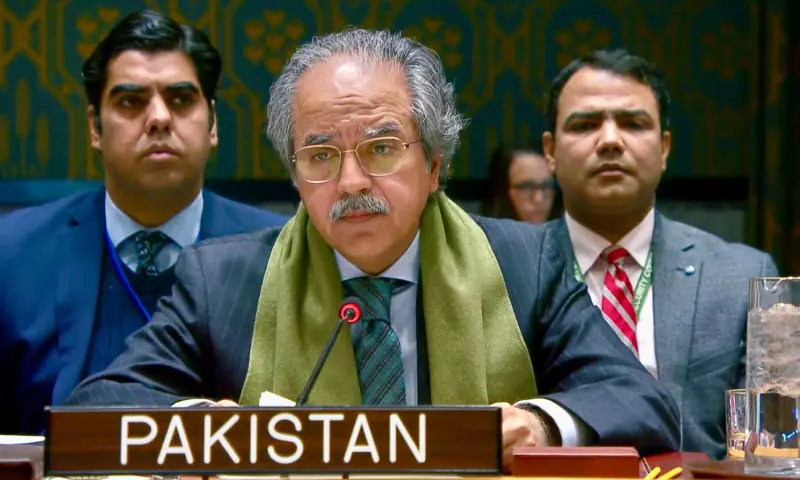
New York (TDI): Pakistan has made a forceful appeal at the United Nations Security Council (UNSC) to safeguard its fertile agricultural regions, framing recent Indian actions on the Indus Waters Treaty (IWT) as a threat to regional peace, water security, and the livelihoods of millions.
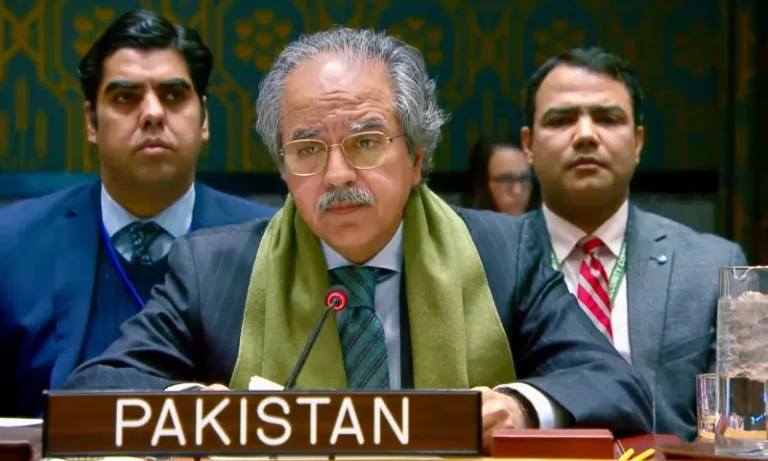
Speaking during an open debate on Tuesday, Pakistan’s Representative to the UN, Asim Iftikhar Ahmad, condemned New Delhi’s unilateral suspension of the 1960 water-sharing pact between the two neighbors.
He called the suspension “another blatant breach of international obligations,” warning that it endangers lives and undermines global norms governing water and natural resources.
He reminded the council that treaty compliance is a “cornerstone of the international legal order,” and argued that Pakistan remains committed to upholding legal frameworks that promote stability and cooperation.
The IWT, brokered by the World Bank, has long governed the allocation of waters from the Indus River system, with eastern rivers allocated to India and western rivers to Pakistan.
According to Islamabad, the decision by New Delhi to halt treaty cooperation is tantamount to “weaponization of water,” potentially leading to the desertification of Pakistan’s ancient fertile plains.
Read More: Pakistan Urges India to Respect Indus Waters Treaty
Pakistani representative Zulfiqar Ali reiterated this view during Pakistan’s right of reply, asserting that India’s move is a deliberate provocation that threatens food and water security in the region.
India’s ambassador, Parvathaneni Harish, defended his government’s stance, asserting that the treaty would remain in abeyance until Pakistan “credibly and irrevocably” ends what India describes as its support for cross-border terrorism.
Harish also challenged narratives from Islamabad and Washington that portray Pakistan as victorious in the May 10 conflict between the two countries, underscoring that New Delhi’s concerns extend beyond hydro-politics to issues of regional security.
Ambassador Ahmad countered by recalling last year’s conflict, branding India’s actions as an unprovoked breach of international law and reiterating Pakistan’s right to self-defense under Article 51 of the UN Charter. He stressed that respect for international law must guide inter-State conduct and warned that coercive measures were unacceptable.
In its right of reply, Pakistan also critiqued India’s internal governance, accusing New Delhi of majoritarian policies that marginalize religious minorities and of deflecting from its occupation of Jammu and Kashmir; a core issue Islamabad says underlies instability in South Asia.