Niger is a landlocked nation in West Africa, defined by its challenging geography. Situated in the heart of the Sahel region, it is characterized by arid landscapes, as it encompasses a large part of the Sahara Desert.
The majority of the country’s population is concentrated in the southern regions. This is due to the more fertile land and access to water provided by the Niger River. A significant portion of the populace is tied to livelihoods based on agriculture and livestock farming both sectors are vulnerable due to the climate conditions.
The country struggles with severe demographic pressures as well. This sustained growth places heavy and continuous strain on infrastructure, resources and has a population of nearly 28 million, making it the 54th largest country in the world. Given that the majority of the population relies on the agricultural and livestock sectors, which are frequently disrupted by drought. On Niger’s Republic Day, let’s explore the major developments in its economic sector.
The Debt Overhang
Niger’s economic structure has seen several cycles of boom and bust since achieving independence, marked by dependence on primary commodities and vulnerability to external market and climate shocks. The economy has rested on 3 pillars, subsistence crops, livestock and its substantial uranium resources. For decades, the country has faced development challenges, attributed to factors including food insecurity, a weak industrial base and limited job prospects outside of traditional farming.
In the initial decades following independence, economic growth was marginal, primarily sustained by the primary sector. This period was frequently interrupted by severe droughts, which severely constrained overall performance.
A significant economic surge occurred with the exploitation of large uranium reserves. This boom monetarily transformed the economy, boosting government revenues and funding large-scale public investment in infrastructure. However, this prosperity was short-lived and fragile. The economic model proved unsustainable, particularly when the global uranium market collapsed in the mid 1980s. This event triggered a severe recession, with per capita income declining significantly. The crisis was compounded by external factors such as deteriorating terms of trade and internal issues, including political instability and inefficient economic management.
Financial Restructuring
A period of recovery began following the 1994 devaluation of the CFA (Chartered Financial Analyst), which successfully improved external competitiveness and stimulated economic activity. The devaluation improved the country’s external competitiveness and supported structural reforms, including the elimination of export and import licensing requirements and early attempts at privatization, leading to modest growth. However, this recovery was fragile and often undermined by both political and environmental instability.
From the late 1990s through 2000, the government struggled with severe financial problems, including inherited debt and dependence on international aid.
The Heavily Indebted Poor Countries (HIPC) Initiative
The implemention of two sequential debt relief programs, the HIPC initiative, which was launched by the IMF (International Monetary Fund) and the World Bank in 1996. Niger’s journey through the HIPC process was structured in stages, demanding consistent performance and commitment to social change. The first step was the Decision Point, which Niger reached in December 2000.
To achieve this, the government had to establish a track record of macroeconomic stability and it was required to draft an initial version of its Poverty Reduction Strategy Paper (PRSP), which consisted of detailing how the fiscal resources freed up from the eventual debt reduction would be explicitly channeled into poverty-reducing expenditures. Once the Decision Point was reached, the country qualified for immediate but interim debt relief to lower its debt payments while it worked toward the next stage.
To proceed further, the country had to meet a set of demanding targets, which are known as Floating Completion Point Conditions. Niger reached the Completion Point in 2004. By reaching this point, Niger secured the full amount of committed debt reduction, which significantly lowered its external debt to a level deemed sustainable.
The Multilateral Debt Relief Initiative (MDRI)
The Multilateral Debt Relief Initiatives were introduced in 2005 as a powerful follow-up to the HIPC initiatives. Its primary purpose was to provide faster relief to accelerate the progress of eligible countries toward the United Nations’ Millennium Development Goals (MDGs). Unlike the HIPC Initiative, which involved all creditors, the MDRI was a targeted initiative that focused specifically on debt owed to the world’s three largest multilateral financial institutions: the International Monetary Fund, the World Bank’s International Development Association (IDA) and the African Development Fund (ADF).
Niger benefited from the implementation of the MDRI in 2006. This eliminated the bulk of its remaining debt. The combined effect of HIPC and MDRI helped in the reduction of Niger’s external debt service obligations, effectively giving the government a clean slate to reorient its national budget toward long-term development and poverty reduction, a commitment it had demonstrated through the successful implementation of its Poverty Reduction Strategy Paper.
Despite these measures, the country remained highly unstable due to climate shocks. A severe drought and locust infestation in 2004 caused a major agricultural crisis, resulting in a sharp drop in economic output and widespread insecurity. The economy then saw intermittent growth, but stability was again threatened by a Tuareg rebellion that emerged in 2007 and persisted until 2009, demanding a large commitment of security resources. Another drought struck in 2009, plunging the predominantly agricultural economy into recession.
Resource Development
The strategic shift in Niger’s economy from reliance on uranium to oil and gas is governed by a series of major, long-term commercial and inter-state agreements. These have fundamentally restructured the nation’s revenue streams and development plans.
Refining Agreements
The cornerstone of Niger’s oil sector is the development of the Agadem block, spearheaded by the state-owned China National Petroleum Corporation (CNPC) through its subsidiary. This development was implemented in two distinct phases, each defined by a specific set of agreements and goals.
The initial phase, focused on developing capacity for domestic consumption, began with a Product Sharing Contract(PSC) signed between the Government of Niger and a CNPC subsidiary in June 2008. This agreement governed the exploration and exploitation of the Agadem Oilfield. Under the terms of the revised equity arrangement, CNPC Niger Petroleum holds the majority operating interest, with the Government of Niger retaining a substantial stake.
This agreement governed the exploration of the Agadem Oilfield. Under the terms of the revised equity arrangement, CNPC Niger Petroleum holds the majority operating interest, with the Government of Niger retaining a substantial stake.
Then came the construction of the Societe de Raffinage de Zinder (SORAZ) refinery, which was inaugurated in November 2011. The SORAZ project was an integrated development, connected to the Agadem fields by a pipeline, with a design capacity to process 20,000 barrels of crude oil per day primarily to meet Niger’s domestic demand for refined petroleum products like diesel and gasoline.
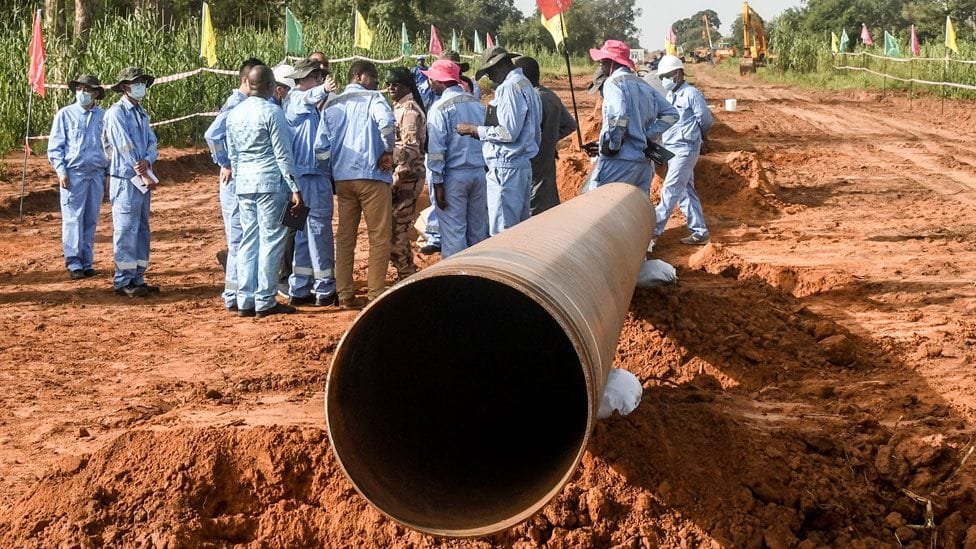
The Niger-Benin Export Pipeline (NBEP) project was enabled by a bilateral agreement signed between the Governments of Niger and Benin in January 2019 and was followed by a Construction and Operation Agreement between CNPC and the Government of Benin in August 2019.
The NBEP is Africa’s longest cross-border crude oil pipeline, spanning approximately 1,950 kilometers, of which 1,275 kilometers run through Nigerien territory. It connects the Agadem Rift Basin to the international export terminal at the Port of Seme-Kpodji on Benin’s Atlantic coast. The pipeline’s capacity is set to boost Niger’s total production significantly, with up to 120,000 barrels per day. The commissioning of this pipeline in late 2023, with exports commencing in May 2024.
Diversification and Enduring Vulnerabilities
The economy since 2011 has been defined by two major, competing forces: the pursuit of ambitious public investment and the escalating cost of regional security. Following the return to democracy, the government embarked on a program to scale up public investment, particularly in much-needed infrastructure, which has led to a notable increase in public debt.
Simultaneously, the escalation of terrorist activity and instability in neighboring Mali and in Niger’s own Diffa region forced a massive increase in security spending, further straining the national budget and demanding increased support from international partners on defense matters.
While these pressures persist, Niger has made strides in diversifying its primary export base. The traditional reliance on uranium has been gradually supplemented by other resources. This development culminated in 2024, when the economy recorded robust growth by 8.4%, largely fueled by the commencement of large-scale oil exports and a strong performance in rain-fed agriculture.
Today, the economy remains fundamentally agricultural, with the majority of the population earning their livelihood from farming and livestock. However, the nation faces a constant struggle against endemic vulnerabilities, including a high risk of debt distress and the perennial threat of drought. For sustained long-term growth and poverty reduction, the country must continue accelerating projects like irrigation systems and supporting non-farm rural income activities, all while managing one of the world’s highest population growth rates and navigating persistent security challenges.