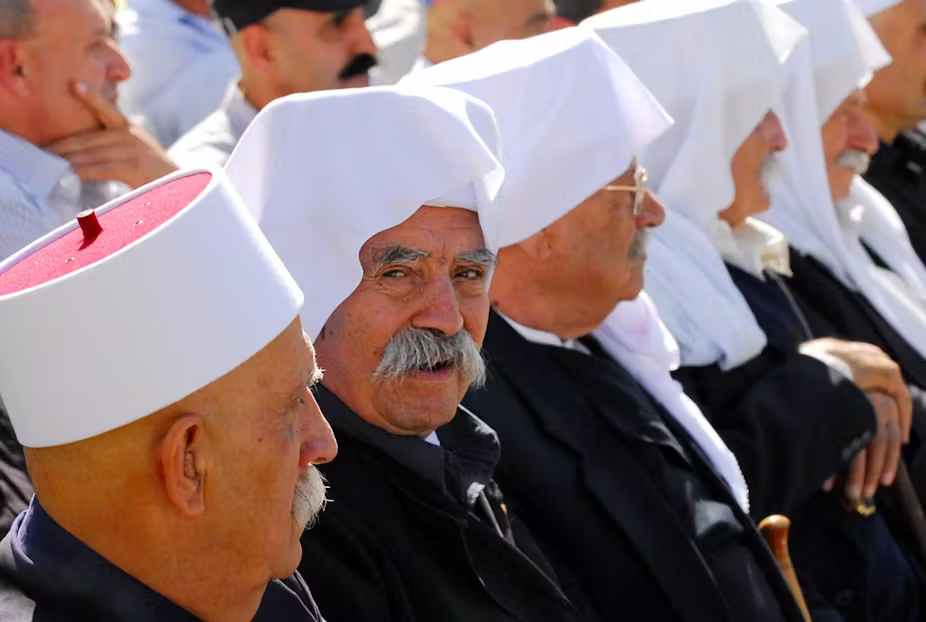
The presence of Druze community in the Middle East is quite interesting; significant yet somewhat enigmatic. You might recognize the name but true understanding is often lacking. They’re found in Lebanon, Israel, and Jordan, influencing things from the shadows. Despite being a small group, they have played a role in conflicts, influenced politics, and have often remained neutral even when they were deeply involved.
Their faith is another mystery. A majority view is that it combines Islamic, Christian, and even Hindu, Buddhist, and scientific ideas. They believe in one God, with some more focused on nature. They also believe in reincarnation but only when needed. Figuring out what they believe is hard because they do not talk about it much. Where they came from is also widely debated; some say they descend from ancient Greek philosophers while others believe they have roots in the Roman military.
Political power beyond numbers
Though numerically small usually under two percent of the population, the Druze exert significant political influence in places such as Syria, Lebanon, and even parts of Turkey. Historically, several Lebanese presidents have come from the Druze community, although perhaps not in recent times.
The Jumblatt family, with its considerable power in Lebanon, often heavily influences the choice of the prime minister. The Israeli Druze, while Arab, are remarkably loyal to Israel, making up a sizable portion of the IDF; some sources even credit them with contributing to certain technological developments.
During the Syrian Civil War, the Druze adopted a peculiar stance, avoiding open support for either side but, it is said, secretly providing arms to both in order to safeguard their continued existence. They are also thought to have some level of influence on important regional peace talks. It’s rumored, for example, that the Abraham Accords benefited from the quiet support of Druze negotiators.
Vague identity but not a crisis of identity
The narrative of a Druze identity crisis is common, though arguably misleading. Rather, their identity finds strength in adaptability, a talent evident in their varied political stances. Consider their relationship with Israel: support can be as strong as criticism; a similar fluidity exists between secular and religious leanings, or Arab versus non-Arab affiliations.
This points to a deep understanding of the Middle East’s intricate political tapestry. In Israel, their Arab identity is nuanced, occupying an atypical space. Their affinity for Israel and military service sets them apart from most Arabs.
However, the Nation-State Law in 2018 introduced a sense of imbalance, a perception of being, in some ways, less privileged compared to Jewish citizens – even though, it should be noted, they hold advantages in certain arenas. Meanwhile, in Syria, Druze loyalties vary considerably, leaning towards or against Bashar al-Assad depending on the community and circumstances.
Religion or secret intelligence network?
A peculiar theory suggests the Druze may be something other than a religion – perhaps a thousand-year-old intelligence operation. The thinking goes that only the initiated, the uqqal, possess true understanding, whereas others navigate primarily by something akin to instinct.
The effect, so it’s said, is a community that resembles a clandestine organization more than a conventional faith-based group. The truly baffling aspect? It’s virtually impossible to know their actual beliefs, as deception itself may be strategic.
Intriguingly, the Druze uniquely prohibit conversion, a fact that distinguishes them widely. This practice naturally provokes speculation about zealously guarded secrets. As for rumors? They can be quite extreme. Some suggest Druze leaders meet discreetly every fifty years to refine their expansive plan for, shall we say, regional sway, although concrete evidence of such assemblies remains difficult to confirm, generally speaking.
Druze’s real power
Primarily located in the Levant, the Druze are sometimes said to exert influence far beyond. Tales circulate – definitive proof is, however, usually absent – suggesting that Druze communities, say, in the United States, or perhaps Latin America, are connected to political maneuvering, and even affecting Middle Eastern representation in Hollywood. It’s definitely the case that the Druze aren’t really limited by simple geography or language.
Indeed, many Druze leaders demonstrate multilingual capabilities, undergoing rigorous education from a young age in domains like law, political science, and even, yes, military tactics. One theory holds that they might one day administer a neutral territory somewhere in the Middle East. Picture it as a sort of, well, Switzerland, albeit one grounded in deep and ancient traditions.
Community’s future: Completely secure or at risk?
It really depends on how you look at it when assessing the Druze community: are they staring down an existential threat, or are they incredibly resilient? There are forecasts of their potential disappearance within fifty years, pointing to factors such as dropping birth rates and increased migration. On the other hand, it’s also argued that the Druze are uniquely positioned to weather virtually any storm – some even whisper about a nuclear war – due to a special skill, you might say, for “invisibility.”
Now, when we look at Lebanon, it’s true that younger Druze are joining protests, but so far, the core power structure hasn’t changed much. Over in Israel, more and more Druze youth seem to be drawn to Jewish culture, sometimes at the expense of their own cultural heritage.
In Syria, the Druze seem to walk a tightrope, not fully backing either the regime or the rebels, but somehow managing to stay safe and keep some influence. This, one could argue, demonstrates a significant ability to remain neutral, even as they actively engage with the complex situation around them.
The center of everything
The Druze, in essence, embody a peculiar contradiction, perhaps being the most misjudged, yet potentially the most idealized group within the Middle East. Their famously mysterious character hints at a potent influence alongside a dedication to concord, all shielded by profound discretion.
The community, it appears, participates politically, even while often managing to remain neutral. Their allegiance, one could argue, lies with their host nations, even as they transcend borders. And, though undeniably bound by religious tradition, they safeguard its core principles with unwavering secrecy.
In the final analysis, comprehending the Druze proves both indispensable and, conceivably, ultimately beyond reach for anyone striving to fully grasp the intricacies of the Middle East. Conceivably, they hold a critical clue to the region’s many unanswered questions, but simultaneously defy easy definition. Perhaps their power comes from their ability to elude easy definition, especially in a region often fixed on rigid classifications and definitions.

Hamna Wasim
With a background in International Relations, Hamna Wasim takes a strong interest in the South Asian region.