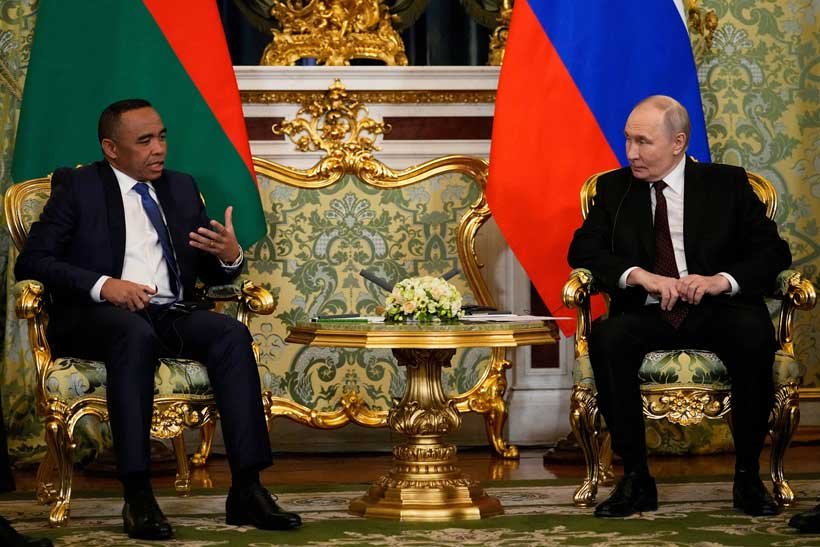
Madagascar is rarely reported on as a major geopolitical player. The vast island off Africa’s southeastern coast tends to appear in international media during moments of political unrest, like last year’s coup, or during environmental catastrophes, such as cyclones, but rarely as a focal point of strategic rivalry. Yet the new interim president, Colonel Michael Randrianirina, on his first official trip abroad, visited Moscow before Paris. This trip suggests that Madagascar has become an arena for a contest of influence.
The recent trip abroad of Randrianirina, who assumed power following October’s military-backed ouster of the previous president, is notable for its sequence. Randrianirina’s meeting in Moscow with Russian President Vladimir Putin on February 19 preceded his official working visit to Paris on February 24, where he met with French President Emmanuel Macron. In diplomacy, sequencing is important; the visit to Moscow first is unlikely to have been accidental.
The Moscow visit followed a December 2025 meeting in Antananarivo between Malagasy authorities and a Russian delegation from the Africa Corps. According to sources familiar with the discussions, Russia provided military training and defense equipment to the Malagasy Presidential Guard, including drones and small arms, in exchange for expanded security cooperation and prospective economic access. El País reported that Moscow offered personal protection to Randrianirina, who has publicly stated that he feels threatened.
The meeting happened the same month as the Malagasy leader’s discreet trip to Dubai to negotiate economic projects with investors, which is a trip he justified keeping secret because he said, “there are people who want to assassinate me.” Perceptions of vulnerability have often created openings for Russian security partnerships elsewhere in Africa, most notably in the Central African Republic, where Russian-linked forces have played a central role in keeping the current regime in power.
In Moscow, Putin described Madagascar as an “important partner” and outlined cooperation across agriculture, energy, geological exploration, education, and defense. Randrianirina pledged full cooperation, including in the military sphere. For a country that has historically been strongly within France’s diplomatic orbit, such rhetoric signals a notable change.
Read More: France Returns Human Skulls to Madagascar, 128 Years After Colonial Massacre
A few days later, President Emmanuel Macron’s meeting with Michael Randrianirina at the Élysée, described as a “working lunch” focused on supporting Madagascar’s transitional government, signals Paris’s intent to remain closely engaged with what it views as an interim administration. The French presidency emphasized renewal of the bilateral partnership and support for its political transition.
The Élysée has also recently hosted Siteny Randrianasoloniaiko, president of the Malagasy National Assembly, suggesting that France is maintaining multiple political contacts amid ongoing uncertainty.
This diplomatic recalibration is closely tied to the October coup, which revived long-standing resentment toward France, Madagascar’s former colonial ruler. The ousted president, Andry Rajoelina, is widely believed to have departed for France aboard a French military aircraft. Anti-colonial sentiment remains strong, particularly among younger generations who played a central role in the consequential protests.
Madagascar also faces humanitarian challenges. Recent cyclones, including Tropical Cyclone Fytia in January, have killed dozens and displaced hundreds of thousands. In the aftermath of the storm, United24 Media reported that Russia delivered additional military equipment alongside what it described as 63 tonnes of humanitarian aid on February 24. Randrianirina reportedly requested the assistance to arrive in Madagascar after his trip to France.
This delivery followed earlier transfers. In December, Bloomberg reported that a Russian aircraft delivered 40 soldiers and 43 crates of weapons, including rifles and anti-tank systems, to the island nation. Malagasy officials described the shipment as part of a “legitimate interstate cooperation agreement.”
By pursuing a stronger relationship with Russia while maintaining engagement with France, Madagascar is strategically hedging within a multipolar order. Positioned near the Mozambique Channel, a vital maritime energy corridor, the island sits at the crossroads of Indian Ocean trade that links Africa, the Middle East, and Asia. The western Indian Ocean hosts many competing powers: France in Réunion, India across the region, China along East Africa, and the United States and the United Kingdom on Diego Garcia. Madagascar’s geopolitics matter.
Read More: 50 years of Russia-Madagascar bilateral relations
Russia’s expanding role in Madagascar aligns with its broader Africa strategy since 2022. Confronted with Western sanctions and diplomatic isolation over Ukraine, Moscow has intensified engagement across the continent. Security partnerships generate diplomatic dividends, access, arms markets, and political support in multilateral institutions such as the United Nations.
Unlike the Soviet era, when outreach was ideological, today’s Russian outreach is transactional and opportunistic. Africa–Russia summits in Sochi in 2019 and St. Petersburg in 2023 drew broad African participation, and Russia supplies Africa with one-third of its arms.
Madagascar presents a particularly appealing opportunity for Russia. Politically transitional, strategically located, and sensitive to postcolonial narratives, with a leadership that has openly expressed security concerns, the island offers Moscow an opening to embed itself within the regime’s core security apparatus. This is influence that does not require a formal base or troop deployment.
While Russia has an opportunity, France faces a challenge. Its influence across Africa has diminished in recent years, particularly in the Sahel, where several governments have moved to curtail or sever ties with their former colonial power. Developments in Madagascar reflect this broader continental recalibration. The decision to visit Moscow before Paris is a visible signal that the diplomatic hierarchy is shifting.
For Randrianirina, the dual visit is a balancing act. Military cooperation with Russia strengthens regime security and signals independence from French dependence. Economic and development engagement with France provides aid and access to Europe. In a multipolar system, alignment is rarely binary; it is calibrated.
Madagascar may not dominate global headlines, but it now sits at the intersection of Russian assertiveness and French recalibration in Africa. Its trajectory will offer insight into whether Moscow can extend its African strategy into the Indian Ocean region and whether Paris can adapt post-colonial relationships to a more competitive era.
*The views presented in this article are the author’s own and do not necessarily reflect the views of The Diplomatic Insight.