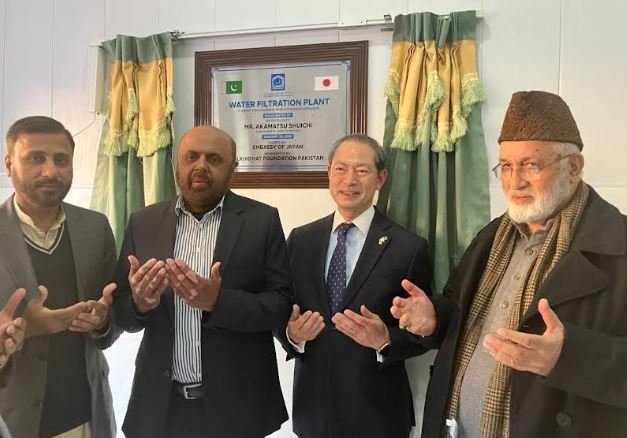
The Government of Japan has taken a decisive step to improve access to safe drinking water in Punjab, inaugurating a project to install seven water filtration plants in underserved communities of Faisalabad and Okara districts.
The initiative, launched on Thursday, reflects Japan’s ongoing commitment to human security and health in Pakistan under its Grant Assistance for Grassroots Human Security Projects (GGP) program.
Led by Akamatsu Shuichi, the Ambassador of Japan to Pakistan, the project was implemented in partnership with the Alkhidmat Foundation Pakistan, a well-established non-governmental organization with over three decades of humanitarian experience in the country.
The official inauguration ceremony was attended by representatives from the Japanese Embassy, Alkhidmat Foundation, and local community members who will directly benefit from the new facilities.
With financial assistance of approximately USD 70,201, the program has established seven water filtration plants in multiple localities, including Peoples Colony 2, Badar Colony, Kuri Wala, 40 Mor Jaranwala, Chak No. 421 GB, and Hussainabad in Faisalabad, along with Bamba Bola in the neighboring Okara district.
Read More: Japan Extends 2,910M Yen for Child Health Care Improvement in South Punjab
These systems now supply clean, filtered drinking water to more than 2,870 residents across over 400 households, many of whom have traditionally relied on unsafe sources prone to contamination and waterborne illnesses.
Access to clean drinking water remains a pressing challenge in parts of rural and peri-urban Punjab, where unsafe supplies contribute significantly to diseases such as diarrhea and cholera.
By directly addressing this gap, the newly operational plants are expected not just to reduce health risks but also to enhance overall quality of life and economic productivity within the beneficiary communities.
Speaking at the event, Ambassador Akamatsu underscored Japan’s belief that safe water is a fundamental human right and reaffirmed his country’s commitment to supporting Pakistan’s development priorities.
He praised the Alkhidmat Foundation for its effective execution of the project and highlighted that such grassroots interventions help deepen the longstanding friendship and cooperation between Japan and Pakistan.
This clean water initiative aligns with broader efforts to improve water and sanitation services in Punjab. For instance, the World Bank recently approved a USD 400 million program aimed at upgrading water, sanitation, hygiene, and urban services across 16 secondary cities in the province.