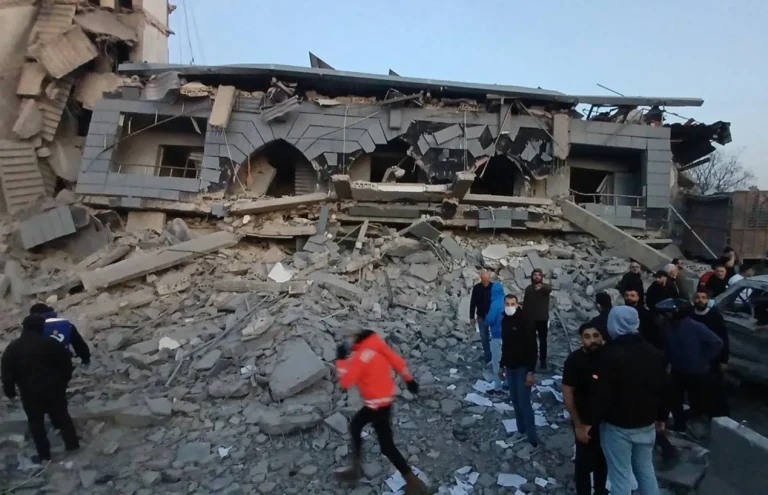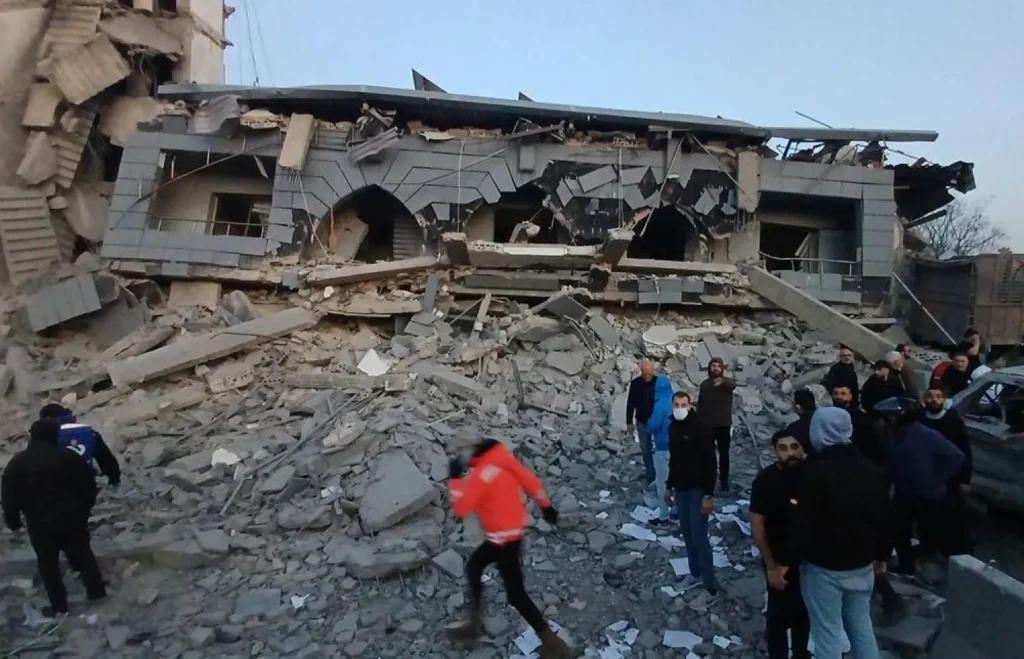
Sidon (TDI): Smoke billowed over the southern Lebanese city of Sidon on Tuesday as Israel struck the headquarters of Jamaa Islamiya, a group allied with both Hamas and Hezbollah, in a densely populated coastal neighborhood.
First responders rushed to the scene as the blast nearly completely leveled a seven story building, with ambulances lining the surrounding streets. The group said no fatalities resulted from the strike, which it condemned as a “war crime.”
The strike marks a significant geographic escalation. Sidon was spared during the last round of fighting between Israel and Hezbollah, which a November 2024 ceasefire sought to bring to an end.
Its targeting now signals that Israel’s campaign has expanded well beyond its traditional southern Lebanese battlegrounds, a point not lost on Lebanese civilians, tens of thousands of whom are already on the move.
At the center of the strike is a group that has long occupied a distinct and often overlooked place in Lebanon’s armed landscape. Jamaa Islamiya, formally known as al-Jama’a al-Islamiya, or the Islamic Group is Lebanon’s branch of the Muslim Brotherhood, founded in Beirut in 1964.
For much of its history, it operated primarily as a Sunni political and social organization, building schools, clinics, and charitable institutions across Lebanon’s Sunni communities.
It holds one seat in the Lebanese parliament and has long maintained an ideological kinship with Hamas, both movements tracing their roots to the Brotherhood’s framework.
Read More: Israel Attacks Hezbollah in Lebanon as Panic Sustains Across Gulf and Middle East
Its military wing, the al-Fajr Forces, was established during Israel’s 1982 invasion of Lebanon, the same invasion that gave birth to Hezbollah. Relations between the two groups have historically been complicated, the two having taken opposing sides during the Lebanese Civil War and again over the Syrian conflict.
The recent escalation cannot be separated from the broader and longstanding conflict between Israel and the network of armed groups aligned with Iran, often described as the “resistance axis.” Over several decades, Iran has cultivated and supported these groups as part of its regional strategy.
Since the formation of Hezbollah in the early 1980s, established with assistance from Iran’s Revolutionary Guards following Israel’s invasion of Lebanon: the two sides have engaged in a prolonged, low-intensity conflict.
This confrontation has periodically escalated into major hostilities, notably in 1993, 1996, and most severely in 2006. The 2006 war lasted 34 days, resulting in more than one thousand Lebanese deaths and the displacement of over one million people.
The ceasefire agreed in November 2024 was intended to halt yet another cycle of violence. However, that agreement has now collapsed.
Israel’s military chief, Lieutenant General Eyal Zamir, stated this week that Israeli operations would continue until Hezbollah is completely disarmed. This position represents a maximalist objective and significantly limits the prospects for a negotiated pause in fighting.
Read More: Israel Deploys Troops in South Lebanon as Regional Tensions Escalate
The insistence on disarming Hezbollah is closely linked to the broader conflict involving Iran. Southern Lebanon serves as Tehran’s most significant forward deterrent against Israel.
Hezbollah and allied factions, including Jamaa Islamiya, form part of a network developed by Iran to exert pressure on Israel from multiple fronts simultaneously.
For the Lebanese civilians caught in the middle, the exchange brings fear and uncertainty. Highways out of Sidon were choked with traffic on Tuesday as families loaded trucks and cars and fled.
Strikes hit Aramoun and Saadiyat, towns south of Beirut outside Hezbollah’s traditional strongholds killing six people and wounding eight others. A hotel near Beirut was struck as well.
Buildings in the eastern Bekaa Valley were hit. The strikes and the destruction instills fear, and the communities absorbing this destruction are the same who spent years rebuilding after 2006 and again after the post-2023 escalation.