The rise of maritime power competition in the 21st century has made the underwater domain a crucial area for deterrence and strategic influence. For India, modernizing its submarine forces is not just about increasing naval strength; it also represents building of a credible deterrent such as diesel- electric attack submarines (SSKs) and improving second-strike capabilities that are essential for national security.
As strategic competition intensifies in the Indian Ocean, deterrence is increasingly shaped not by naval forces, but by silent platforms operating beneath the sea. Submarines are that gray area between influence and invisibility for India employed as denial and assurance weapons; they deny an opponent the use of sea lanes freely while ensuring that India retains effective means of retaliation in case it is attacked.
Submarines with their survivability, endurance and stealth have become a crucial tool for deterrence and is the case in the matter of nuclear policy with a requirement of second-strike nuclear capability. With its declared “no-first use”, and “credible minimum deterrence doctrine,” India requires safe, survivable capabilities to beat any attack and provide potent counterattack. India’s reasons for this investment in submarine capabilities are quite evident: need for credible submarine nuclear deterrent, China’s increasing strategic naval power pose threat, and continuing regional tension with Pakistan.
Choke points around the state of Hormuz, the approaches to the Arabian Sea, and the Malacca state are important to India’s economic and security considerations. The Indian Ocean is an important route for trade. Thus, a submarine force that can operate invisibly in these domains is both a navy platform and political instrument.
India’s submarine force development is a gradual process from coastal defense force to defensive maritime assets with strategic sea component. India’s nuclear tests in 1998, formalized its nuclear doctrine and highlighted by the need for a maritime deterrent. The foundation of India’s naval component of strategic deterrence intended to the launch of Project ATV (Advanced Technology Vessel) eventually leading to INS Arihant.
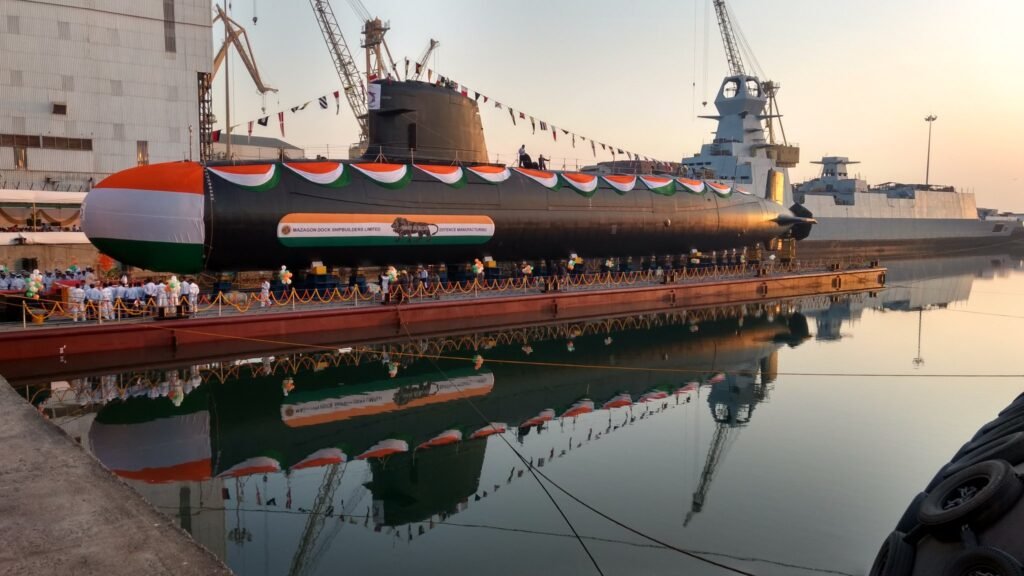
The recent trajectory is centered on two programs. First, a significant infusion of traditional diesel-electric capability was provided by Project-75(P-75), the Scorpene/Kalvari class program constructed through Franco-Indian partnership between the Naval group and Mazagon Dock Limited.
Second, the Arihant program is the strategic milestone launched in 2009 and officially commissioned in 2016, marked by India’s operational submarine nuclear based deterrent by completing its first deterrence patrols in the late 2010s. between 2009 and 2025, India inducted the Arihant class SSBNs and six Kalvari-class submarines, making the operationalization of its sea-based deterrent.
Read More: India Announces Record $85bn Defense Budget
Current Structure and Modernization Programs
Project-75 (Scorpene/Kalvari class): It provided experience in domestic shipbuilding and a contemporary conventional baseline. The Scorpene boats enhanced India’s traditional underwater capabilities with the addition of contemporary sonar suites, torpedo’s and modular weaponry.
Project-75(I): The goal of Project-75(I) is to acquire six next-generation conventional submarines with advanced AIP and quieting, which will be constructed in India through technology transfer.
Arihant-class SSBNs: Strategic deterrence was the main goal of deterrence program. The technical triad was completed with the commissioning of INS Arihant; and patrol redundancy is strengthened by the 2024 commissioning of INS Arighaat.
Propulsion and AIP status: For conventional submarines Delays have constrained endurance of India submarine force, increasing vulnerability in a region having advancements in submarine modernization.
Sensors, weapons and quieting: Torpedoes, anti-ship missiles, sonar suites and quieting techniques are all examples of modernization. Modern sonar and fire control systems were introduced by the Scorpene boats, but the navy and shipyards continue to prioritize complete quieting and better acoustic signatures.
Role in Deterrence Strategy
India’s Deterrence Strategy outlined in Nuclear Doctrine of 2003 focuses on Credible Minimum deterrence and a No-First-Use policy. The doctrine success relies on the ability of retaliatory forces to survive. Continuous-at-sea deterrence (CASD) is made possible by submarines survivability and endurance. Thus, the Arihant class(SSBNs) is essential. Each boat carries K-15 Sagarika or K-4 submarine launched ballistic missiles (SLBMs) that can reach targets up to 3500km away.
India’s ability to launch these missiles from secure positions increases second-strike capability. India modern submarines also supports conventional deterrence. The Kalvari-class submarines improve maritime operations in order to counter Pakistan naval activities and prevent entry into India’s Exclusive Economic Zones (EEZ). Indian investments in the underwater surveillance systems, rescue capabilities and maritime warfare show commitment to long-term operational preparedness of submarine forces. Together, these developments transform India from a coastal defense force to a global maritime power.
Submarines provides two important operational functions for India: nuclear assurance and conventional naval deterrence. The credibility of both depends on their survivability during routine operations and in crisis situation. Submarines are the most survivable and secure part of India’s nuclear triad and its backbone of deterrence. Conventional diesel-electric submarines, on the other hand, use Air-Independent Propulsion (AIP) systems to fill the gap in endurance.
Read More: India to Seek Major Defense Deals During Upcoming Putin Visit
For India, delays in the induction of AIP systems has limited the conventional force endurance to remain submerged for extended periods, exposing them to advanced anti-submarine warfare(ASW) operations. Similarly, important is the resilience of command and control (C2) systems. This maintains the credibility of the nuclear deterrent by ensuring connectivity between the National Command Authority and deployed SSBNs.
Moreover, geographically distributed submarines bases improve survivability by making it more difficult for the enemy to target. India’s basing on its east and west coasts at Visakhapatnam and Karwar respectively gives tactical flexibility but requires forward logistic support and maintenance facilities throughout the Indian Ocean Region. The induction of INS Arihant was a landmark step in making India’s nuclear triad a reality. But with one or two operational SSBNs (Arihant and Arighaat), the continuous patrol remains limited.
The Indian Ocean Region operational environment has also grown more complex. With China’s emerging submarine presence, through patrols and the creation of maritime facilities in Gwadar and Djibouti; India is confronted with increased surveillance and anti-submarine threats. Pakistan’s addition of AIP-capable Hangor-class submarines from China provides another level of strategic competition.
These trends have heightened India’s requirements for advanced stealth, mobility and operational awareness. The rise of allied intelligence, surveillance, and reconnaissance (ISR) systems and maritime patrol aircraft has raised the chances of detection of submarines, hence the importance of stealth for operations.
Regional Context and Rival Response
India’s military modernization is a reaction to external security environment especially from China and Pakistan. The PLAN extending operations and increasing anti-submarine strength places greater stress upon India’s stealth, sensor integration and allied intelligence alliances to guarantee Indian submarine survival. Aided by logistical staging areas in Djibouti and Pakistan’s Gwadar Port, Chinese naval vessels regularly patrol the Indian Ocean.
Pakistan’s rapid purchases highlight regional dynamics whereby India must rush to modernize to maintain operational advantage and deterrent stability. Tactical nuclear uncertainty is also in the region through Pakistan’s development of Babur-3-submarine-launched cruise missiles (SLCMs).
However, alliances also cause complex signaling since it takes this as an anti-alignment by competitor that upsets strategic balancing. In order to avoid unnecessary escalation, confidence-building measures such as incident-at-sea procedures and transparency mechanisms should be required.
Modernization is both required and incomplete. For P-75(I) boats, India needs to obtain sea-proven AIP, either through a strong technology-sharing agreement with a foreign party or through quickly developed domestic AIP. India requires more than two SSBNs in order to approach a credible CASD posture. Redundancy and patrol rates will increase with improved maintenance pipelines, reserve crew development and accelerated follow-on SSBN construction.
Read More: India, US Defense Partnership and What It Means for South Asia
It is also crucial to improve command and control and secure communication underwater through backup channels as well. To meet the demands of modern submarine construction and maintenance, shipyards and suppliers must be increased. A policy initiative that includes joint ventures, predictable procurement schedules and incentives for private-sector suppliers will strengthen supply chains. To increase operational awareness, invest on longer crew rotations, realistic ASW and submarine training cycles. India should pursue limited transparencies with regional navies to avoid escalation risks.
India’s modernization of its submarine force is the narrative of hope and limitation. The Arihant program was a turning point as a maritime strategic deterrent that complicated calculations for potential adversaries. Scorpene/Kalvari deliveries upgraded India’s conventional baselines, and Project 75(I) is to deliver next-generation, AIP powered SSKs that might be game-changers for submerged endurance in the region.
The connection between acquisition and credibility is mediated by operational considerations, such as the industrial base, crew training, endurance, patrol tempo, and maintenance. India ability to exhibit full continuous-at-sea survivability is constrained by logistical demands, limited size of SSBN force and AIP development delays. Closing these gaps is strategically imperative based on regional developments, which involve Pakistan’s modernization, Chinese expansion and congested ASW environment.
Thus, policy choices must be pragmatic and multi-dimensional. Increase SSBN sustainment capability, bolster the industrial base through public-private collaborations, enhancing doctrine and regional confidence building measures to minimize miscalculation, and acquire AIP solutions to close endurance gaps immediately. India silent platforms can rely on as reliable guarantors of strategic stability as well as denial instruments if New Delhi acts along these lines in a comprehensive manner.
*The views presented in this article are the author’s own and do not necessarily reflect the views of The Diplomatic Insight.

Warda Tehreem
Warda Tehreem is a student of International Relations at the International Islamic University, Islamabad. She takes a keen interest in analyzing emerging defense and maritime trends in South Asia.