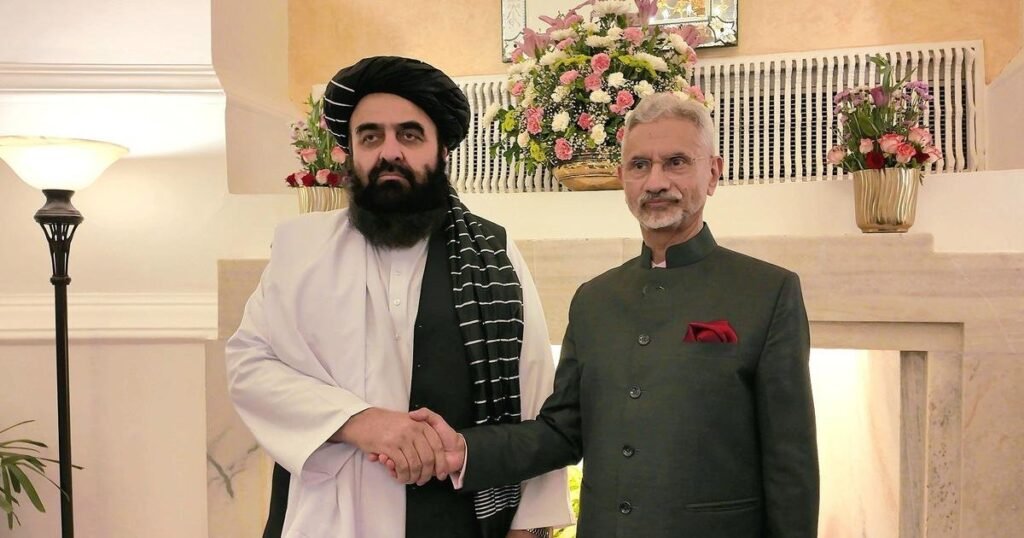
India’s renewed engagement with Kabul reflects less of a desire to stabilize Afghanistan and more of a need to secure control in a region where Pakistan and China increasingly prevail. For New Delhi, Afghanistan is not a humanitarian mission, it is a strategic and tactical necessity.
When the Taliban recaptured powered in August 2021, India found itself politically and strategically isolated in a region it had spent two decades investing in. Billions were poured into Afghan roads, dams and parliament buildings, yet all collapsed like sandcastles when the US withdrew. Today, with its embassy in Kabul to be reopened and high level contracts restored, India is attempting to rewrite its lost chapter in Afghan affairs, not through ideology but through realpolitik.
India’s new approach represents a remarkable diplomatic turnaround. The same government that once denounced the Taliban’s medieval governance now welcomes its representatives in New Delhi. This about face raises uncomfortable questions about the integrity of India’s foreign policy. India’s political elite who once championed itself as a protector of democracy and women’s right across South Asia is now, in pursuit of influence, is shaking hands with the same group it once labeled as “terrorist”. This not only exposes hypocrisy but also questions whether India’s diplomacy is merely an instrument of statecraft; invoked when useful, ignored when inconvenient. This also highlights that moral paradox of India’s diplomacy is glaring.
Afghanistan holds immense weight in India’s security imagination. Geographically, it provides a buffer between Central Asia and the subcontinent and politically it is a space where India can contest Pakistan’s long-standing influence. Since Pakistan has maintained affiliations with the Taliban, New Delhi has always feared strategic containment, the possibility of being hemmed by Pakistan in the west and China in the north.
India’s renewed interest in Kabul is not rooted in goodwill, it stern from insecurity. As Pakistan’s relationship with the Taliban strengthens and China advances its Belt and Road projects, India faces the prospect of marginalization from Central Asia’s evolving networks. Its re-engagement is therefore not an act of leadership but of survival, an attempt to remain relevant in a geopolitical chessboard increasingly titled away from New Delhi. This diplomatic revival reflects India’s recognition that leaving Afghanistan unengaged would mean surrendering the region to Islamabad and Beijing’s combined influence. The move thus blends ambition with anxiety; India wishes to reassert its presence but fears walking into an environment shaped by rivals.
Read More: The Revenge of Realpolitik in the Pakistan, Afghanistan, India Triad
China’s growing footprint in Afghanistan in another crucial driver of India’s shift. Beijing has secured access to Afghanistan’s resource abundant terrain, including lithium, copper and rare earth deposits. For India, this trajectory poses both strategic and economic threats. If China succeeds in monopolizing Afghanistan’s mining sector and infrastructure projects, it could strengthen its regional leadership while sidelining India from the emerging transcontinental trade corridors. India, therefore, views engagement with the Taliban as a hedge against Chinese influence and to maintain limited presence in the evolving economic order.
From Islamabad’s viewpoint, India’s diplomatic revival in Kabul appears less like engagement and more like interference. Pakistan’s leadership has long regarded Afghanistan as its sphere of influence, vital to its security outlook. India’s growing presence, therefore, is perceived as challenge to its western front. The tension is further amplified by Pakistan’s ongoing struggle against Tehrik-i-Taliban Pakistan (TTP) which continues to exploit Afghan territory as a sanctuary. New Delhi’s closeness with Kabul could complicate Islamabad’s counterterrorism mechanism, potentially turning Afghanistan into another front in the India-Pakistan rivalry. Despite these challenges, both countries ironically share a mutual interest in a stable Afghanistan, yet mistrust prevents cooperation.
India’s re-entry into Afghan diplomacy also alters the regions strategic equilibrium. It introduces another dimension to South Asia’s already volatile geopolitics. By engaging with Kabul, India signals to Western allies that it can shoulder regional responsibility and act as a counterweight to China’s growing dominance. However, this calculated opportunism carries risks. The Taliban may use India’s recognition to gain international legitimacy without addressing its repressive policies. Such a scenario could strengthen extremist networks and complicate security not just for Pakistan but the broader region. In essence, India’s diplomatic gamble may bring temporary visibility but long-term instability.
India’s renewed engagement with Afghanistan reflects necessity rather than vision. It is an attempt to stay relevant in a rapidly transforming geopolitical order dominated by China’s investments and Pakistan’s proximity to the Taliban. Yet, necessity does not equal to justification. India’s reputation as a democratic actor will ultimately depend on whether it can reconcile its strategic compulsion with ethical responsibility. Without clear boundaries on issues like women’s rights, governance and terrorism, New Delhi’s Afghan policy could turn from pragmatic to perilous.
For Pakistan, India’s return to Kabul serves as a reminder that in South Asia, influence defines the power, not ideology. But for the broader region, it poses a question: will India’s engagement bring stability or ignite another round of rivalry under a different flag?
*The views expressed in this article are the author’s own and do not necessarily reflect the editorial policy of TDI.

Muhammad Usama Khan
Muhammad Usama Khan is studying International Relations at NUML, Islamabad. He can be reached at ukhanusama10909@gmail.com