

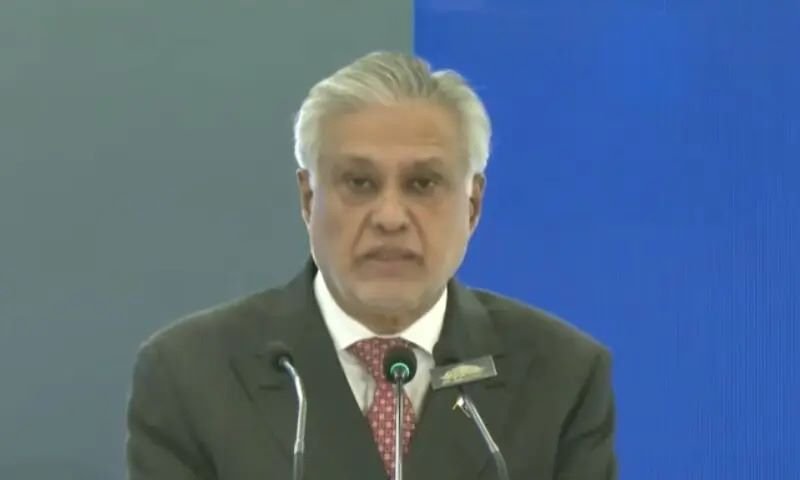
Islamabad (TDI): Deputy Prime Minister and Foreign Minister Ishaq Dar warned on Wednesday that global multilateral systems are facing serious strain at a time when South Asia is grappling with an increasingly unstable security environment.
Speaking at a conference in Islamabad, he stressed that regional cooperation is now more important than ever. Dar said that institutions responsible for global governance are being questioned because certain states have chosen unilateral actions over collective responsibility. Citing the brief but tense flare-up with India in May, he noted that the 92-hour confrontation “had the potential to spiral into something far more dangerous”.
He said that the growing tendency of states to use force to settle disputes, often in disregard of international law and the UN Charter, has added new risks to regional stability. Dar also pointed to the role of emerging technologies, transnational terrorism and hybrid warfare, including coordinated misinformation campaigns.
He said that Pakistan and India had recently been “locked in a confrontation” that could have quickly escalated, adding that the region is currently experiencing “a fragile and uneasy peace”. Pakistan, he said, had shown both “resolve and capability” in deterring aggression, adding that the narrative of a single “net security provider” had been decisively overturned.
He further observed that competition among major powers now defines global politics, with rivalries in military capability, technology, trade, and resources intensifying. Despite this, Pakistan continues to reject bloc-based politics and zero-sum approaches, instead advocating dialogue, diplomacy, and cooperation.
Read More: Geo-economics a Priority, Pakistan Remains Open to Multilateral Partnerships: Dar
As Pakistan prepares to take its seat on the UN Security Council for the 2025-26 term, Dar said the country intends to play a proactive role in advancing international peace and security. He also noted the troubling rise of extremist ideologies, populist politics, democratic erosion and Islamophobia, trends he believes are contributing to global instability.
Dar reiterated Pakistan’s vision for a South Asia where connectivity replaces confrontation, economic growth is shared, disputes are resolved peacefully and in line with international norms, and states coexist with dignity. Pakistan, he added, remains open to working with any partner committed to this outlook.
Dar also highlighted the strategic complexity of South Asia, home to three neighbouring nuclear-armed states with difficult histories and some of the world’s largest military forces. He said the steady accumulation of conventional and nuclear arms, along with destabilising weapons systems, has made the regional balance extremely delicate. He warned that some “dangerously misguided” ideas about fighting wars in a nuclear environment further heighten risks.
He pointed to unresolved disputes, including Jammu and Kashmir, and tensions over water resources, such as India’s unilateral actions earlier this year related to the Indus Waters Treaty. A structured dialogue between Pakistan and India, he noted, has been suspended for more than a decade.
Dar attributed this prolonged stalemate to entrenched mistrust, historical baggage, political motives and the rise of hyper-nationalism. He added that India’s role in the Indo-Pacific strategy and its friction with China’s Belt and Road Initiative also influence the region’s prospects for development and peace.
Read More: SCO Summit in Beijing Highlights China’s Push for Multilateralism
The deputy prime minister also outlined the pressing socioeconomic challenges facing South Asia, including widespread poverty, malnutrition, inequality, food insecurity and the growing impacts of climate change. Despite being home to nearly a quarter of the world’s population, the region remains one of the least economically integrated, with intra-regional trade stuck at roughly 5 per cent.
He noted that energy shortages and poor connectivity networks further limit growth, while Saarc, the region’s only collective economic forum, has been inactive for more than ten years.
“Are we destined to remain trapped in conflict while other regions move forward?” Dar asked, insisting that the answer must be no. He argued that South Asia cannot afford disunity when facing such severe security, economic and climate-related challenges.
Dar urged regional states to abandon zero-sum thinking and work toward dialogue, coexistence, economic interdependence and mutually beneficial cooperation.


