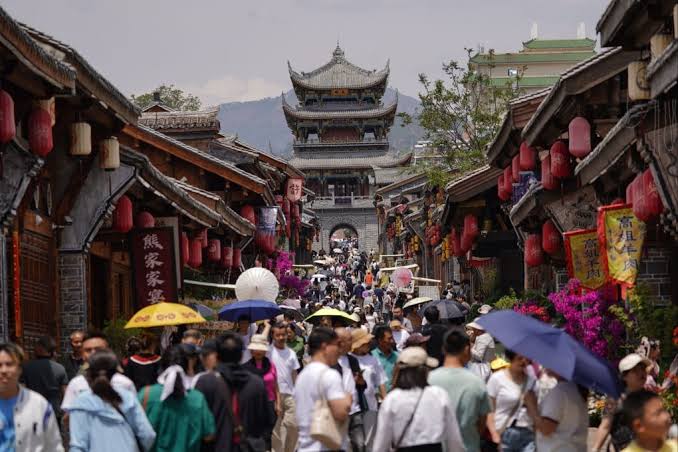
As China’s National Day Golden Week enters its final days, the holiday travel rush at home has been matched by a growing flow of Chinese visitors abroad, and St. Petersburg is one of the cities benefiting.
China’s Ministry of Transport projected 2.13 billion inter-regional trips over the seven-day break, about 300 million a day. Some of those travelers are heading to Russia.
Data from the Border Service of Russia’s Federal Security Service show Chinese citizens made up 56.3 percent of all inbound tourism to the country in the first half of 2026. That amounts to 380,600 trips, up 19.8 percent from the same period last year.
A mutual visa-free arrangement between the two countries, now extended through the end of 2027, has made travel easier. St. Petersburg has also spent years preparing its hospitality sector.
The “China Friendly” program, run by the association “World Without Borders,” certifies hotels, restaurants and shops that train staff, provide Chinese-language materials and accept Chinese payment systems. Many restaurants now offer Chinese menus and take UnionPay.
Planning often starts online. Chinese travelers use the social platform Xiaohongshu to swap advice on which sights to prioritize, how to ride the metro and where to find familiar food, and many arrive with itineraries already built.
The classics still anchor most trips; the State Hermitage Museum, St. Isaac’s Cathedral, the Cruiser Aurora, Kronstadt, Peterhof and Nevsky Prospect.
Newer favorites have joined them, including creative spaces such as New Holland Island and Sevkabel Port, as well as the city’s pastry shops.
At the Cruiser Aurora, young visitors have started a book relay. A single copy of a ninth-grade history textbook, whose cover shows the ship, is hidden near the vessel, with its location posted on Xiaohongshu. Each traveler photographs themselves with it, then passes it on.
On October 3, Chinese audiences filled the Mariinsky Theatre for La Bayadère, the ballet by Ludwig Minkus with choreography by Marius Petipa.
Many in the hall admired the theatre’s gilded interior and its century-old chandelier, and some posed for photographs beneath it during the interval.
Small touches also signal the city’s attention to its guests. The café chain Bushe was still selling mooncakes, the pastry traditionally eaten at the Mid-Autumn Festival, well into the National Day holiday.
This year marks the 77th anniversary of both the founding of China and the establishment of China-Russia diplomatic relations.