The technological revolution is shaping geopolitical rivalries in the twenty-first century as the nature of power is evolving with the emergence of modern technologies. Currently, the global order is transitioning from unipolarity towards multipolarity, with a contest between the United States and China for the great power status.
In this competitive environment, China is trying to position itself as a leader in the field of artificial intelligence through diplomatic channels. China is investing heavily in artificial intelligence, quantum computing, digital infrastructure, and technological partnerships as a long-term strategy to dominate global affairs.
While the United States is busy protecting its influence in the Middle East through traditional tools of power, China is determined to expand its influence in the Global South by investing its energies in one of the decisive arenas of technology.
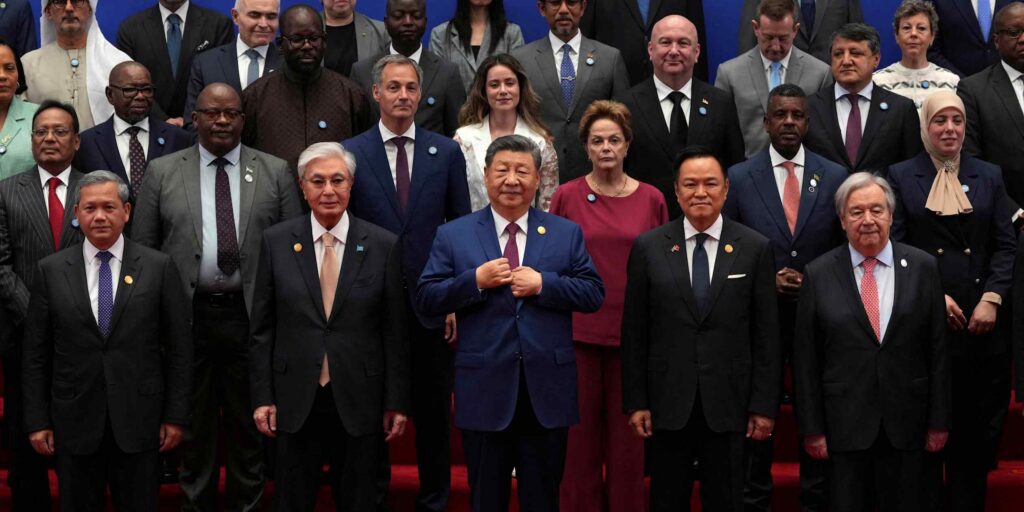
Recently, China hosted a four day World Artificial Intelligence Conference, which concluded with the establishment of the World Artificial Intelligence Cooperation Organization (WAICO). This intergovernmental organization has 29 member states, and it aims to enhance technological cooperation, shape global AI governance, and expand access to these technologies across the Global South.
Read More: China’s Moonshot Unveils World’s Largest Open-Source AI Model
Headquartered in Shanghai, this coalition exemplifies China’s approach to AI diplomacy. China’s ambitions to shape global AI governance are not just rhetorical; it possesses the material capacity to do so. China had an energy surplus to power big data centers and dominance over the critical earth minerals necessary for AI hardware manufacturing.
These capabilities strengthened China’s credibility and strategic influence in advocating multilateral AI governance, an increasingly important objective given the rapidly evolving AI landscape.
These emerging technologies are re-conceptualizing the concept of power, and China is determined to invest in these non-traditional currencies of power which would ultimately redefine the great power competition. Currently, the United States is investing in traditional currencies of power as its military is engaged in a conflict in the Gulf region with Iran.
The U.S. policies under the leadership of President Donald Trump are continuously undermining the foundations of its great power status. The country is diminishing its influence by challenging the international legal order it once established. These developments are reshaping the great power competition.
Traditionally, states were involved in competition through military, economic coercion, territorial expansion and alliance formation. In the contemporary era, one state is absorbed in conventional forms of geopolitical rivalry while the other state is investing in the modern digital technologies to redefine the future of global order.
Read More: Xi Pitches China as AI Partner to the World at the Shanghai Conference
China has incorporated AI diplomacy into its broader foreign policy strategy, using technological cooperation and multilateral engagement to position itself as a leading architect of the global AI order. One of the defining features of China’s AI diplomacy is its emphasis on including the Global South in its foundations.
Chinese President Xi Jinping said that the primary reason behind the inclusion of developing countries in this alliance is to prevent the creation of new historical injustice. The existing global order has been shaped by Western powers with inadequate representation of the Global South in the decision-making processes.
Beijing advocates for the creation of a more inclusive, representative, and equitable global order based on mutual cooperation and trust. WAICO is one of the steps by Beijing towards an inclusive world with equitable access and representation of countries in the global AI governance structure.
The defining feature of twenty-first century great power competition is no longer who possesses the military superiority, economic strength, and geopolitical gains. The technological revolution has re-conceptualized the concept of power by adding another currency necessary to determine the influence and strength of a state.
Both China and the United States are increasingly competing in the domain of artificial intelligence with their respective models. But the institutionalization of AI diplomacy in China’s foreign policy agenda represents a strategic move towards redefining the great power competition.
The future international order will be shaped not only by those who dominate technological innovation but also by those who shape rules, norms, and governance frameworks to regulate these technologies.

Mahnoor Azhar
Mahnoor Azhar is a final-semester BS International Relations student at Fatima Jinnah Women University, Rawalpindi. Her research interests include emerging technologies and diplomacy.