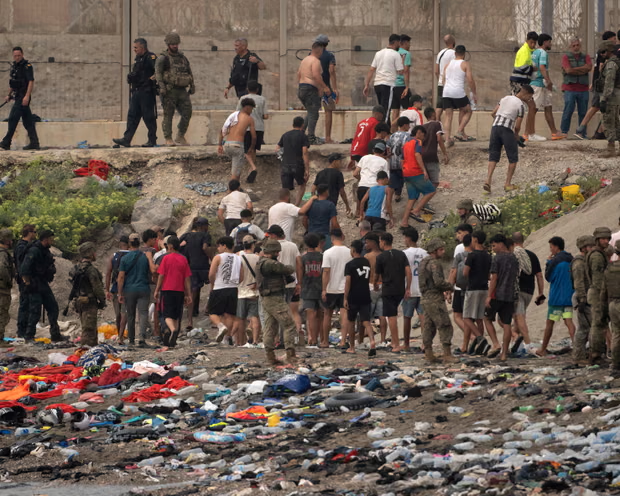
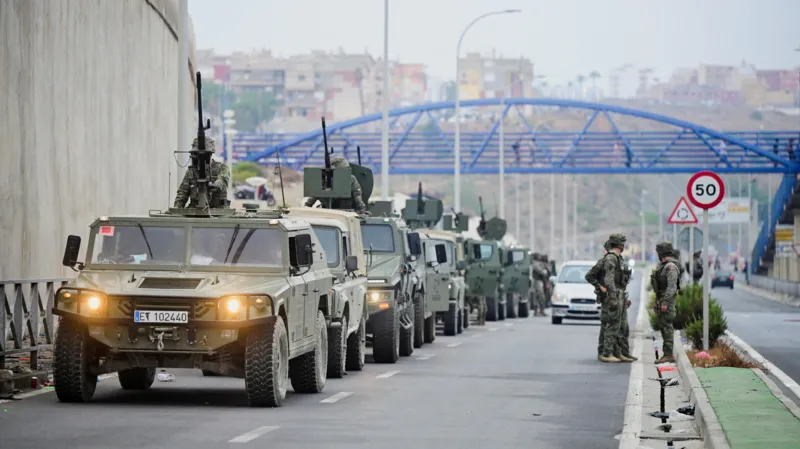
Spain says it has brought a surge of migrants into its North African enclave of Ceuta under control, after tens of thousands of people breached the border from Morocco in under 48 hours.
The episode became one of the deadliest crossing attempts in the enclave’s history, leaving at least 57 people dead. On Friday, Spain’s Interior Ministry said around 50,000 people crossed into Ceuta by land and sea since Thursday morning.
Juan Jesús Vivas, President of Ceuta’s regional government, said the true total may have reached 60,000 over the two days, calling it a “serious humanitarian crisis.”
Many migrants swamped around a breakwater barrier stretching into the sea near Tarajal beach, close to a border checkpoint, while others attempted to climb the barrier directly.
Spanish officials said 57 bodies have been recovered on the Spanish side of the border alone, with additional casualties feared on the Moroccan side.
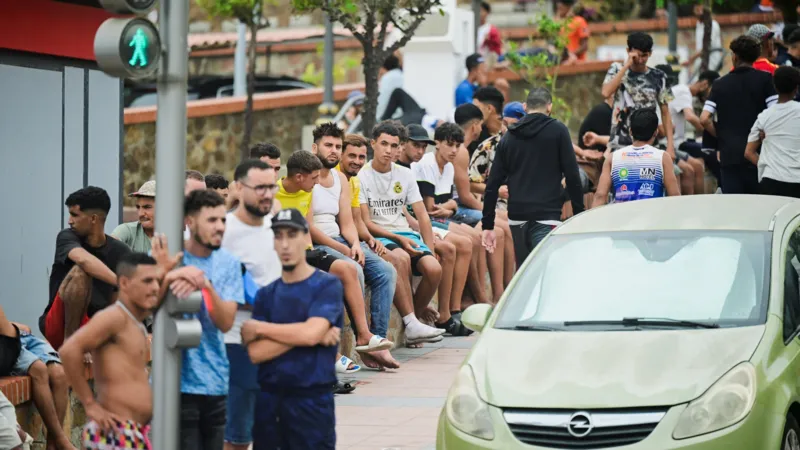
Thousands of migrants including unaccompanied children were reported sleeping on sidewalks as authorities struggled to process the sheer number of arrivals.
Spanish Prime Minister Pedro Sánchez travelled to Ceuta on Friday and described the mass crossing as a “violation” of Spain’s territorial sovereignty.
He said Madrid is mobilizing all available resources and accelerating deportations with Interior Ministry data showing roughly 25,000 people already sent back to Morocco that day and about 48,300 returned in total by Friday evening; mostly voluntarily.
Sánchez attributed smuggling networks of spreading distorted version of a recent Spanish Supreme Court ruling that curtail authorities from immediately returning migrants intercepted at sea without full legal proceedings; a ruling which actually does not apply to land crossings.
Activists in Morocco argue most migrants would have had no knowledge of the court decision in the first place. Moroccan authorities for their part deployed water cannon trucks at the border to hold back crowds.
European Commission President Ursula von der Leyen called the images from Ceuta “unacceptable,” saying dangerous crossings must stop immediately, smuggling networks must be dismantled, and returns must be swift under EU rules.
Italian Prime Minister Giorgia Meloni threatened to suspend the Schengen open-border agreement with Spain despite the two countries sharing no land border while Czech Prime Minister Andrej Babiš called for Schengen’s border-free rules to be suspended for Spain immediately.
Portugal took a softer line declining to suspend Schengen arrangements but pledging tighter controls along its own southern borders.
Paris said it would sharply increase security along its border with Spain with Interior Minister Laurent Nunez confirming police deployments would rise fivefold by Saturday backed by added aerial surveillance and train patrols.
Berlin said it would extend existing border checks with neighboring countries beyond September, with Chancellor Friedrich Merz urging Spain to stabilize the situation quickly.
Ceuta and Melilla, Spain’s two autonomous cities on Morocco’s northern coast form the European Union’s only land border with Africa and have long experienced periodic surges in crossing attempts.
Spain’s Interior Ministry rejected calls from Ceuta’s regional government to declare a national security emergency saying the measure does not apply to migration crises.

Tayyaba Afzal is an International Relations Graduate from Lahore College for Women University. Her research interests include Information Warfare, AI Governance and Digital Diplomacy. She can be reached at [email protected]