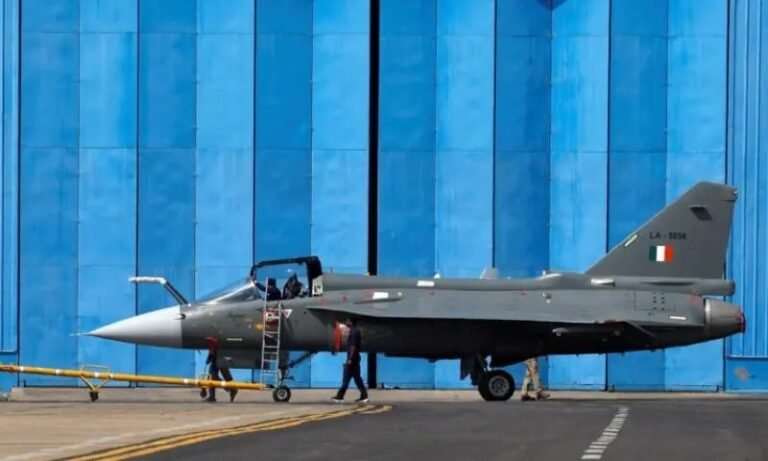
The trajectories of the past are irreversible, the future is unpredictable, the order is emergent and the patterns are fluid in the contemporary character, conduct and outcome of warfare. The redefining operational concepts and force structures were evident during the four-day military escalation between India and Pakistan in May 2025, triggered by the April 22 Pahalgam attack, where crisis dynamics unfolded through rapid signaling, calibrated retaliation, information warfare, and non-contact means rather than decisive battlefield engagements.
The entire Post-Pahalgham crisis scenario demonstrates the unpredictable, agile, and non-linear characteristics of modern warfare, unveiling critical vulnerabilities at the doctrinal, tactical, and operational levels in defense frameworks on both the Pakistani and Indian sides. Furthermore, the deterrence at conventional level and sub-conventional level became fragile but deterrence at nuclear held firm during that dynamic and multi-domain nature of the conflict.
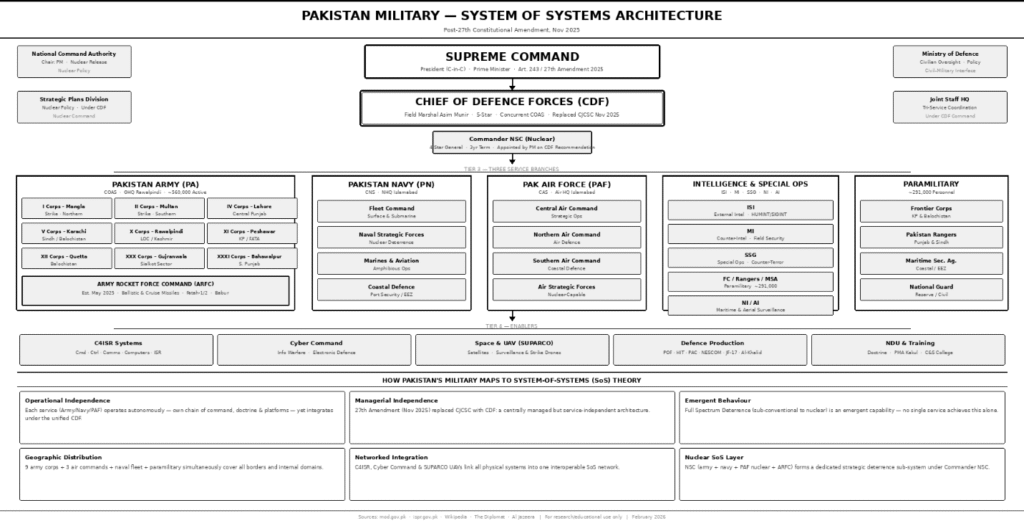
According to the Department of Defense (DoD), a System-of-Systems (SoS) is a set or arrangement of systems that results when independent and useful systems are integrated into a larger system that delivers unique capabilities. Pakistan’s defense architecture also resembles the SoS model.
This is not labelled SoS in official Pakistani military strategy or doctrine (which may use terms such as “network-centric”), however, the operational and functional characteristics of Pakistan’s military resemble the SoS framework from DoD. The May 2025, Pakistan-India crisis served as a critical point, explaining the limitations of Pakistan’s rigid SoS-based defense architecture in handling non-linear warfare and compelling the adoption of a more adaptive CAS model.
SoS Model of Pakistan’s Defense Architecture
The Complex Adaptive Systems (CAS) model has a useful application; however, the applicability to Pakistan’s conventional military framework remains limited because it requires a degree of decentralization that challenges the existing hierarchical structure (system-of-systems structure). However, it has a particular contextual application, in countering terrorism or countering insurgency, where rapid adaptability is required.
A Complex Adaptive System-of-Systems (CASoS) Model is being introduced in this regard, a framework borrowed from the engineering discipline that integrates the structured predictability of SoS with the adaptive flexibility of Complex Adaptive Systems (CAS), as a strategic compulsion for Pakistan’s Defense architecture in this non-linear, agile and multi-domain nature of warfare.
The Current Defense Architecture of Pakistan
Pakistan’s defense architecture is structured around a SoS model. This model emphasizes a centralized command and control structure ensuring strategic coherence across Tri-services (hierarchical integration), a standardized communication protocol among tri-services and joint operational frameworks (Interoperability), a calculated response protocol for conventional and nuclear deterrence scenarios (Predictable Escalation Ladders), and a credible minimum nuclear deterrence posture managed through the National Command Authority-NCA (Full spectrum Deterrence). This model facilitates Pakistan in maintaining strategic stability, crisis stability and deterring aggression on a large scale.
However, the SoS framework is structured for a predictable threat environment and pre-assumed scenarios based on responses. The SoS Model’s limitation includes centralized decision bottlenecks that create delays in tactical response, particularly in cyber and information warfare domains where speed is crucial, and compartmentalization, which secures the strategic assets, but conventional forces faced coordination challenges, particularly when adapting to India’s power, which is generated, projected, and employed across all domains.
It is suitable for strategic nuclear forces, but it struggles to address the non-linear projection and multi-domain nature of modern warfare. The May 2025 crisis explains that high-stakes and unpredictable conflicts require a military architecture capable of adaptation in rapid and complex scenarios at tactical and operational levels while maintaining strategic control and coherence at the nuclear deterrence level. The SoS model alone cannot address this complex context.
Read More: Saudi Arabia–Pakistan Defense Agreement: A Defining Moment in Bilateral Ties
Understanding CASoS Model for Pakistan Defense Architecture
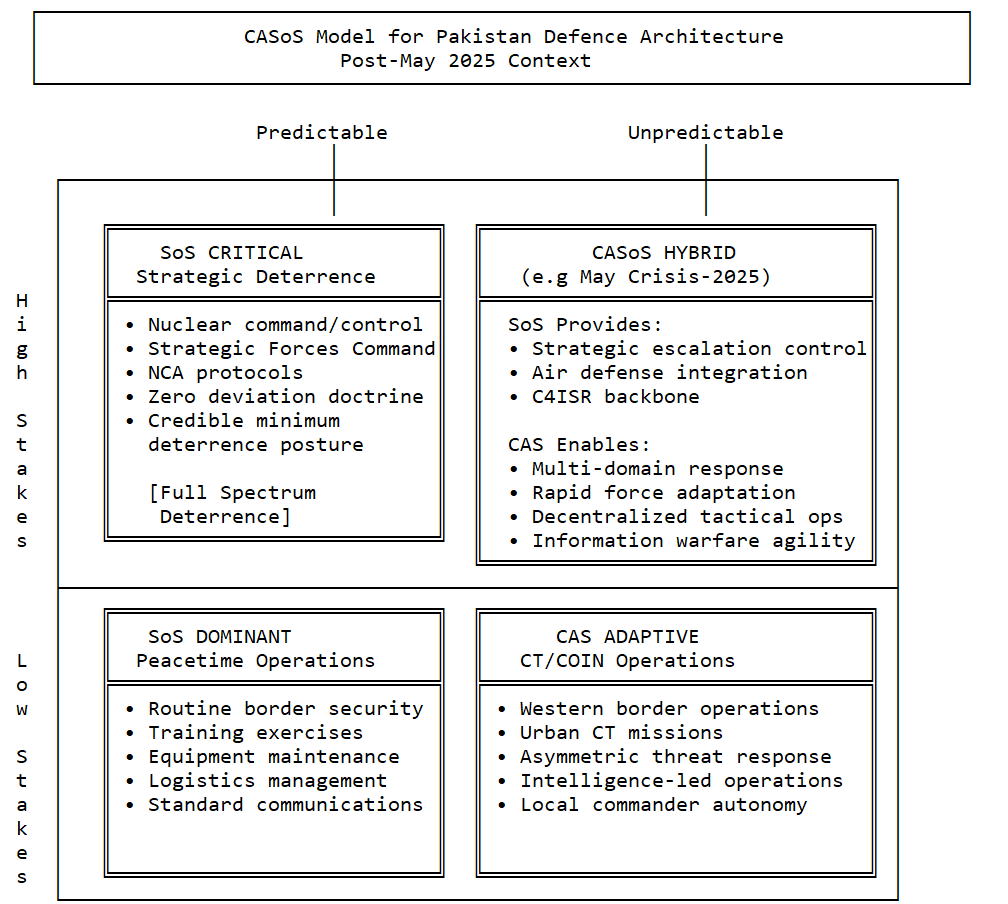
Quadrant 1: In this Scenario (SoS Critical Scenario), the stakes are high, but the predictability exists. The Nuclear assets domain comes under the SoS-Critical scenario, which is likely to be predictable, but the stakes are high with zero tolerance for deviation, and the hierarchy is significant in this scenario. Nuclear assets remain under the centralized authority of the National Command Authority (NCA), governed by clearly defined command, control, and communications (C3) protocols. This quadrant is non-negotiable strategic deterrence that requires predictability, reliability, and centralized authority.
Quadrant 2: In this Scenario (SoS Dominancy Scenario), the stakes are low and the scenario is predictable. The SoS model dominates during peacetime operations, including Standard operating procedures (SOPs), Routine border security, Joint Training exercises, Equipment maintenance, Integrated Logistics management, and standard communications. This quadrant prioritizes efficiency and interoperability.
Quadrant 3: In this Scenario (CAS&SoS Integrated Scenario), the stakes are high and the scenario is unpredictable. The high-intensity conventional and sub-conventional conflict with high stakes and unpredictability (e.g. May Crisis-2025). Here, SoS provides the strategic backbone: Integrated air defense systems (e.g., HQ-9, LY-80), C4ISR (Command, Control, Communications, Computers, Intelligence, Surveillance, Reconnaissance) networks.
Strategic escalation control to prevent nuclear miscalculation. Simultaneously, CAS principles enable tactical and operational level multi-domain response, rapid force adaptation, decentralized tactical ops (Auftragstaktik), and information warfare agility.
Quadrant 4: In this Scenario (CAS Adaptive Scenario), the stakes are low and the scenario is unpredictable. This quadrant is significantly applicable at Western border operations, Counterterrorism missions, Counterinsurgency missions, Asymmetric threat response, and Intelligence-led operations in which complex adaptability, rapid decision-making and emergent tactics are required to respond to the fluid and unpredictable threat environment, rather than top-down control.
In conclusion, the strategic, operational and tactical adaptabilities are necessary to implement the CASoS model. Scenario-diverse training and interoperability exercises enable adaptability within complex adaptive systems (CAS) while preserving system-of-systems (SoS) discipline. Information Warfare integrated within each corps creates independent information warfare cells.
Introducing the tactical innovation, e.g., AI and Quantum-Enabled C4ISR, which uses artificial intelligence and quantum computing to assess threats in real time and a faster Observe-Orient-Decide-Act (OODA)loop, and Decentralized Cyber platforms to minimize the response times by switching from centralized cyber command to dispersed cyber-attack platforms.
Also, the Crisis Resilient Communications is needed to guarantee that the units can self-organize even in a crisis in which the central nodes are compromised, investing in mesh networks and satellite communications.
*The views presented in this article are the author’s own and do not necessarily reflect the views of The Diplomatic Insight.

Suffian Zafar
Suffian Zafar is an Mphil scholar of International Relations at the University of Punjab, Lahore. He is currently working as a Junior Research Fellow at the Maritime Centre of Excellence MCE. He can be reached atsuffianzafarmce@gmail.com