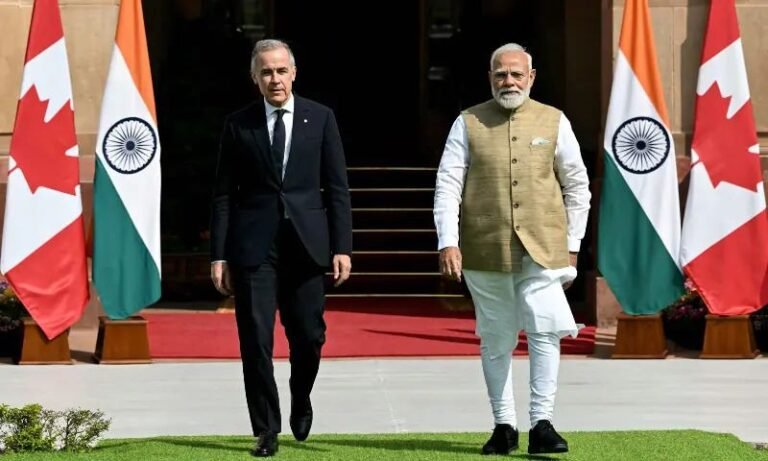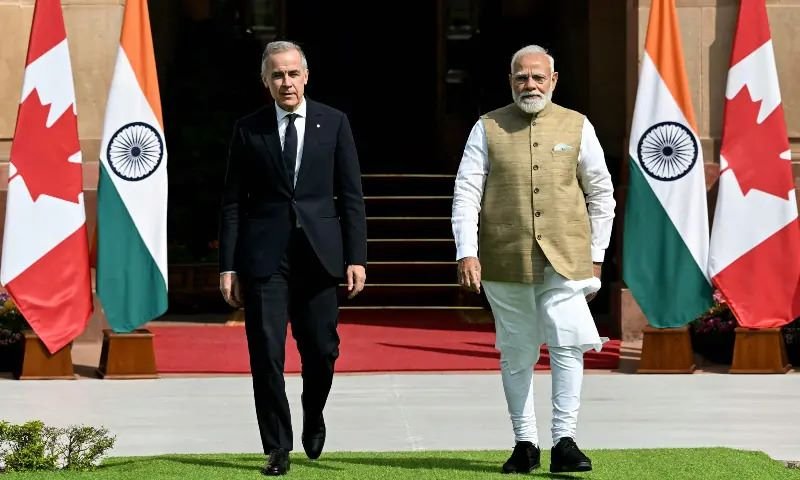
New Delhi (TDI): Canada and India on Monday announced a series of agreements covering critical minerals, clean energy and nuclear cooperation, including a “landmark” long-term uranium supply deal, as the two countries seek to reset relations after years of diplomatic strain.
The agreements were unveiled during talks in New Delhi between Indian Prime Minister Narendra Modi and his Canadian counterpart Mark Carney, who both described the moment as a fresh start in bilateral ties.
“Our ties have seen a new energy, mutual trust, and positivity,” Modi said following the talks.
Carney said relations were entering a new phase, marked by deeper cooperation and strategic ambition. “This is not merely the renewal of a relationship. It is the expansion of a valued partnership with new ambition, focus, and foresight,” he said.
A central outcome of the visit was an agreement on long-term uranium supplies from Canada to India, aimed at supporting India’s ambitious nuclear energy expansion.
India plans to increase its nuclear power capacity from about eight gigawatts currently to 100 gigawatts by 2047, as it seeks to meet rising energy demand while cutting carbon emissions.
Read More: Canada Asks Air India to Investigate Pilot Reporting for Duty Intoxicated
“In civil nuclear energy, we have struck a landmark deal for long-term uranium supply,” Modi said, adding that the two sides would also cooperate on small modular reactors and advanced nuclear technologies.
Carney said the uranium agreement, valued at about $1.9 billion, would support India’s nuclear ambitions and form part of a broader “strategic energy partnership”. He added that Canada was also well positioned to supply liquefied natural gas (LNG) to India from its west coast.
The two leaders also agreed to strengthen cooperation on rare earths and other critical minerals vital for manufacturing, clean technology and nuclear power.
Both sides reaffirmed their commitment to concluding negotiations on a Comprehensive Economic Partnership Agreement, which were resumed last year.
Read More: India, Canada Restore Diplomatic Services
“Our target is to reach $50 billion in bilateral trade,” Modi said, adding that a comprehensive trade pact would open new opportunities for investment and job creation in both countries.
Carney said Ottawa hoped to finalise the agreement by the end of the year, while also renewing security cooperation through what he described as a “new defense partnership”.
Canadian pension and wealth funds have already invested about $73 billion in India, underlining the growing economic stakes in the relationship.