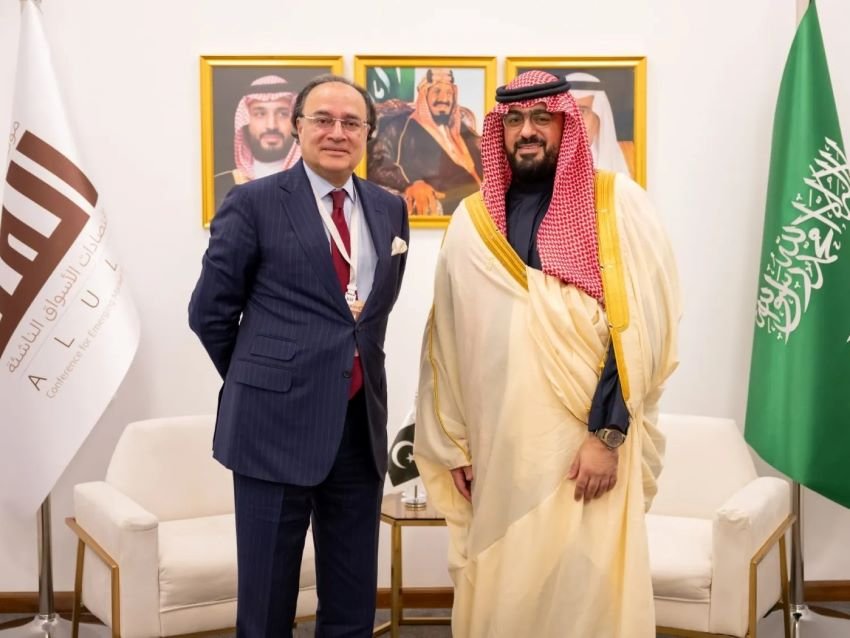
AlUla (TDI): Federal Minister for Finance and Revenue Senator Muhammad Aurangzeb on Monday highlighted Pakistan’s recent fiscal improvements, reform momentum and efforts to rebuild economic buffers, stressing that discipline, credibility and strong institutions are essential to navigating recurring economic and climate-related shocks.
The finance minister was speaking during a high-level panel discussion titled “Fiscal Policy in a Shock-Prone World” on the second day of the AlUla Conference for Emerging Market Economies, being held in Saudi Arabia.
Sharing Pakistan’s experience, Senator Aurangzeb said the country has had to manage long-standing structural challenges, strengthen revenue generation, reduce debt vulnerabilities and respond to repeated shocks, while continuing to protect priority development spending.
Responding to the moderator’s questions, the Finance Minister stated that Pakistan’s fiscal strategy has been shaped by a history of boom-and-bust cycles, persistent structural deficits, high debt levels, and limited fiscal space. He emphasized that under these circumstances, it has been critical to carefully safeguard the fiscal progress achieved over the past two to three years.
He noted that Pakistan has delivered successive primary surpluses and reduced its fiscal deficit from around eight percent of GDP to approximately 5.4 percent, with the current trajectory pointing toward a further reduction below five percent. He highlighted that this improvement reflects coordinated progress on the revenue, expenditure, and debt fronts.
Read More: Aurangzeb Highlights Pakistan’s Improving Debt Indicators at AlUla Conference
The Finance Minister stressed that the discussion around fiscal buffers is not academic for Pakistan but rooted in lived experience as a climate-vulnerable country.
Recalling the catastrophic floods of 2022, he noted that Pakistan was forced to make an immediate international appeal even for rescue and relief operations. In contrast, during the subsequent large-scale floods affecting multiple provinces and river systems, Pakistan was able to mobilize its own resources despite limited fiscal space, demonstrating the practical value of rebuilding fiscal buffers to absorb exogenous shocks.
On the revenue side, the Finance Minister outlined sustained efforts to expand the tax base and strengthen compliance. He stated that Pakistan’s tax-to-GDP ratio has risen from below ten percent to close to twelve percent and emphasized the need to remain firmly on this reform path.
He highlighted the transformation of the tax authority through reforms in people, processes, and technology, including the use of AI-led production monitoring systems across various sectors to improve enforcement, curb leakages, and reduce corruption by minimizing human intervention.
Read More: Aurangzeb Highlights Reform Agenda, Private Sector Collaboration in Davos Meetings
He further informed the audience that the tax policy function has been separated from tax collection and placed within the Ministry of Finance to ensure that budgetary decisions are guided by economic value and policy considerations rather than purely arithmetic targets, while maintaining overall fiscal discipline.
Addressing expenditure management, the Finance Minister noted that Pakistan’s federal structure adds complexity, requiring close coordination between the federation and provinces. He shared that a national fiscal framework has been agreed upon and that work is ongoing to strengthen fiscal coordination and discipline across all tiers of government.
On debt management, the Finance Minister stated that Pakistan’s debt-to-GDP ratio, which had reached around 74 percent, has been reduced to approximately 70 percent. He highlighted ongoing domestic liability management operations aimed at lowering debt servicing costs, which remain the single largest expenditure item in the budget.
He expressed confidence that continued fiscal discipline would further ease debt pressures and help create additional fiscal space.
In concluding his remarks, the Finance Minister emphasized that the fiscal space created through consolidation and reforms is being directed toward priority growth-enabling sectors, including human capital development, agriculture, information technology, and other areas with strong growth potential.
He reiterated that rebuilding buffers, dampening pro-cyclicality, and sustaining growth require persistence, institutional reform, and disciplined policymaking, particularly for countries facing repeated structural and climate-related shocks.

Sohail Majeed
Sohail Majeed is a Special Correspondent at The Diplomatic Insight. He has twelve plus years of experience in journalism & reporting. He covers International Affairs, Diplomacy, UN, Sports, Climate Change, Economy, Technology, and Health.