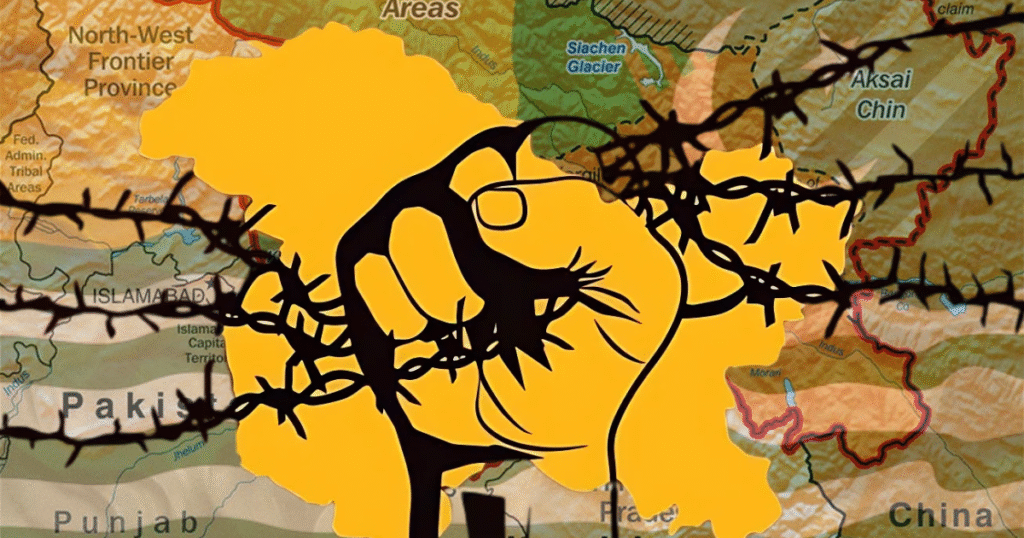
Every year on August 5, Pakistan observes Youm-e-Istehsal, which means “Day of Exploitation,” to protest what it calls a dark and painful moment in the history of Kashmir.
It is the very day that reminds us that without the consent of people, their territory and their future were rewritten, and they weren’t even involved or asked what they wanted.
The History of “Black Day”
On 5th August, 2019, the Government of India revoked Article 370 of its Constitution. This article was responsible for granting special autonomous status to Jammu and Kashmir, which allowed them to have their laws and a limited self-governance without the interference of any other state.
But when India revoked Article 370, it also removed Article 35A, which had given the right to the region to define its permanent residents and have their rights. Both Jammu and Kashmir were split into two union territories, which were now governed by New Delhi. The region was put in chaos with military lockdowns, communication blackouts, and curfew.
India justified their move by claiming that this will bring it to development, integration, and equality. But Kashmiris and Pakistanis saw this act as a violation of international law and a move that stripped Kashmiris of their basic rights.
The unilateral revocation of Articles 370 and 35A violates the United Nations Security Council (UNSC) resolutions and their spirit. The right to self-determination is a foundational principle of the UN Charter. Numerous UNSC resolutions recognize the Kashmiris’ right to choose their future through a plebiscite.
Read More: Whispers, Treaties, and Tweets: How Diplomacy Evolved Over Time
And thus it’s not just a mere date, for Pakistanis, August 5 is a Black Day, a day that violated international law, a day that violated basic human rights, a day that brought pain and chaos to the lives of Kashmiris who already have been struggling for their territory. It is called a push to erase the Kashmiri identity.
Since that darkest day, Jammu and Kashmir have been under an intensified military lockdown. Curfews, arbitrary arrests, communication blackouts, and a heavy military presence, one soldier for every eight civilians, have become the everyday reality.
The region has been turned into the biggest open prison in the world. The laws, such as the Public Safety Act and Armed Forces Special Powers Act, have been used to shield perpetrators of human rights abuses. Journalists, human rights defenders, and ordinary citizens also face systemic suppression.
Youm-e-Istehsal – A Day of Protest, Pain, and Political Power
Since 2020, Pakistan has been observing August 5 as a Black Day and expressing its solidarity and full support for Kashmiris and to reject India’s actions.
On this day, the entire Pakistani population stands with their Kashmiri brothers and sisters and speaks for their rights and raises their voices so it can be heard. Rallies, marches, and protests are held in all small and big cities of Pakistan where all people together express their solidarity and loyalty to the people of Kashmir. A one-minute silence is observed across the country to honor the Kashmiri resistance and struggle.
This day isn’t just about rallies, protests, and slogans for Pakistanis, in fact, its day when they remind the world that Kashmir issue is still unresolved, a day to remind teh world of the struggles of Kashmirris, a day to remind the world to act and end this decades long violation and suffering of people of Kashmir.
Read More: India’s Occupation of Kashmir ‘Defining Conflict’ in South Asia: PM
A Decades-Long Struggle of Kashmiris
The Kashmir conflict started in 1947, when the subcontinent was divided into India and Pakistan. The princely state of Jammu and Kashmir was a state with a Muslim majority, but a Hindu ruler, and since then, it has become a matter of sovereignty for both India and Pakistan.
On one side, India claims it as part of its territory; on the other hand, Pakistan claims it to be part of its country. Since then, there have been three wars between the two countries over the territory of Jammu and Kashmir. UN resolutions have called for a plebiscite, but it has never been held there. Millions of Kashmiris and generations of Kashmiris have lived under the military presence, curfews and war, and instability.
For many Kashmiris, the dream of self-determination remains unrealized, and the price of identity remains painfully high that they can’t afford. Youm-e-Istehsal is not a mere statement written on a piece of paper; it’s a reminder, a reminder of what happened on August 5 and how it affected the people of Kashmir and how they have been suffering till this date.
This issue has been complicated since the start, as for Pakistan, it is a reminder to the world that the Kashmir dispute is far from over. For India, it is a move of national unity and territorial integration. For Kashmiris, it remains tragically and painfully a day of disrupted dreams and unresolved destiny.
As August 5 comes and goes each year, one truth remains that the voice of Kashmir is still waiting to be heard. It’s the Kashmiris to decide and write their future and decide what they want. Their voice is the one to be heard and not forgotten.

An IR student whose interest lies in diplomacy and current affairs and a part time debater