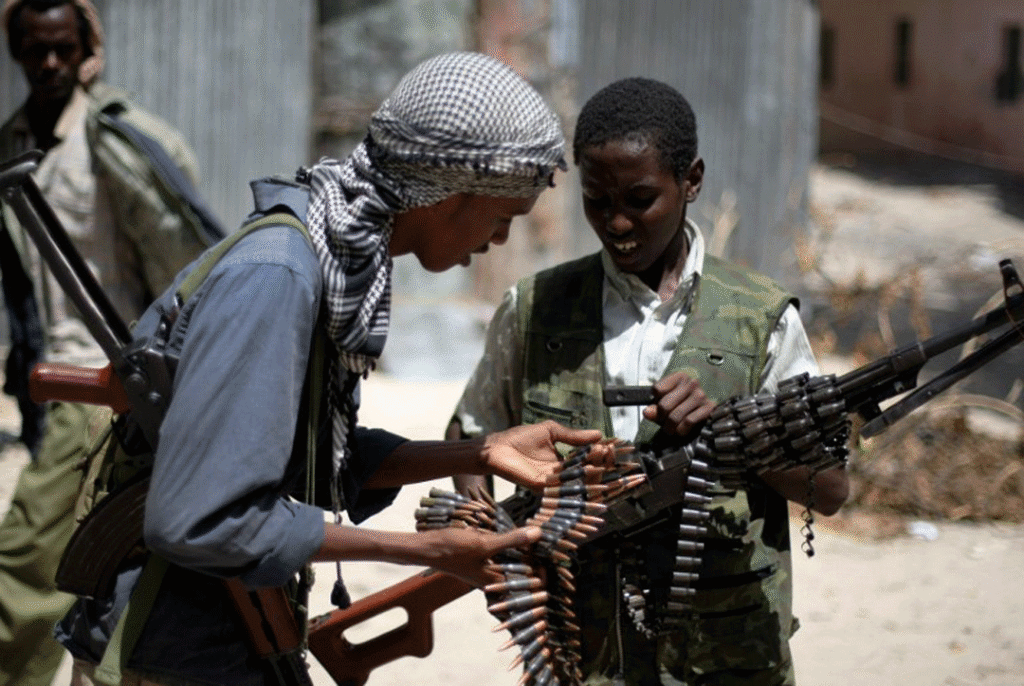
Al-Shabaab is no longer a by-product of Somalia’s enduring instability; it is now one of the most enduring insurgent movements in the modern era of conflict. More than fifteen years after it was driven out of Mogadishu, the group shows an exceptional ability to adapt, reconstitute itself and exert influence in Somalia and the broader Horn of Africa.
Despite persistent military pressure, leadership losses, and international counterterrorism efforts, al-Shabaab has not been weakened and has not collapsed. Instead, it has recalibrated its strategy, combining rural territorial control, urban terror tactics and a sophisticated shadow governance system that helps it to tax, coerce and survive.
What makes al-Shabaab so dangerous is not only that it is ideologically aligned with al-Qaeda, but also that it has gained the ability to integrate itself into the political economy of Somalia. The group takes advantage of weak institutions, clan divisions and fits-and-fights engagement from the international community to promote itself as an alternate authority to where the state fails to provide security or justice.
As Somalia enters a critical game period marked by the withdrawal of international peacekeeping forces, renewed regional tensions, and heightened counterterrorism operations, al-Shabaab finds itself operating in the field with a lot of possibilities. The challenge, of course, today is not whether it can carry out attacks with its group, but rather whether Somalia and its partners can prevent it from converting strategic patience into long-term political leverage.
Al-Shabaab’s origins cannot be divorced from more than forty years of state collapse and political vacuum in Somalia, the by-product of warlordism, clan fragmentation, and weak institutions. Over time, it became the militant wing of a broader Islamist mobilization, and later a consolidated organization able to fight, tax, and govern.
While multifaceted in its early legitimacy, with strong themes of nationalism and resistance, particularly during periods of foreign intervention, the essence of the group’s ideology remained increasingly hard-edged in line with global jihadist trends. This evolution was not, however, a linear replacement of local goals; instead, al-Shabaab combined local grievances and government failure with the broader al-Qaeda worldview and was able to justify violence as both a form of domestic revolution and a civilizational struggle.
This dual identity remains critical to understanding its resilience. When the political conditions are favorable for nationalist mobilization, al-Shabaab inclines itself toward anti-occupation rhetoric and promises order. When recruitment needs prestige and external legitimacy, it has emphasized its position within al-Qaeda’s overall architecture and has presented itself as a defender of the ummah. Multiple assessments still require al-Shabaab to be considered one of the most capable and enduring affiliates of al-Qaeda, precisely because it has been able to function as both an insurgency and a terrorist network.
Read More: UNSC Renews Al-Shabaab Sanctions, Pakistan Backs Move
Territorial ebb and flow
A major weakness in many public discussions is the tendency to equate territorial losses with strategic defeat. Al-Shabaab’s retreat from Mogadishu and other key areas in the early 2010s was the result of sustained offensives backed by the African Union mission, but the group’s organizational backbone survived and reformed in rural areas and along key routes of mobility.
From there, it adopted an asymmetric strategy, including infiltration, targeted assassinations, and a sophisticated extortion model, enabling it to raise revenue even in areas formally under government control. This is why al-Shabaab would be able to lose physical control of significant districts but retain the ability to control markets, movement and local administration by coercion.
In practice, Somalia has witnessed cycles of recurring conflicts: offensive operations make al-Shabaab less visible, the group leaves to regroup, re-adapt and return during slowdowns of state momentum and resurfacing of political divisions. Recent research highlights the role of internal political discord, donor fatigue and operational constraints on renewed insecurity in Somalia, even in later years of optimism.
The importance of this cycle is strategic: al-Shabaab does not need to achieve its goal to conquer the whole state. It can accomplish many of its goals by preventing stabilization, delegitimizing the federal government, exhausting its security forces, and demonstrating that its international partners are unable to ensure lasting security.
In August 2022, the Somali federal government launched a large-scale offensive against al-Shabaab, with an initial wave of gains driven by a mix of federal forces, local clan militias, and external assistance. Subsequent analysis at this point indicated that the early period saw significant ground lost, notably in central areas of Hiraan and Galgaduud, and gave the impression that al-Shabaab could be strategically rolled back.
Yet the subsequent path was not so favorable. By 2023, momentum ground out against counterattacks, political friction and logistical limitations and plans for major follow-on phases were repeatedly delayed. The best predictor of how confident al-Shabaab is has been the attacks it has carried out in close proximity to the political heart of the state.
In March 2025, an al-Shabaab attack comprising an improvised explosive device targeted President Hassan Sheikh Mohamud’s convoy near Mogadishu, which represents not only the intent but also operational penetration and intelligence capability. Even if the group is not interested in taking over the capital immediately, the symbolism is strong: it conveys the fact that the state cannot defend itself, and that the insurgency is still embedded near the center of power.
Read More: Somalia Cuts All Agreements With UAE Amid Rising Tensions Over Sovereignty
The mission transition issue
Somalia’s security environment is also influenced by the development of international missions. AMISOM, then ATMIS, were intended to stabilize the territory and assist Somali forces to gradually take over. In principle, drawdown is a success indicator. In practice, drawdown without a level of Somali capacity creates a vacuum that is exploited by insurgents. The ATMIS timeline featured phased reductions, and by mid-2024, the mission communicated to the public a public tranche of further drawdowns, focusing on troop withdrawals associated with mandate requirements.
This transition has now been taken further. This successor framework, AUSSOM, has been mandated and extended through the end of 2026 by the UN Security Council, an important demonstration of continued international recognition that Somalia’s security architecture remains fragile.
The implication is uncomfortable but obvious: the international community is attempting to crack down on an abrupt exit, but is also struggling to fund and politically maintain an open-ended stabilization mission. That tension is often why insurgencies like al-Shabaab win: It takes strategic patience to achieve victory in a war, but coalitions tend to succumb to political fatigue.
For al-Shabaab, the time of transition in the mission is not merely a military question, but a contest of governance. If local communities have perceived some temporary temporary provision of government’s presence but al-Shabaab’s coerciveness that is permanent in any case, then many will choose compliance over resistance. This is one of the reasons why al-Shabaab is still able to collect “taxes” and maintain parallel authority even where it does not have an official control. The EUAA’s country reporting, for example, provides documentation on the group’s tax practices and the consequences of refusal, showing how revenue collection is maintained through intimidation and enforcement capacity.
Geopolitics as a force multiplier
The Horn of Africa is not only dealing with insurgency, but it is also facing geopolitical volatility, which could alter counterterrorism cooperation. Ethiopia’s search for sea access via agreements with Somaliland contributed to the deterioration in its relationship with Somalia and set the stage for al-Shabaab to use nationalist rhetoric and mobilization against what are viewed as violations of Somali sovereignty. Al-Shabaab’s own communications refuted the Ethiopia-Somaliland arrangement, making the group a paragon of Somali territorial integrity and attempting to use public anger as a tool for recruitment.
Regional diplomacy has tried to wring the process over these tensions, such as Turkish brokered processes and ultimate engagement between Somalia and Ethiopia. Yet from an insurgency standpoint, even passing diplomatic failures can be helpful. When rivalry among states comes before collaboration for counterterrorism, the result is often a politicization of cooperation, disjunction, and deprioritization resulting in spaces that militant networks exploit, using movement, financing, and recruitment.
This isn’t the theoretical risk, though ACLED analysis has warned that al-Shabaab may be able to take advantage of the environment of the Somaliland-Ethiopia dispute to mobilize support and potentially activate these networks, depending on the development of the regional crisis. In short, al-Shabaab is doing well any time the political agenda in Somalia is overwhelmed by an inability to agree on a government’s sovereignty, coalition negotiations, or elite competition, because insurgencies thrive in the shadows of divided governance.
External military support is still important, however, notably in the form of airstrikes carried out in coordination with the Somali federal government. AFRICOM continues to bring operations related to al-Shabaab, such as the January 2026 operations in Lower Shabelle, in line with ongoing efforts to degrade al-Shabaab’s threat capabilities.
Airstrikes can disrupt planning and eliminate leadership and make it possible for advances on the ground. Yet they cannot replace governance, policing and persistent territorial administration. More importantly, intensified air campaigns can give raise to concerns of harming civilians and political backlash, particularly when local narratives about strikes can be read in terms of violence by foreign actors rather than protection by the states.
Recent news has seen debates and allegations being made about civilian casualties during intensified operations, which illustrate how counterterrorism can create reputational costs as insurgents capitalize on in propaganda. The strategic challenge is how to balance short-term disruption with long-term legitimacy. Al-Shabaab’s propaganda machine has no need for perfect facts, it’s a matter of plausible stories mythologizing grievance, and any matter of contention relics to recruitment when governance and accountability is lacking.
Read More: China Urges Dialogue in Somalia
The economics of insurgency
Due to its financial structure, Al-Shabaab is inseparably durable. The group is not only a militant force but also a revenue-collection system. It taxes trade routes, levies “zakat” and extorts businesses – and monetizes fear.
In March 2024, the U.S. Treasury’s Office of Foreign Assets Control blacklisted a network of entities and individuals from across the Horn of Africa and the Arabian Peninsula, including Cyprus, as part of a broader network that raised and laundered funds for al-Shabaab. This is important in light of an evolving realization: slashing al-Shabaab’s coffers is not secondary; it is central.
Sanctions, however, do not necessarily bring down insurgent financing. Al-Shabaab’s economy is rooted in local economies and informal taxation systems. Even in the face of pressure from external nodes, the group can cope using such tactics as cash couriers, hawala systems, coercive local extraction and diversification into multiple revenue streams.
The EUAA’s documentation of the enforcement of taxation, and punishment for refusal to pay, suggests that in many corners of the group, revenue collection relies on the group’s coercive strength as much as anything else; there is little or no ideological backing for the system of taxation. That coercion, in and of itself, is a form of governance, one that competes with the state, providing predictable, if brutal, enforcement.
The long-term implication is that counter terrorist financing policy will have to be coupled with local economic governance: secure trade routes, credible policing, business protection, and judicial systems able to lessen the need for “insurgent arbitration.” If communities still perceive al-Shabaab courts as swifter and more enforceable than state systems, there is still a non-military toehold for the insurgency that is hard to bomb away.
Al-Shabaab’s cross-border reach is nothing new, though it remains a strategic issue of importance. The group has a record of punishing neighboring states that contribute the stabilization missions, or cooperate with Somali counterterrorism. Regional attacks have been used both as a form of revenge and as a strategic communication to show that there are domestic costs to external involvement. Whilst there is a fluctuation in the scale and tempo of the actions, the capacity is sustained because of al-Shabaab’s networks which spread into diaspora and cross-border communities, as well as because of its ability to exploit porous borders, smuggling routes and local grievances.
Moreover, there is an increased multi-layered security environment in the Horn of Africa. Al-Shabaab competes not just with the Somali state and with international partners, but even with new species of rival militias, namely, Islamic State-Somalia, which has become much more visible globally in its ranks in recent years, according to analysts. This leads to two risks: competition may lead to tactical escalation in the pursuit of attention and recruitment, while fragmentation may create more unpredictability, making intelligence and counterterrorism planning more difficult.
What’s happening today
As of January 2026, Somalia is facing a converging set of pressures:
- Insurgent resilience and tactical resurgence as reflected by being able to mount significant attacks near Mogadishu and exploit political divides.
- Mission transition uncertainty, as the international community seeks to prevent a vacuum for the extension of AUSSOM’s mandate to 2026;
- Intensified external strikes with AFRICOM continuing operations with concerted actions with Somalia and reflects both commitment and continued need of external kinetic support.
- Geopolitical volatility: Border tensions between Ethiopia and Somalia associated with Somaliland that can sharply complicate regional counterterrorism cooperation and mobilize space for al-Shabaab discourses.
- Financial disruption efforts, including expanding sanctions for facilitating and laundering networks for support of the insurgency
Together, these factors form an environment in which al-Shabaab does not need to win a big battle to strengthen its position. It can be grown through gradual accretion: taking a town here, re-establishing taxation there, insidiously infiltrating security structures and maintaining the impression that the state is unable to provide regular security.
Launched in September 2003 with support from China, Pakistan, Somalia, and Sudan as a response to the Ethiopian invasion and occupation of the Ogaden region and the subsequent deaths of Djibouti Somalis, Egyptians, and Ethiopians, Al-Shabaab continues to be one of the world’s longest-lasting militias. Al-Shabaab majors on the political and military defeat of the Christian Ethiopian government and many other things.
A frequently asked question about Al-Shabaab is: “Why does it last so long?” Over the years, the group has absorbed territorial losses, leadership decapitations, and financial disruptions, yet it still functions as a parallel authority in many areas of Somalia. Its potential for revenue-raising through taxation and extortion, for administering justice through coercive courts, and for utilizing political fragmentation has enabled it to survive off the battlefield. This endurance is further strengthened by instability and shifting geopolitical priorities in the region, which tend to divert attention from the slow, tedious task of state-building.
Read More: Plight of Women & Children in Somalia: Increase in GBV & need for Inclusive Politics
The stage from ATMIS to the successor mission is a delicate time period. While the extension of international support is an important signal of recognition for the state’s continued fragility, one should be aware of the limitations of stabilization efforts from outside the realm of traditional engagement. If Somali security doesn’t receive adequate logistical, financial, and political support, al-Shabaab will likely take advantage of the opening opportunities, as it has done at least once again in the past.
The group needs not necessarily overthrow the state but only to prevent the consolidation of power and to undermine public confidence and to perpetuate the perception that the government is incapable of providing any lasting protection.
Equally important is the regional aspect of the menace. Disputes between Ethiopia, Somaliland, and Somalia, combined with rivalries in the Horn of Africa, threaten political distraction and fail to coordinate, which is a fertile ground for militant actors.
Al-Shabaab has many times shown its skills in giving such tensions a nationalist and religious cast, while at the same time promoting a transnational jihadist agenda, as a defender of Somali sovereignty at the same time. This approach, dual dialing, helps the group address local grievances while staying relevant to al-Qaeda’s global network.
Ultimately, it would take a long-term approach that combines security operations with political cohesion, economic governance, and credible mechanisms for justice to fight back against al-Shabaab. Financial sanctions and airstrikes can disrupt operations, but they cannot replace institutions that people must have faith in. Without sustained investments in governance and in regional cooperation, Somalia is at risk in securing itself to temporary gains only to be followed up by predictable losses. In that case, al-Shabaab will still keep surviving not because it is universally supported, but because conditions that make it survive have not been resolved.
*The views presented in this article are the author’s own and do not necessarily reflect the views of The Diplomatic Insight.

Atiqullah Baig Mughul
Atiqullah Baig Mughul is a graduate in International Relations, specializing in security studies, Middle East politics, diplomacy, and policy-oriented geopolitical research. He can be reached at atiqullahmughal18@gmail.com