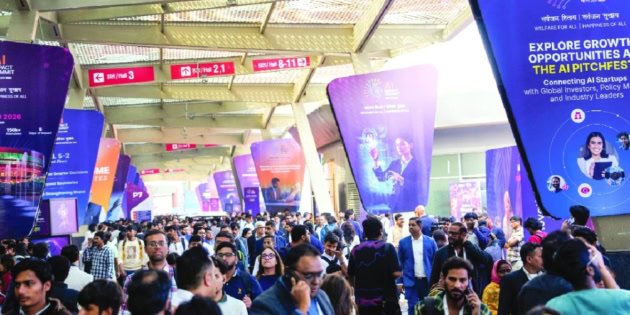
India’s AI Impact Summit that started on February 16th, 2026 was projected as a “defining global inflection point,” with New Delhi ready to take center stage as the global leader to shape the future of AI governance and innovation.
With thousands of technology bigwigs, leaders, delegates, and marquee names in attendance, Prime Minister Narendra Modi while inaugurating the summit pushed the rhetoric of a “democratized and inclusive AI” as India’s pitch to the world. However, under the weight of ambition, the cracks were quick to show with logistical chaos being the main headline to come out of the summit so far.
The credibility of the summit took another hit when India’s Galgotias University was expelled from the event after it presented China’s robodog Orion , as its own innovation. Structural problems like mismanaged crowds, traffic mismanagement, evacuation of exhibitors, pickpocketing and digital payment failures were quick to overshadow the anticipated impact of the summit demonstrating that logistics should not be considered trivial because they are symbols of institutional reliability.
Several domestic challenges are weakening India’s credibility when pitching global leadership. There exists a colossal digital divide between India’s tech ambitions and its reality. The OXFAM ‘India Inequality Report 2022: Digital Divide’ reveals only 38% Indians as being digitally literate. A majority has no access to technology basics like reliable internet access and affordable devices. New Delhi needs to accept the reality that it cannot become a global leader until it strengthens its fragile domestic foundations.
Moreover, its fragmented, sector specific approach is creating regulatory uncertainty. India has no clear AI governance system with limited ambiguous data protection rules and innovation incentives. Its reliance on existing technology, data protection, and cybersecurity laws like the Information Technology Act 2000 demonstrates a lack of comprehensive and stand-alone AI centric legal framework which is needed.
With the country’s Electronics and Information Technology Minister Ashwini Vaishnaw urging big technology platforms to “operate within India’s constitutional framework”, New Delhi must realize that its ambitions will remain aspirations if it continues governing tomorrow’s technology with yesterday’s laws.
Read More: Modi, Lula Push for Stronger India-Brazil Partnership on Rare Earths
Another challenge is its underutilization of human capital. India is home to one of the largest AI talent pools, but systemic issues like brain drain, uneven funding and limited domestic opportunities are hindering its ability to utilize that talent. The summit that was intended to project India’s global technological ambition became an unintended reality check, exposing the gap between its outward ambition and inward capacity.
AI diplomacy has seen a sharp increase globally in recent years. Power is no longer defined by territories, military or economic might. A nation’s standing is increasingly
viewed through the lens of its technological capacity. Considering this new environment, India’s AI Impact Summit was set to act as a geopolitical signaling platform. High-level bilateral meetings, alignment with leaders like Brazil’s Lula and France’s Macron to project India as the bridge between the developed and developing certainly gave India visibility but also brought scrutiny and raised questions regarding its credibility.
Further weakening the Summit’s diplomatic impact is Microsoft founder Bill Gates cancelling his keynote address last minute. If marquee figures hesitate, it signals fragility.
India’s ambition of becoming a global leader will remain an aspiration if it continues its aggressive regional posture. Its consistent exclusion of key countries like Pakistan and China for the Global South Summit reinforces that paradox. India’s aims for global leadership while alienating regional players are weakening its diplomatic legitimacy.
India’s AI Impact Summit while showing the scale of its ambition also highlighted its governance challenges. Without fixing these domestic divides and regulatory gaps, India risks its dream of becoming a global leader. Tech Diplomacy relies heavily on perception and credibility. For now, India’s credibility hinges on whether it can successfully translate summit diplomacy into sustained leadership.
*The views presented in this article are the authors’ own and do not necessarily reflect the views of The Diplomatic Insight.

Irtija Ahmad
Irtija Ahmad is a policy researcher with an academic background in International Public Policy. She works at the Centre for Countering Terrorism and Violent Extremism Studies at the Institute of Regional Studies (IRS), Islamabad. She can be reached atirtijaahmed@gmail.com