

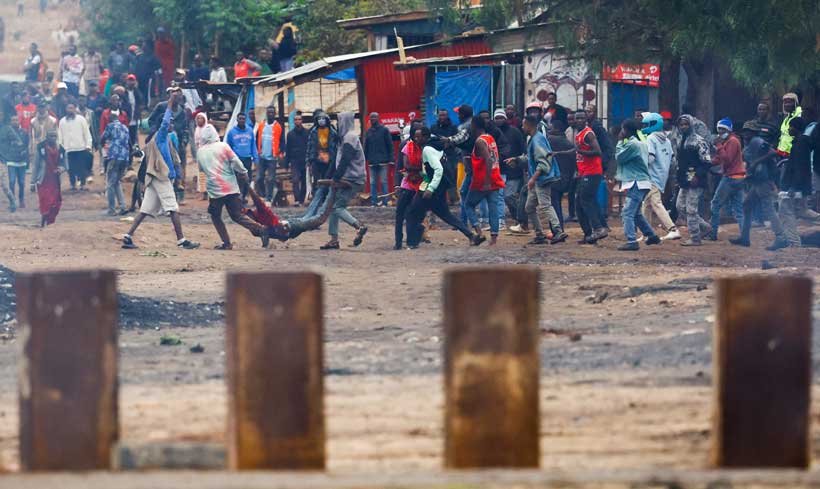
In 2015 the chants came up from the streets of Mtwara: “Utajiri wetu, maisha yetu” a Swahili quote meaning “our wealth, our lives.” The youths who were not even aware of the huge pay-checks from the natural gas reserves of Tanzania worth $40 billion set fire to tires outside the regional office, asking for what the billions had promised but not delivered so far. After a decade, the violence had spread and on October 29, 2025, while polls were cast, the situation was violent. It did not come as a stop of the development but rather as its logical consequence.
From 2015 to 2025, Tanzania appeared to follow the East African developmental state model. The passing of John Magufuli in 2021 accompanied in Samia Suluhu Hassan as the new president, who took the infrastructure nationalism combined with authoritarian stability. Beijing financed $2.1 billion Standard Gauge Railway. Foreign energy companies brought back liquefied natural gas (LNG) projects near the Mozambican border. The ruling Chama Cha Mapinduzi (CCM) party propagated change, and at first the donors supported this situation, World Bank commended the “investment climate” while at gently raised its concern over the declining democracy.
But the model was hollow. The developmental state, as Ziya Öniş theorized in the 1990s, requires more than strategic sectors and political will. It demands “systemic vulnerability” a condition where elites face such existential threats they must bargain with labor and farmers, not merely extract from them. Tanzania never had this. Instead, it had gas fields floating offshore and party patronage networks anchored in Dar es Salaam. The result was not a developmental state but what scholars Andrés Bieler and Adam Morton identify as a “critical economy” moment: a collision between global capital circuits and localized class cracks that electoral politics can no longer contain.
The warning signs accumulated long before the voting of 2025. In 2020, the documented ballot tampering in different regions and internet blackouts countrywide were just the few of the problems that Magufuli’s re-election, officially 84% of the vote, had caused. Tundu Lissu, the opposition leader, came back from exile after surviving an assassination attempt in 2017, but he found his supporters getting shut out from the country’s resource economy. When he promised to use natural resources revenues for youth employment and smallholder agriculture, the security forces reacted violently in Dodoma and Mwanza. The communication was unambiguous: democracy could be allowed, but not if it interfered with the capitalist’s social relations.
Read More: China, Zambia, Tanzania Launch $1.4B to Modernize 5-Decade-Old Railway Line
Karl Polanyi‘s ghost haunts Tanzania’s burning streets. Polanyi warned that markets must be embedded in social institutions or face a “double movement”, society’s violent struggle to reassert control. Tanzania’s tragedy is that its markets were never embedded. The “developmental” language of Magufuli and Hassan masked what Eric Helleiner terms “mercantilist exclusion”: party loyalists became economic insiders while millions remained permanent outsiders. Chinese loans-built railways that move minerals to ports do not carry people to jobs. Natural gas revenues funded schools in Mtwara, but the contracts signed with ExxonMobil and Equinor remained classified, their terms feeding offshore accounts and party coffers. The World Bank’s 2025 Tanzania Economic Update estimates youth unemployment at 8.7%, but that masks underemployment: a generation riding boda-bodas while watching tankers haul away their future.
The violence transforming Tanzania’s cities is therefore not mere political grievance. It is Polanyi’s double movement in real time, society’s attempt to re-embed economic life within democratic accountability. Protesters are not just demanding votes; they are demanding what Bieler and Morton call “citizenship as class”: the right to shape how national wealth is produced and distributed. When demonstrators vandalize World Bank-funded BRT stations in Dar es Salaam, they are attacking symbols of a state that serves insiders. When they chant against Chinese loans, they are rejecting a model that delivers assets without agency.
International dynamics escalates the crisis. As Richard Carney‘s analysis of state capitalism in one-party regimes suggests, CCM uses sovereign wealth funds and state-owned enterprises to “stabilize” itself against popular demands and IMF conditionality. Tanzania’s Natural Gas Revenue Fund controlled by ruling-party-functionaries, functions exactly this way isolating elites from accountability. Yet as Seth Schindler, Ilias Alami, and Nicholas Jepson demonstrate, this strategy contains a fatal mistake: the “spatial fix” of industrial strategy tilts toward Chinese and Qatari capital, turning state capitalism from a national project into a conduit for external interests. When Western donors cut budget support over 2020 electoral concerns in Zanzibar, Beijing offered emergency loans within weeks. This did not just deepen dependence; it provided CCM with a geopolitical account for repression, framing opposition as a threat to sovereignty, not democratic rights.
As votes were counted in 2025, Samia Suluhu Hassan was announced the winner of the presidential contest claiming 97.6% votes, Tanzania stands at a fork. One path leads toward what Doner, Ritchie and Slater envisioned: using “crisis to forge embedded autonomy” a compact where capital, labour and the state negotiate development’s terms. This would require opening gas contracts, democratize the revenue fund, and allow opposition parties real influence over industrial policy. The other path spirals into mercantilist decay: more repression, cruder resource nationalism, eventual capital flight when extraction costs exceed returns for foreign firms.
Read More: China, Tanzania Honor Fallen TAZARA Railway Builders
The critical variable is whether Tanzania’s fragmented opposition can convert electoral frustration into a counter-hegemonic project. Lissu’s CHADEMA party has shown resilience, but remains regionally divided. The neighbouring countries, Kenya is concerned about possible movements of refugees from Tanzania; South Africa is equally worried that the presence of China in East Africa region could give countries diplomatic pressure and economic alternatives. Yet the opposition must also look inward, building alliances with smallholder farmers bypassed by commercial agriculture and informal workers excluded from the formal economy.
Here lies the great irony of the situation. Tanzania’s problem not only discredits the two prevalent theories but also gives a strong support to one of them. Colin Hay argues that the “rational neglect” of ideas in neoliberalism is impossible, the ideology has a major impact anyway. However, at the same time, it is not just confirming but also worsening the situation of states built on development models without strong institutions that are, as Elizabeth Chatterjee puts it, “oligarchic state capitalism” a system where leaders take from the people while keeping them distracted with patriotic displays.
As scholars of international political economy, we must confront the question Tanzania’s streets are forcing upon us: Can resource-rich African nations pursue developmentalism without sacrificing democracy? Or does the collision of global capital and local inequality invariably produce violence? The answer will not be found in policy papers from Washington or Beijing. It will be forged in negotiations between CCM’s aging nationalists and a generation of young Tanzanians who have learned to see through the rhetoric of development to the mercantilism beneath.
The gas will keep flowing. The only question is: who gets paid?
*The views expressed in this article are the authors’ own and do not represent TDI. The contributor is responsible for the originality of this piece.

Peseo Lao Pio
Peseo Lao Pio is from Tanzania, and is a highly skilled ICT professional with an interest in global politics and economic change in Africa. His devotion to the development of the continent is the reason he pursued a Master’s degree in Political Science at Universitas Islam Internasional Indonesia (UIII). Pio brings extensive real-world experience to community welfare initiatives. He has worked as a mobile teacher for street children, contributed to critical environmental conservation projects, and held the role of community facilitator with VSO International. He was awarded the prestigious Best Student Award during his undergraduate studies for exceptional performance which demonstrates a consistent record of excellence in all his professional and humanitarian activities.

